





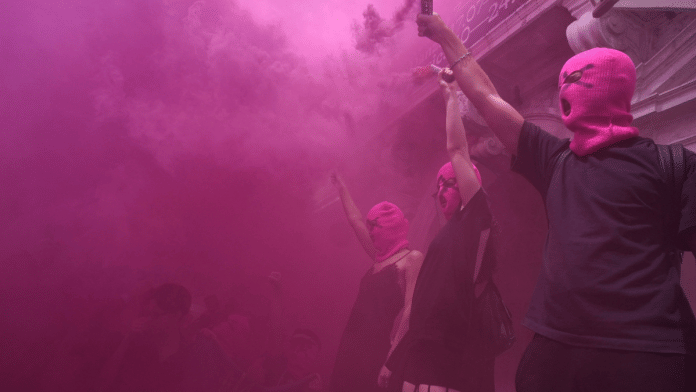


New Delhi: Pink smoke, punk chants and Ukrainian flags have turned the opening days of the Venice Biennale into a live protest stage, as feminist art collectives Pussy Riot and Femen stormed the Russia Pavilion to denounce what they call the art world’s “normalisation” of a country at war.
As clouds of pink, blue and yellow smoke rose over Venice’s Giardini, chants of “Blood is Russia’s art” and “No Putin in Venice” echoed through the 61st Biennale, which is usually regarded as the art world’s most prestigious gathering.
Wearing Pussy Riot’s signature pink balaclavas and carrying Ukrainian flags, protesters gathered outside the Russian Pavilion on 6 and 7 May. The protests capped weeks of controversy, including large-scale boycott calls against Russian, Israeli, and US pavilions. On 23 April, the European Commission withdrew € 2 million in funding over Russia’s participation.
The Russian musical group shouted slogans such as “Curated by Putin, dead bodies included” and performed their new song ‘Disobey’ while police blocked access to the building, creating one of the most dramatic political confrontations at the international cultural exhibition in recent years. The demonstrations revived memories of the student‑led uprisings that disrupted the Biennale in 1968, when protesters denounced the Italian art establishment as elitist and overly commercialised.
This year, however, the outrage centred on the decision to allow Russia back into the exhibition after a four-year absence. Russia had withdrawn from the Biennale in 2022 following the invasion of Ukraine, amid widespread cultural boycotts across Europe. The country’s return this year immediately drew criticism from artists, curators and European political leaders, many of whom argued that participation by the Russian state could not be separated from the ongoing war.
Protestors also criticised Israel’s participation, with activists condemning both countries over ongoing conflicts and alleged human rights violations. The controversy deepened further after the unprecedented resignation of the entire five-member Biennale jury. Led by Brazilian curator Solange Farkas, the jury had announced that it would not award prizes to artists representing countries whose leaders face arrest warrants from the International Criminal Court.
Russian President Vladimir Putin faces ICC charges linked to the war in Ukraine, while Israeli Prime Minister Benjamin Netanyahu also faces charges of alleged war crimes and crimes against humanity committed in Gaza. Within days of the announcement, the jury stepped down entirely—a move widely seen as a protest against the Biennale administration.
Despite mounting criticism, Biennale chairman Pietrangelo Buttafuoco defended the inclusion of Russia and Israel, arguing that art institutions must remain neutral spaces for dialogue rather than instruments of censorship. Supporters of the decision have said that excluding nations from cultural platforms risks turning art into a political weapon.
But for demonstrators, the Biennale was no longer merely an art exhibition. It had become a battleground where culture, politics and war collided in real time—challenging the very neutrality its organisers claimed to defend.
(Edited by Insha Jalil Waziri)