


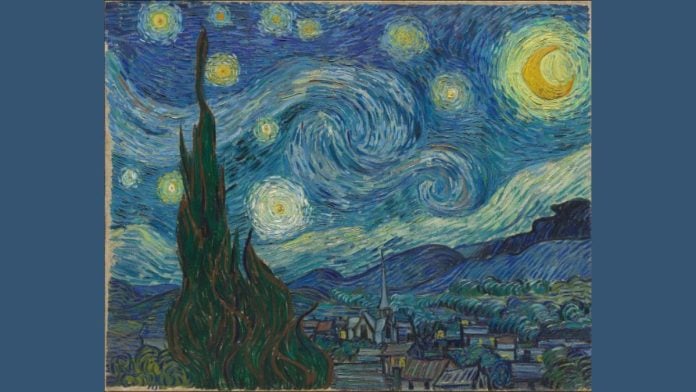
New Delhi: Vincent Van Gogh’s famous painting Starry Night may have represented a real French sky from 1889. A new study published in the journal Scientific Reports suggests that the iconic painting may have been inspired by an astronomical arrangement visible over southern France in July 1889.
Researchers from South Korean space-science company SLLAB and Kyung Hee University conducted an observational geometric study of the Starry Night, a post-Impressionist oil painting that depicts a crescent moon with various bright stars.
The study, published on 22 October, found that the painting’s central stars represent the Hyades star cluster in the constellation Taurus, which consists of five prominent stars depicted by Van Gogh. Moreover, the researchers found that on or around 22 July 1889, this cluster appeared near Venus and a waning crescent Moon, creating a night sky very similar to Van Gogh’s canvas.
Earlier, this painting — currently housed in the Museum of Modern Art in New York — was thought to have been finished sometime around mid-June 1889, based on historians’ analysis of Van Gogh’s letters to his brother Theo. However, the South Korean researchers also took that theory into account, arguing that the period would have a waning gibbous moon, rather than a crescent moon as Van Gogh depicts.
In May 1889, the Dutch painter Vincent Van Gogh had checked himself into the Monastery of Saint-Paul de Mausole, in Provence, France, after experiencing mental health issues and nervous breakdowns. It was during this one year at the asylum that Van Gogh produced around 150 paintings, including his famous ones such as Irises, The Starry Night, and Almond Blossom.
Using texts and correspondence between Van Gogh and his brother, historians have been able to decode the two views the artist had in the asylum — his bedroom and his painting studio.
The researchers from Kyung Hee University also followed in these footsteps and travelled to France to reconstruct Van Gogh’s field of view. They identified the location from which he appears to have drawn the landscape beneath The Starry Night and recreated the view from that spot.
Also read: Prince William crashes Graham Norton’s couch. Talks Earthshot prize, Christopher Nolan, & football
Tracing the art
One issue with their thesis, as pointed out in the press release shared by SLLAB, was that the date of the astronomical arrangement — 22 July — is said to correspond with one of Van Gogh’s seizures in the asylum. The artist, who suffered from mental health issues, often wrote about his seizures and periods of instability to his younger brother Theo in letters.
By analysing the letters and contemporary weather records, the study was able to peg the seizure to have happened in late July, opening up the possibility that on 22 July, the artist would have been conscious and in his room in the asylum, and could have witnessed the night sky.
This is one of the first analyses of Starry Night that uses Procrustes shape analysis, a mathematical method for comparing two shapes after accounting for differences in their position, orientation, and scale.
“I hope this work prompts a renewed, multidisciplinary look at the sequence and working methods of the Saint-Rémy paintings, and at Van Gogh’s movements that summer,” said Elijah Jeong-hyun Kim, CEO of SLLAB, in a press release.
“Our conversation with Van Gogh’s other skies is still ongoing. We plan to tell those stories one by one.”
(Edited by Aamaan Alam Khan)