





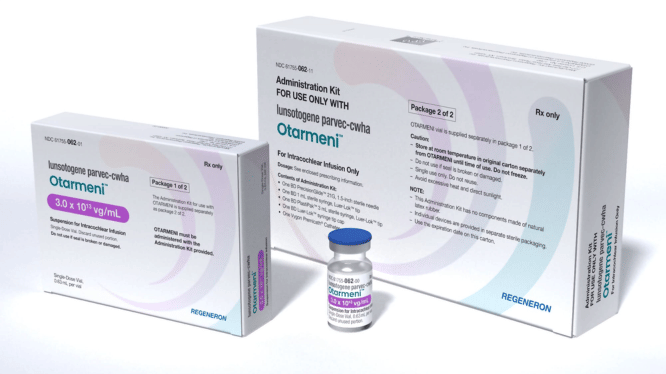


New Delhi: The United States’ Food and Drug Administration on 23 April approved a new gene therapy that promises to restore hearing in children born with genetic hearing loss.
Regeneron, an American biotechnology company, has introduced a gene therapy that can cure a rare, inherited form of deafness.
The company will provide the latest therapy, Otarmeni, free to eligible children in the US with Otoferlin deafness-related genetic hearing loss. George Yancopoulos, Regeneron’s chief scientific officer, told The New York Times, “We wanted to make a statement”.
Yancopoulos added that the biotechnology company wants to be sure its treatment “would be able to reach its full potential and help as many people as possible.”
Regeneron’s co-founder and CEO, Leonard Schleifer, said in a statement that the American taxpayers have shouldered a disproportionate share of the cost of biotechnology innovation.”
He added, “For more than a decade, we have argued that the most direct path to meaningful relief for American patients depends on getting other high-income countries to finally contribute their fair share to the cost of the breakthroughs they rely on just as much as we do.”
How does Otarmeni work?
Otarmeni, a therapy for children with Otoferlin deafness, a congenital non-syndromic hearing loss, has proven to be “groundbreaking” for hearing loss treatments.
“This is the first time in history that there has been a medical therapy that has enabled deaf children to hear”, said Dylan Chan, a pediatric otolaryngologist at the University of California, San Francisco.
Otoferlin deafness is found in just 2 per cent to 8 per cent of congenital hearing loss. It is a rare form of deafness that is caused by a mutation in a single gene. Its permanent alteration destroys a protein in the inner ear, which helps in sending sound to the brain.
Until now, the only way to treat Otoferlin has been a cochlear implant, an electronic device placed in the inner ear. Through the implant, sounds come through as robotic or tinny. Implants can be restored, but people face difficulty in noisy environments, especially at high frequencies. The device also needs to be charged regularly.
In developing the treatment, researchers started by getting the genes to the cochlea, a spiral-shaped cavity almost at the centre of the skull. The cochlea has 3,500 inner hair cells and fluid. When sound vibrations move through the fluid, the hair cells bend. The hair cells then send signals to the brain through the auditory nerve. The hair cells and fluid play an important role in the process.
Otolaryngologists long contemplated injecting a medicine into the inner ear that would inevitably damage the delicate cells and membranes of the cochlea. In the new therapy, doctors simply deliver a working copy of the otoferlin gene.
Children with otoferlin deafness were the “perfect target,” Chan told the NYT. Even if the attempt fails, the children can still get cochlear implants.
Also Read: Are US kids safe? New vaccine approval process puts public health at risk, say ex-FDA officials
Gene therapy for Otoferlin deafness
Apart from Regeneron, Eli Lilly and Skylark Bio are developing their own gene therapy for genetic hearing loss. China and France are also developing gene therapies for Otoferlin deafness.
Kerri M, speaking to the NYT, said that her baby can now hear.
“Gene therapy completely changed our lives,” she said. Her child was born deaf and received Regeneron’s therapy on 19 May 2025 when he was 13 months old.
Scientists are now targeting a mutation in the GJB2 gene. The mutation is a common form of congenital hearing loss in children, accounting for about 20 percent of cases. In GJB2, however, deafness is more complex than that of Otoferlin. In the latter, gene therapy is more like fixing a broken wire.
“A lot of people are working on how to reprogram cells of the inner ear to rebuild themselves,” Chan said.
He added that the hope is to create a cochlea, “the ultimate holy grail”.
(Edited by Insha Jalil Waziri)