





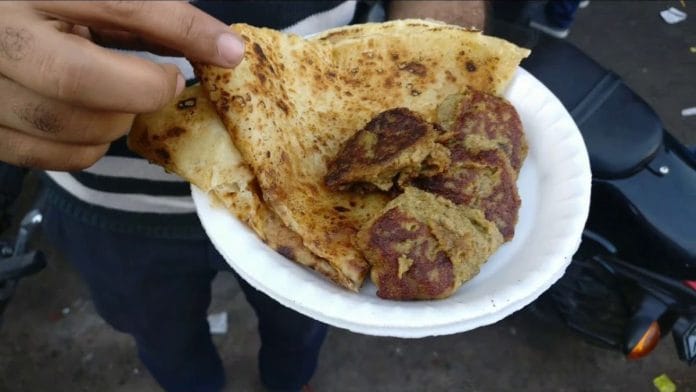


New Delhi: A video circulating on YouTube shows mutton being cooked near the Tarkulha Devi Temple in Gorakhpur, where meat prepared in earthen handis is also offered as prasad. The comment section is flooded with chants of “Jai Mata Di.” And this is far from an isolated example. At Mirzapur’s Vindhyachal Temple, animal sacrifice has long been part of ritual practice, with goat and buffalo meat distributed among devotees as prasad.
It is this deeply embedded relationship between food, faith, and regional identity that has led several food experts and chefs to question the exclusion of non-vegetarian dishes from Uttar Pradesh’s newly launched ‘One District, One Cuisine’ (ODOC) scheme.
The initiative, which features an extensive list of 208 dishes intended to promote local culinary heritage, has drawn criticism for overlooking meat-based traditions that many argue are central to the state’s cultural and historical fabric.
Food historian and founder of The House of Zaikanama, Aali Kumar, called the scheme “definitely forced.” Meanwhile, author and chef Sadaf Hussain warned that the danger of reducing culinary identity to “one district, one dish” lies not merely in simplification, but in flattening the diversity of food cultures that define the state.
According to Hussain, Uttar Pradesh is shaped by the distinct culinary traditions of “Awadh, Purvanchal, Bundelkhand, Rohilkhand, Bhojpuri and Braj regions, alongside tribal communities, agrarian households and countless home kitchens” that rarely find representation in official narratives.
The omissions, critics argue, are difficult to ignore. Lucknow’s selection reportedly includes rewari, chaat, malai makkhan and mango produce, while the Moradabad division highlights dal dishes and handi halwa. Dishes such as galouti kabab, Moradabadi biryani, Azamgarh’s slow-cooked handi mutton, Kakori kababs and even Char Magaz ka Murga, a traditional Awadhi preparation associated with Kayastha households, do not feature in the list.
The ODOC scheme, first announced by Chief Minister Yogi Adityanath in December last year, was formally launched by Union Home Minister Amit Shah during Uttar Pradesh Day celebrations in Lucknow on 24 January. Inspired by the state’s successful ‘One District One Product’ initiative, the scheme aims to promote traditional cuisines through branding, packaging and marketing.
According to government sources, the final list maps 208 dishes across 75 districts and 18 divisions.
‘Not a government file’
For Hussain, food is not a “government file” that can be reduced to ‘one district, one dish’. He argued that culinary traditions are shaped not just by recipes, but by histories of migration, caste, religion, seasonal practices and the labour of ordinary people whose kitchens sustain these cultures across generations.
“Lucknow did not receive UNESCO’s recognition for gastronomy because it served one dish,” he added.
Author Sangeeta Khanna recalls that Holi was a festival where mutton was always cooked in most homes, to be had along with the other Holi special dishes.
“Apart from this, the fish of several types are part of everyday food. Fish and small shrimps were always an everyday kind of food, fisherwomen would ferry fish door to door very commonly, even till a decade ago. Now the delivery apps and market orientation are different, but the consumption pattern has not changed,” explained Khanna, who has authored Culinary Culture of Uttar Pradesh: A Food Trail.
Another thing is that food has historically never been equal. What communities eat and what eventually gets recognised as “authentic cuisine” has often been shaped by class, caste and social privilege.
According to Kumar, it is usually communities with greater cultural and economic capital that succeed in documenting and defining a region’s cuisine through cookbooks, newspapers and public discourse.
“This became especially visible from the 20th century onwards,” she explained, “when print culture began shaping public identity around food, while simultaneously homogenising it and freezing it into fixed ideas of authenticity.”
In reality, she argued, the culinary map of any region is far too layered to be represented by a single dish. “The true picture is much more complicated,” she said, calling the idea of compressing an entire geography into one culinary identity “absurd, to put it mildly.”
To illustrate the scale of that diversity, Kumar traced the historical geography of what was once known as the United Provinces of Agra and Oudh under British rule between 1902 and 1947, territories that roughly fall in present-day Uttar Pradesh and Uttarakhand. The province, she explained, combined dramatically different cultural and ecological zones: the Agra region, the fertile plains of Oudh around Lucknow and Ayodhya, princely states like Rampur and Tehri-Garhwal, and the ancient city of Benares.
Stretching from the Himalayan foothills bordering Tibet and Nepal to the Gangetic plains and central Indian territories, the region’s food traditions evolved through royal courts, trade routes, climate variations, agrarian practices and religious customs.
“The sheer scale of this territory hints at a culinary landscape of remarkable diversity,” she said.
Also read: Is masala dosa India’s new soft power? It’s ranked world’s 6th best pancake
Vegetarianism doesn’t define Indian food
Aali Kumar challenged the assumption that vegetarianism alone defines Indian food culture. She pointed out that statistically, the majority of Indians are non-vegetarian, including many upper-caste communities that traditionally follow rules of ritual purity. And, historically, meat consumption has long existed across communities and regions.
“To be vegetarian is often a privilege of choice. Go as far back into history or prehistory and archaeological evidence itself tells us what people consumed based on the bones found at excavation sites,” she said.
It also reflects a reality of society that some people simply do not have the luxury of choice, while others continue eating according to traditions passed down through generations. Equally important is recognising that grain and vegetable-based diets are not entirely free from ecological or ethical consequences either.
According to Kumar, urbanisation has increasingly distanced people from the realities of food production and erased older systems of agricultural knowledge.
“If you are a farmer and work the land, many of these misconceptions do not survive,” she said, adding that modern consumers are often disconnected from how food is grown and what sustains it.
India’s position on the Global Hunger Index should push conversations around food toward questions of access and nourishment rather than rigid moral binaries.
(Edited by Ratan Priya)