



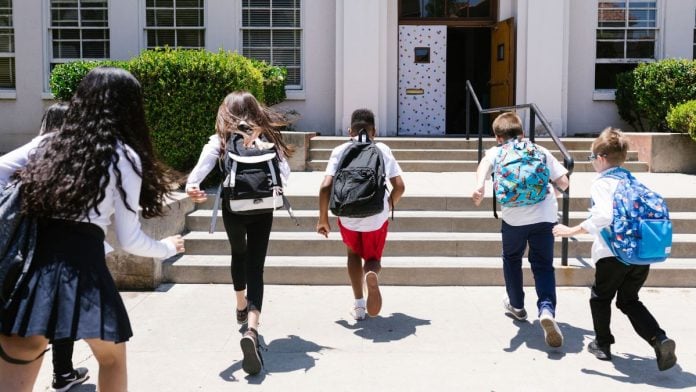
Teen girls in a town in England have started a campaign to ban school uniforms in porn films. And they are petitioning to have this ban debated in parliament, reported The Times.
The girls, belonging to grades 9-11, highlight that school uniforms are a common costume for female performers in pornographic films, even as most school students in the UK are required to wear them. Studies also show that there is a higher degree of physical aggression toward women in pornography where they are coded “young” or “childish” through their school uniforms. This gives rise to a vicious cycle, where girls are sexualised for something they are obliged to wear for multiple hours a day.
Rose, a 15-year-old studying at the Cooper School in Bicester, hates wearing her school uniform on her journey home. “I can’t stand it,” she told The Times. “Not because it’s uncomfortable but because of the possibilities of how it is perceived. Especially a skirt. I definitely don’t wear skirts any more.”
Aylin, too, feels the same about school uniforms.
“I keep reflecting on us feeling unsafe in our own uniform. Why don’t we take this seriously? Why is it not regulated?” the 15-year-old asked. “It shows how cruel the world is, but we’re trying to make it better”.
The roots
The roots of this “sexy schoolgirl” archetype can be traced back to the St. Trinian’s comic strip created by Ronald Searle in the 1940s. The school featured many wayward and even criminal girls. And although Searle’s drawings, the report said, were “more satirical than sexual”, consequent film adaptations of the comic ended up fetishising the school girl, showing her as a precocious adult female child, inviting the desires of men.
This is not just a British phenomenon. A BBC report from 2017 described the widespread prevalence of the fetishised schoolgirl figure. Tokyo’s “JK street”, or “schoolgirl alley” has teenagers in school uniforms selling their time to passers-by, while its more than 300 JK cafes allow adult men to pay to hangout with underage girls. In the schoolgirl alleys, “Men pay to hold hands, go for a walk or have a cup of coffee with the girls. Some even pay to sleep on a girl’s lap”, the report said. “This is all legitimate, above board and legal.”
Sexualised portrayals of school girls goes beyond pornography, extending to pop culture depictions as well. Britney Spears, for example, was dressed in a school uniform as she sang the words “hit me baby one more time”. She was 16 at the time. The medical TV drama House shows the protagonist fantasising about his adult female colleague pole dancing toward him in a “sexy schoolgirl” outfit.
Also read: Aneet Padda’s eyes to Raghubir Yadav’s menacing godman—what’s drawing viewers to Hunkkaar
Legal precedent
The Crime and Policing Act, passed in April this year, will make it criminal for porn actors to mimic children, in a first such legislation of its kind in the UK. While the act has been passed, it has yet to come into force, and there is no clear date for it.
The paradox of having to wear school uniforms while designing a campaign against the uniform’s sexual representation in pornography is not lost on the students. However, this is also what gives their campaign its symbolic power.
“It starts to click when it comes from us,” Aylin said. “To have the victims of sexualisation in front of you, pleading — that’s sad.”
(Edited by Aamaan Alam Khan)