


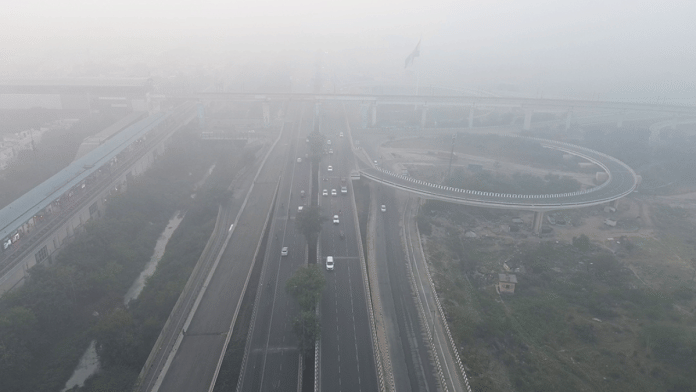
New Delhi: Delhi woke up to a thick blanket of haze the morning after Diwali, with 15 air quality monitoring stations recording ‘Severe’ pollution and visibility dropping sharply at the city’s two airports. While the city’s average Air Quality Index stood at 370 on Monday morning, data from 10 of its 59 monitoring stations was missing, raising questions about whether the official reading reflected the full extent of the pollution.
The AQI on Monday was lower than Sunday morning’s reading of 383 (8 November). However, data from the Delhi government and the Central Pollution Control Board’s (CPCB) portal show that 10 monitoring stations were not reporting pollution levels on Monday morning.
These included RK Puram, PUSA, NSIT Dwarka and Nehru Nagar, all of which had recorded AQI levels above 400 on Sunday. Since Delhi’s overall AQI is calculated as an average of readings from its monitoring stations, the absence of data from these locations could skew the city’s reported pollution levels.
“Diwali night once again showed how quickly Delhi’s air turns hazardous when firecracker smoke meets stagnant winter air,” said Sunil Dahiya, founder and lead analyst of Envirocatalysts, a data-driven environment research organisation.
Last year, too, ThePrint reported that more than 100 hours of pollution monitoring data went missing in Delhi after Diwali. As many as 28 of the city’s 39 monitoring stations went blank the morning after the festival in 2025, leaving significant gaps in the air quality data.
Even among the stations that were operational this year, 14 reported ‘Severe’ air quality on Monday morning, with AQI levels crossing 400. North Campus, Burari Crossing, Narela, ITO and Jahangirpuri were among the locations recording severe pollution.
The highest AQI readings were recorded at the Delhi Technological University (DTU) campus and Burari Crossing, with both stations reporting 437.
This year, the Supreme Court allowed the use of ‘green crackers’ in Delhi only between 6 and 7 am and 8 and 10 pm on Diwali, in an attempt to curb prolonged fireworks. However, enforcement remained a challenge, with fireworks reported in parts of the city even after the 10 pm deadline.
Delhi is currently under Stage III of the Graded Response Action Plan (GRAP), the set of emergency measures implemented by the Commission for Air Quality Management (CAQM) to tackle rising pollution. These include restrictions on non-essential construction and demolition, a ban on BS-III petrol and BS-IV diesel vehicles, and the suspension of stone-crushing and mining operations. Schools have also been directed to conduct classes in a hybrid mode.
The pollution was accompanied by a sharp drop in visibility on Monday morning. At 6.30 am, Safdarjung airport reported visibility of just 50 metres, compared with 700 metres on Sunday. Palam airport recorded 400 metres of visibility under shallow fog, down from 800 metres a day earlier.
“Winds were calm, the mixing layer was barely 55 to 80 metres deep, and humidity was above 80 per cent, so the smoke had nowhere to go. Firecrackers drove most of the spike. SO2 nearly quadrupled, and most of the rise came after the 10 pm deadline,” said Dahiya.
The India Meteorological Department (IMD) also forecast dense to very dense fog over southeast Delhi, east Delhi and central Delhi, advising residents to exercise caution while driving.
According to CPCB data, Delhi’s air quality has remained in the ‘Very Poor’ category since 2 November, with the AQI staying above 320 for seven consecutive days. Persistent calm winds and dry weather have further contributed to the accumulation of pollutants, leaving a thick haze hanging over the city.
(Edited By Raunaq Lekhi)