



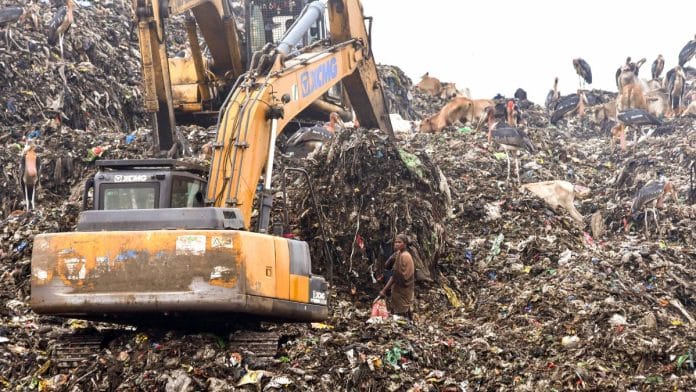

New Delhi: Two of India’s waste landfills are among the top 25 global emitters of methane in the waste sector, says a new study. The waste facility in Telangana’s Secunderabad emits 5.9 tonnes of methane per hour, while the site in Mumbai, Maharashtra, emits 4.9 tonnes per hour.
The report, “Spotlight on the Top 25 Methane Plumes in 2025: Landfills,” was released by the University of California (UCLA) on Tuesday. The top 25 includes sites in Brazil, Chile, Saudi Arabia, Turkey, Malaysia, and the USA.
The Telangana facility ranks fourth on the list, while the Maharashtra site stands at the 12th position.
The 25 sites, identified by satellites, release methane at rates ranging from 3.6 to 7.5 tonnes per hour, with the top sites contributing significantly to global warming.
Methane is one of the main drivers of climate change, responsible for about 30 percent of global warming since pre-industrial times, second only to carbon dioxide.
“These insights come from Carbon Mapper’s public methane emissions data, leveraging two space-based instruments: Planet Labs’ Tanager-1 satellite and NASA’s EMIT instrument on the International Space Station,” the study states.
Data from these instruments were analysed by Carbon Mapper, a nonprofit focused on filling data gaps and improving global monitoring of methane and CO2, and published on its data portal. The “extreme emitters” were identified by categorising landfills with the highest emission rates between 1 January 2025 and 31 December 2025.
The data shows 2,994 plumes from 707 waste sites, including landfills and dumpsites, worldwide. These sites are spread across dozens of countries of all income levels and regions.
The highest methane-emitting site globally is a landfill near Buenos Aires, Argentina, with an emission rate of 7.6 tonnes per hour.
Also read: Chennai is starting to clear the Perungudi garbage mountain. And make furniture from it
Behind the calculation
Explaining the global impact, researchers noted that a landfill emitting 5 tonnes of methane per hour would contribute about as much to global warming as one million SUVs or one large (500-megawatt) coal-fired power plant.
The report notes that the researchers did not calculate the rates themselves but used data from Carbon Mapper’s public portal. Carbon Mapper calculates emission rates by averaging measurements taken each time a source is observed, even when no emissions are detected.
The researchers used methane data from 2025, focusing on sites observed at least twice and showing more than one emission plume. They then selected the 25 largest emitters in the “Solid Waste” category. An automated process was used to gather emission and location data, after which each site was manually matched to a likely responsible operator.
The study also mentions the nearby cities served by these landfills and identifies potentially responsible operators, including governments, municipal corporations, global organisations, and private companies.
(Edited by Theres Sudeep)