








Srinagar: A running joke casually circulates during weddings in Srinagar. It is said that rather than investing in gold or the stock market, newlywed couples choose to purchase land.
“It is the safest asset in this city—you can buy something today and see its price double in the next week,” said Mir Anayat, an advisor based in Srinagar, Kashmir. “Land has never been a volatile investment for us.”
However, with prices soaring at Rs 3-4 crore per kanal (one kanal is equal to 0.125 acres) in some neighbourhoods, this asset is increasingly becoming out of reach for ordinary citizens. Srinagar’s housing industry is teetering on a crisis—explosive urban growth over the past three decades has driven up demand and prices, but the city suffers from the same land constraints as any other hill station.
Article 370’s abrogation in 2019 opened up Jammu and Kashmir’s real estate to people from outside the territory. It also brought along a wave of politically fanned anxiety among Kashmiris about their land being bought by outsiders who will alter the demography of the state. But there are barely any buyers because of the steep rates.
According to the J&K government, only 631 non-residents have bought land in the state since 2019. Moreover, outside investment in tourism and commercial activities has been sluggish.
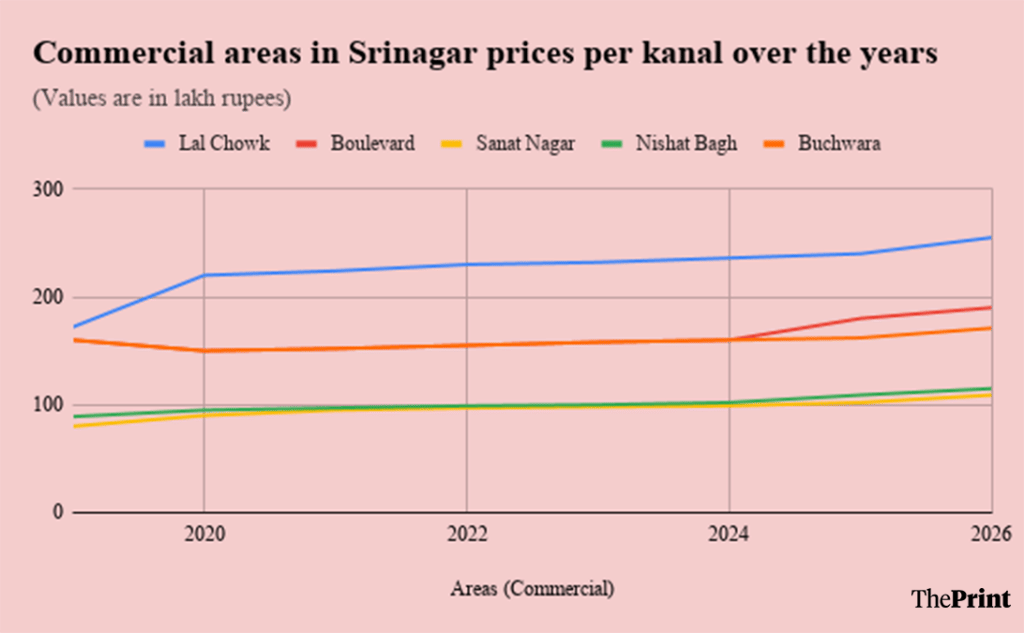
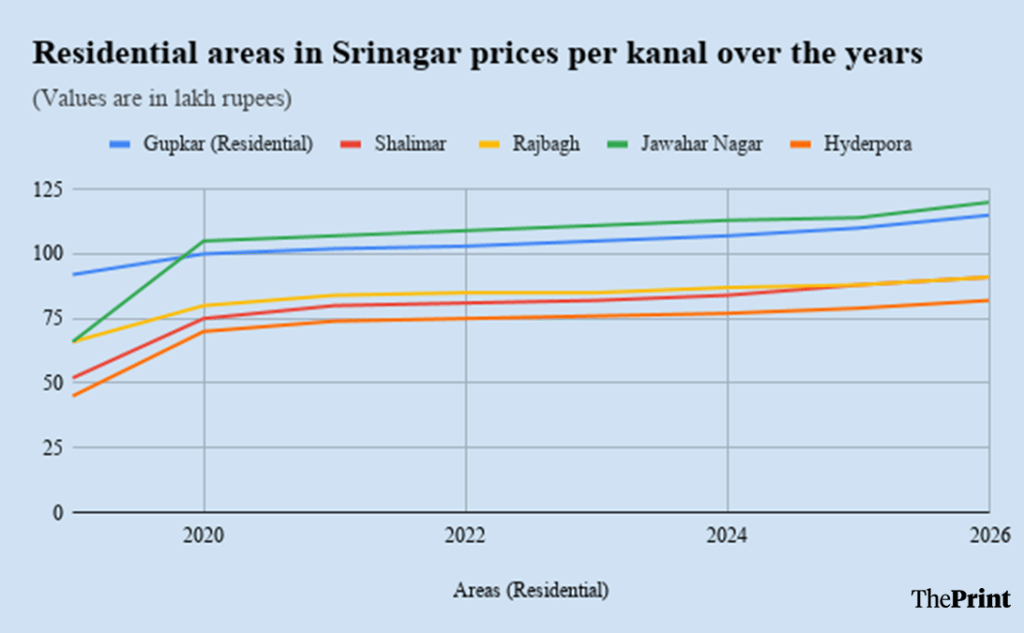
The government’s market value rates show localities like Gupkar Sonwar, Lalchowk and Karan Nagar in South Srinagar priced at more than Rs 1.5 crores/kanal for residential plots and Rs 3.5 crores/kanal for commercial ones. According to realtors, the actual sale prices go even higher, often mirroring real estate costs for cities like Mumbai and Delhi.
“Right now, everyone knows land is scarce in the city, but demand is not,” said Irshad Mushtaq, a financial advisor in Srinagar. “Prices can only increase so much before they hit an inflexion point.”
Reason for high prices
Srinagar’s paucity of land is not unique. Every hill station in the country has to contend with limited land that is available for agriculture, construction and housing, and at the same time is protected from ecological vulnerability.
For the same reason, land prices in hill stations like Shimla, Manali, or Mussorie remain on the higher end too, especially with the development of tourism and the attraction of outside investment. A recent report by the House of Abhinanadan Lodha, a real estate developer in Mumbai, even recommended investing in Shimla for long-term growth.
The report points out indicates that land prices in Shimla, Manali, Mussorie, Nainital, and Ooty are significantly higher than in Srinagar.
On average, land in Shimla and Manali may fetch Rs 7,000-10,000 per st ft, while Srinagar’s land remains between Rs 500-3,000 per sq ft. However, while other hill stations have had years of private development and investment, Srinagar’s case is a little different.
“The main reason Srinagar has seen a rise in land prices is because of the steady growth in urbanisation over the past few decades. People from other parts of Kashmir have been moving into the city for years now, increasing demand for land within the city,” Rasool Malla, a land broker in Srinagar, said, adding that urbanisation has been so high that now the land value of the outskirts of the city is almost similar to what central Srinagar once had.
A study on the expansion of Srinagar showed that built-up land in the city expanded from 24 sq km in 1992 to 108 sq km in 2024, which is a 4.5 times increase. This migration from rural areas into Srinagar also led to major conversion of agricultural land and forest land into built-up areas, and a 2024 study found that 36 per cent of Srinagar’s total area consists of built-up land.
After 2019, when the land and domicile laws changed, and people from other states too could buy land and invest in J&K, there was a major appreciation in commercial land prices fixed by the government. A quick analysis of prices for 2019 and 2020 shows that the commercial rates for many areas like Panthachowk, Eidgah, Buchpora and the Boulevard road near Dal Lake increased by 50-75 per cent.
“There was an expectation that outside investment would come in, and that there would be demand for prime business and commercial plots,” said Rasool. “But it is not so easy.”
Also read: Bengaluru, Chennai eateries charging extra ‘gas bill’ to customers—‘we are being transparent’
Why poor investment?
Years of political instability and the Covid-19 pandemic, right after the abrogation of Article 370, kept investment levels low in the Valley. Even if outside investors wanted to buy plots of land in Kashmir, they were faced with the region’s unique land distribution system.
After independence, Jammu and Kashmir enacted one of India’s strongest land redistribution acts, which abolished the old system of landlordism and gave land to the peasants and tillers with no compensation. While this allowed most citizens to become landowners, over the years, these land holdings became extremely fragmented as they were passed on through inheritance.
“Right now, most landholdings are very small – they’re not even measured in acres anymore, only kanals,” said Mushtaq. “Brothers divide up the land among each other, and each builds his own house or property on it.”
Even if a private investor were to buy land now, they would have to consolidate multiple stakeholders to purchase any significant landholding, said Mushtaq. Moreover, in areas like Lalchowk or Shalimar in the heart of Srinagar, there simply isn’t any land left to buy.
Of the 631 non-residents who bought land in J&K since 2019, around 350 are from the Ladakh region. A report in Deccan Herald showed that even though there are buyers from other areas like Delhi, Haryana, Uttar Pradesh, Maharashtra and Punjab, they remain very few in real numbers. Similarly, most of the land plots bought have been for residential purposes, with only a few corporate individuals, including resort owners, purchasing properties in Srinagar.
Another reason for this is the division of land into horticulture, agriculture, grazing land and forest land, with land conversion remaining a cumbersome process. A 2020 notification had allowed for the conversion of agricultural land to non-agricultural purposes in the state with prior government permission.
According to Rasool, though, this measure is largely used by citizens and residents themselves to build residential properties on their old orchards and paddy fields. The reason remains the same—paucity of land.
“We need to have the right environment for attracting outside investment. Right now, the real estate market in Srinagar still runs on cash flows, unorganised deals, and a very small role of private developers,” said Mushtaq. “How will investment come here?”
(Edited by Saptak Datta)