



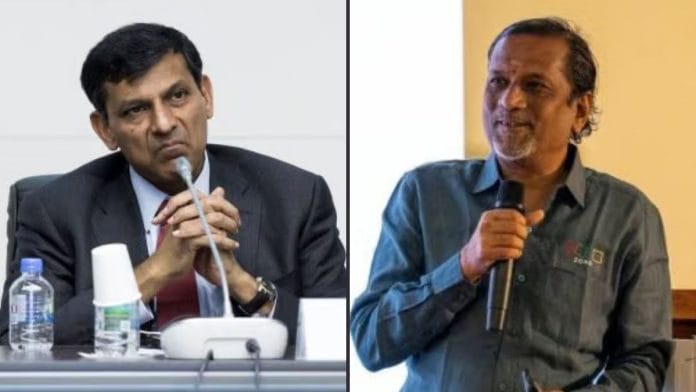
New Delhi: Zoho founder and chief scientist Sridhar Vembu took a swipe at former RBI governor Raghuram Rajan, saying that India cannot complain about low-paying factory jobs while shunning the industrial policy.
In an interview on September 1, Rajan questioned India’s push to develop the domestic semiconductor industry. He said that most chipsets are “the most easily smuggled thing on Earth,” with China and Russia already smuggling them en masse. Rajan further questioned the “effectiveness of the government’s broader industrial policy of picking sectors for targeted support.”
He further presented Tamil Nadu as an example.
“What kind of manufacturing jobs are you getting? They pay in the enterprises that assemble products and all that is not different from the pay the driver gets or a house help gets in Chennai. It’s Rs 20,000 per month. It’s not that great. We need to figure out how we can get better jobs.”
In his response, Vembu wrote a long post on X. His main argument centred on India’s economic model that relies heavily on exporting services while failing to build and own intellectual property (IP).
“High paying jobs, which I agree we need, come from high value addition and that requires that we not only perform the R&D but we also own the IP in India and capture the resulting economic value addition. Only then would pay in even products where India does not have much IP (like the iPhone) would go up,” Vembu wrote on X.
Also read: American prisoners are now calling voters to campaign for Republican candidates
Vembu’s developmental model of India
Vembu went on to illustrate with what he called two “crude examples”. His first example is Nvidia and its gross profit of more than $200 billion a year.
“…And 24 per cent of Nvidia employees are in India, mostly in R&D. Microsoft has a gross profit of about $230 billion a year and 10 per cent of its R&D staff are in India. India’s economic accounts will not show anywhere near 24 per cent of value added by Nvidia or 10 per cent of value added by Microsoft,” Vembu wrote on X. “If we look at major IP-rich, successful companies in the world, all of them do substantial R&D in India. But only a tiny fraction of economic value added by these companies actually is accounted for in India.”
His central argument revolved around what development model India should follow to become a developed economy.
“The only mechanism the world has known for a “developing country” (no IP, low value addition) to become a “developed country” (lots of IP and value addition captured locally) is to spur the domestic entrepreneurs and industry to gain the know-how and capability,” he added on X.
Vembu termed Rajan’s arguments as inspired by the “Chicago School” of economic theory. The Chicago School, he says, does not agree with industrial policy.
And then he says that such a school of economic theory would lead us to Mexico’s economic situation but never to Japan or Taiwan or South Korea and now, China.
“Getting to Japan or Taiwan or South Korea or China requires us to understand “How Asia Works.” China rose from very low wages and now has overtaken nations like Mexico, because China has the know-how and IP and Mexico does not.”
(Edited by Saptak Datta)
Vembu is spot on in his observations.
There is only one way to be a developed nation for India – own IP.
We are not sitting on massive deposits of oil, gas and other lucrative material/mineral. Out human wealth is pretty much the only wealth we have. We must invest heavily in education – the prime focus should be on primary and secondary education.
Heavy investment from the govt and industry on R&D can spur us on to be an IP powerhouse. It will inevitably lead to massive wealth creation.
Mr Vembu, Raghuram Rajan and knowledge in software are different
Your Modi economics is going to lead India as Somalia. You are partners in that destruction
It’s disgrace to a nation whose former head of RBI ,names a school named Shitcago! Instead of our own name!
Such stooge of west have backstabbed our nation!!!
Rajan was made the RBI governor but did not contribute even an iota to India’s financial well being. All his paper theories are impractical. And he should desist from commenting on India – unless of course he’s contracted by the anti-India lobby. Nevertheless his comments are never taken seriously here.