



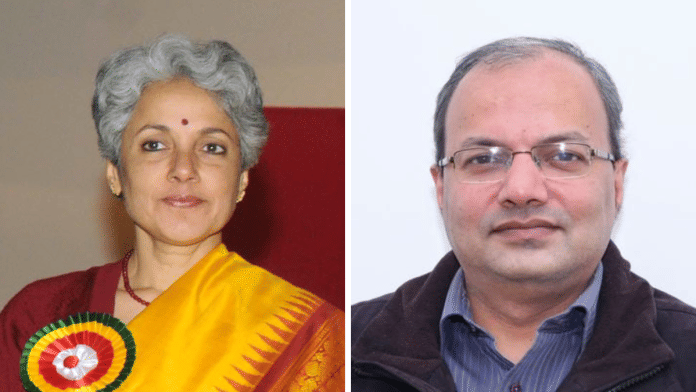

New Delhi: Dr Soumya Swaminathan has become the second Indian woman in history elected as a Fellow to the Royal Society of the United Kingdom. Her father, MS Swaminathan, was elected in 1973, making them the first Indian father-daughter duo to ever receive this honour.
Along with Dr Swaminathan, Professor Manindra Agrawal, Director of IIT Kanpur, has also been elected as part of the academy’s 2026 cohort. The fellowship, one of the most prestigious scientific honours, recognises scientists, engineers, and technologists who have made significant contributions to the world of science.
The Royal Society, founded in London in 1660, is one of the United Kingdom’s oldest scientific academies. Since its inception, over 8,000 fellows have been elected through a peer-review process by existing fellows. Once elected, fellows hold the title of an FRS for the rest of their lives.
The 2nd Indian woman FRS in 400 years
Dr Swaminathan, 67, is a paediatrician involved in medical research who previously served as chief scientist at the World Health Organisation and as the director-general of the Indian Council of Medical Research (ICMR).
As principal adviser to the National Tuberculosis Elimination Programme, she has helped devise strategies to battle the disease in India. Her father was elected FRS for his work in agriculture and plant genetics.
Over 12 prestigious awards
Agrawal, 60, is currently the director of the same institution where he received his Bachelor’s in Technology (1986) and later a PhD in Computer Science and Engineering in 1991.
Along the journey, he has been awarded several prizes like the Infosys prize of mathematics, the Gödel prize for outstanding research in theoretical computer science, as well as the Padma Shri in 2013, India’s 4th highest civilian award.
The FRS marks Manindra Agrawal’s 12th prestigious award in his career as a researcher, spanning several decades.
A professor of algorithms, complexity theory, cryptography, and computational number theory and algebra, Agarwal became internationally known in the scientific fraternity in 2002. At the time, he developed the AKS primality test with his students Neeraj Kayal and Nitin Saxena. The contribution was a milestone that changed the way mathematicians think about prime numbers.
Both Swaminathan and Agrawal have now entered a prestigious cohort of scientists like Isaac Newton, Michael Faraday, and Albert Einstein. However, among the global fellows in the Royal Society are several Indians as well.
Also Read: Researchers finally answer why the T. rex had short arms
Indian Fellows of the Royal Society
The first Indian ever to be elected a fellow of the Royal Society was Adaseer Cursetjee Wadia in 1841, a civil engineer and a member of the prominent Wadia shipbuilding family in Mumbai. At 14, Wadia was employed in the service of the East India Company to train as a Naval architect. Along with his fascination for engineering, he was also curious about steam engines and helped create the first horsepower steam engine in Mumbai.
Another Indian FRS is Srnivasa Ramanujan, who was given the honour in 1918. The mathematician is known for his extensive contributions to the field, most notably for solving problems which were at the time considered unsolvable. Ramanujan was known for being a self-taught mathematician with a sharp intuition.
CV Raman was elected as a fellow in 1924, just a few years before he won a Nobel Prize for his research into the inelastic scattering of photons, now universally known as the Raman Effect. However, for reasons never known, Raman resigned from the Fellowship of the Royal Society in 1968, and he remains the only Indian FRS to ever do so.
The first Indian woman elected FRS was Gagandeep Kang, in 2019, for her research into illnesses where pathogenic microorganisms such as bacteria, viruses, or parasites, find their way into the gastrointestinal tract of children.
(Edited by Insha Jalil Waziri)