





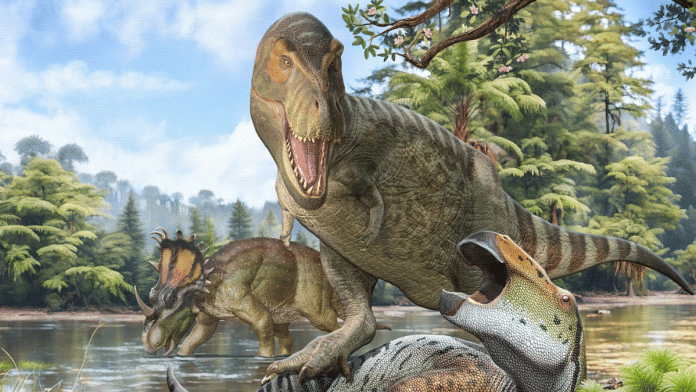

New Delhi: The Tyrannosaurus rex is known to be a fearsome predator, but in comparison to its enormous size, its tiny arms have left scientists puzzled.
However, the mystery may have finally been solved. A study published on 20 May in the journal Proceedings of the Royal Society B, explains that the T. rex may have had tiny arms because the dinosaur’s development focused on strong, powerful heads used to attack prey.
In the study titled “Drivers and mechanisms of convergent forelimb reduction in non-avian theropod dinosaurs”, researchers at University College London (UCL) looked at data from about 82 species of theropods, two-legged meat-eating dinosaurs. They noticed that five groups of theropods demonstrated a shortening of forelimbs over time.
“The head took over from the arms as the method of attack. It’s a case of ‘use it or lose it’—the arms are no longer useful and reduce in size over time,” lead author Charlie Roger Scherer, a PhD student at UCL Earth Sciences, said in a press release.
Scherer explained that when meat-eating dinosaurs found giant prey, it eventually became impractical for them to try to grab and pull a nearly 100ft-long sauropod, a type of plant-eating dinosaur known for its long neck and tail. And so, over time, dinosaurs like the T. rex evolved larger heads, which would allow them to attack and hold on to prey with their strong jaws.
Also Read: Thailand is now home to Southeast Asia’s largest dinosaur. Meet Nagatitan Chaiyaphumensis
Big head, tiny arms
To put the “tiny arms” into context, imagine a giant dinosaur measuring nearly 14 metres high. But its arms were likely to be barely a metre long. If one applied those proportions to a human being, imagine a 6-foot-tall person with arms as short as 25-30cm.
To understand this phenomenon, UCL researchers looked at new ways to quantify “skull robustness” and compared the forelimb length to the length of the skull. They found that dinosaurs with a reduced limb size had a stronger skull.
“While our study identifies correlations and so cannot establish cause and effect, it is highly likely that strongly built skulls came before shorter forelimbs. It would not make evolutionary sense for it to occur the other way round, and for these predators to give up their attack mechanism without having a backup,” said Scherer.
The team of researchers also found that as the prey of meat-eating dinosaurs grew larger, it led to an “evolutionary arms race” where predators, too, had to evolve stronger jaws and larger heads to keep up with their growing prey.
(Edited by Insha Jalil Waziri)