





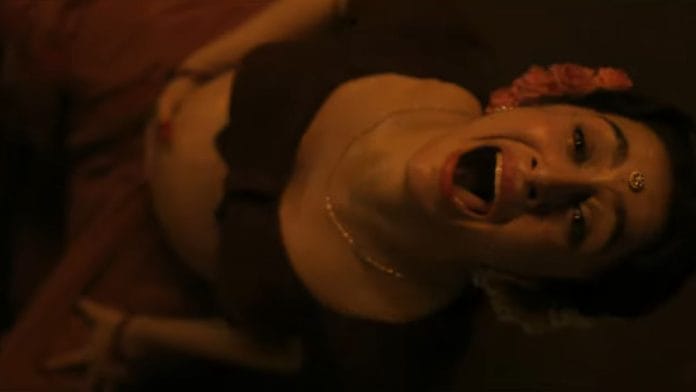


New Delhi: Vithabai Bhau Mang Narayangaonkar, a Lavani and Tamasha artist, cut her umbilical cord backstage with a stone when she was nine months pregnant, after she delivered her baby mid-performance. The scene is also shown in the teaser of the film Eetha, where she is played by Shraddha Kapoor.
The two-minute teaser of the film, released on Tuesday, captures Shraddha Kapoor dressed in folk attire, performing Lavani, as Vithabai.
“If I die lying in bed, I will be remembered as helpless, but if I die dancing, I will be remembered as a legend,” Kapoor narrates.
The film is directed by Laxman Utekar, who previously directed Chhaava (2025). Alongside Kapoor, the biopic also stars Randeep Hooda, Anant Joshi and Nana Patekar. The film will be released on 28 August.
Also read: How Sushruta’s legacy found a permanent home at Royal College of Surgeons of Edinburgh
Tamasha Express
Vithabai was born in the Solapur district of Maharashtra, in a family of artists and performers. She was introduced to different art forms as Lavani, Gavlan and Bhedik. Her father, Bhau Bapu Mang Narayangaonkar, was a renowned artist who used to run a Tamasha troupe established by his father, Narayan Khude.
She followed her family’s artistic lineage and started travelling around villages in Maharashtra, performing and refining the art form. One day, when Marathi playwright Mama Varerkar saw her performing on stage, mesmerised by her art, he invited her to join his team. While working with Varerkar and his troupe, she mastered traditional techniques such as Angik, Vachik, Satvik and Abhinaya, despite not having formal drama training. As her popularity grew, her fans started referring to her as “Tamasha Samradni” (Tamasha Empress).
Vithabai mainly performed in villages with local audiences, but when the China-India war started, she performed a special Tamasha at the North-East Frontier Agency border.
Despite all the love from fans and recognition including the President’s honour twice, in 1957 and 1990, Vithabai and her family were not financially stable. When she died in 2002, her family was reportedly not in a condition to pay the hospital bill and bring her back for her last rites.
In her memory, the government of Maharashtra instituted the annual Vithabai Narayangaonkar Lifetime Achievement Award in 2006, focused on artists working in the art of Tamasha, which she had dedicated much of her life to.