





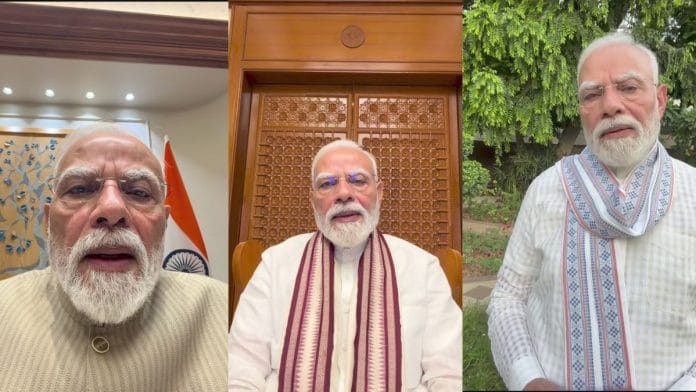


New Delhi: The way politicians use social media is changing. Gone are the days of highly curated, grandiose formal videos. Now, informal, personalized clips – often shot on a phone’s selfie camera – show politicians speaking directly to viewers and have become part of the new political playbook. The era of “Selfie Politics” has arrived.
And the Prime Minister of the United Kingdom Andy Burnham has mastered the art. In his videos, he talks directly to voters, as if having one-on-one conversations with them. One such video has gone viral, with journalist David Yelland describing it as a “direct-to-camera” social media style.
A video by Burnham where he asks “Can AI build a train” has grabbed public attention. In the video, Burnham is seen wearing a workers safety jacket while talking about how his government will fix the job crisis in the country by equipping them with skills.
“AI might be able to write essays, draft a contract or make a slide deck. But it can’t make a train like they do here, rewire your electrics or fix your roof,” Burnham said while moving around a factory with a hammer in hand. “For decades, politicians told young people that desk jobs were the future but learning practical skills has never been more important. I am making it easier for young people to get the skills they need to get into good jobs.”
Journalist David Yelland commented on the video, calling it “brilliantly executed and never done before by a PM.”
“Look. This direct to camera social media style has never been done before by a PM. It is directed at precisely the demographic who have entirely turned away from politics… on their platforms… on their phones… early days and let’s see… but this is an entirely new comms style… brilliantly executed too… whatever your politics… the engagement rates are encouraging…” he wrote in a post on X.
A research paper titled “Selfie Politics: The political commodification of yourself” by Hans-Georg Moeller, Associate Professor and Chairman of the Philosophy Department at Brock University argues, “Selfie politics is not simply a case of narcissism, as some have said, but an increasingly common, and effective, way of being political today – a kind of “ political commodification of the self.”
In another research paper “Personalization of politicians on Instagram: What Generation Z wants to see in political posts,” the authors say that their in-depth interviews with Gen Z, who heavily use Instagram, found that they “identify visual and verbal elements of politicians instagram posts that they consider influential on their beliefs and actions.”
Also read: 50-yr fight that took Indian women’s cricket to Lord’s. Dentures, unpaid dues, and a loudspeaker
Selfie politics in India
Selfie politics also found its way to India through Prime Minister Narendra Modi’s outreach video to students during the NEET protests.
In the video, PM Modi looked directly into his phone’s selfie camera while addressing students as “friends”, instead of delivering a polished, curated speech. The video was seen as an attempt by the Prime Minister to connect with protesting Gen Z students in a format familiar to them.
Soon after, PM Modi held a meeting with his cabinet ministers, asking them to strengthen their presence on Instagram to connect with young people. This was widely seen as the Modi government’s renewed push to connect with Gen Z.
Another research paper “Picture me in person: Personalization and emotionalization as political campaign strategies on social media in the German federal election period 2021” describes how politicians use social media for greater “personalization and emotionalization” in election campaigns.
But this style of politics is not entirely new. It was popularised by Zohran Mamdani, who campaigned for New York City mayor, using raw, short, selfie-style videos in which he looked straight into the camera and spoke directly to viewers.
In one of his Hindi-Urdu videos targeting South Asian voters, Mamdani used a popular movie dialogue: “Tumne kabhi kisi ko vote diya?” The video amassed more than a million views.
(Edited by Janaki Pande)
Comrade Mamdani shamelessly uses products of capitalism—namely, a smartphone and the internet, which were developed through private enterprise—to post selfie videos, even while criticising capitalism as exploiting poor people.