



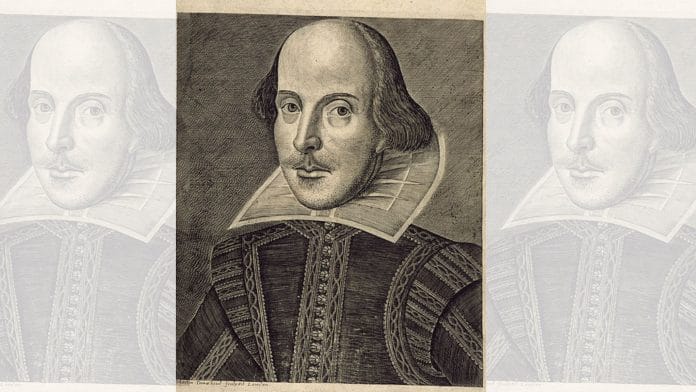
New Delhi: A new study says William Shakespeare wrote most of Edward III, a play published anonymously in 1596. Christopher Marlowe, often described as Shakespeare’s great rival, helped write it too.
For years, scholars suspected that a few scenes of Edward III, a history play about an English king’s wars with France, were Shakespeare’s. Now Rory Loughnane of the University of Kent and Brett Greatley-Hirsch of the University of Leeds say he wrote most of it.
Loughnane told The Guardian that the evidence puts Shakespeare’s authorship “beyond any reasonable doubt”.
The researchers used computer analysis to compare Edward III with works by 10 playwrights from the same period. They looked at how often certain words appeared and how they were arranged in sentences.
In one test, 23 sections of Edward III were identified as Shakespeare’s and nine as Marlowe’s.
Shakespeare seems to have written the scenes in which King Edward III tries to seduce a married countess, who turns him down. Marlowe wrote parts of the battle scenes toward the end of the play, including the French surrender at Calais.
Also read: Elon Musk promises a SpaceX share to every child in the US next year
Rivals or collaborators?
Shakespeare and Marlowe were born just weeks apart in 1564. Both were writing plays in London around the same time. They’ve generally been described as rivals, but the research suggests they were working together too.
“We have become accustomed to thinking of Marlowe and Shakespeare as rivals. They were not simply rivals or influences on one another,” Loughnane told The Guardian.
In 2016, researchers found that Marlowe had helped write Shakespeare’s three Henry VI plays. Now it appears they also worked together on Edward III, probably around 1592.
Marlowe died the following year, aged just 29, after a brawl in a lodging house. Loughnane described his death as the end of “a fruitful early career series of collaborations” between the two.
“The discovery helps us see young Shakespeare differently. The Shakespeare of the early 1590s was not yet the solitary national genius constructed by later generations. He was writing with other dramatists, learning from them, competing with them, and moving between collaborative and independent projects,” he told The Telegraph.
The findings will be published in Shakespeare Quarterly in November.
(Edited by Ratan Priya)