



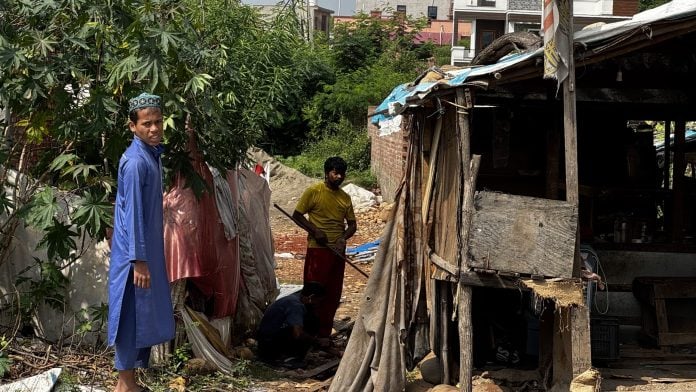
Jammu: Nearly a month after notices were served on plot owners to evict Rohingya refugees from their land, Mohammad Alam is dismantling his home in Jammu’s Narwal colony. He removes the tin roof, unhooks the wooden logs and pulls down the tarpaulin in a swish. He is preparing to leave.
“The owner of the plot asked us to leave as soon as possible. He gave us three days’ time, or he said he would forcefully evict us,” Alam said.
Alam is not alone. Hundreds of Rohingya families in Jammu have been asked to vacate their jhuggis after the administration served notices on plot owners, directing them to remove the makeshift structures from their land.
The action follows the visit of the Centre-appointed High-Level Committee on Demographic Changes (HLCDC), headed by retired Justice Prakash Prabhakar Navalkar, which travelled across Jammu from 10 to 12 August to examine demographic changes, including illegal immigration. The four-member committee also visited a Rohingya settlement in Karyani Talab in Narwal.
Government data presented to the committee showed that 7,656 Rohingyas had been identified across Jammu and Kashmir. Of these, 6,737 were in 10 districts of the Jammu region and 919 in the Kashmir Valley.
In 2017, J&K government data put the Rohingya population in and around Jammu at about 5,700. The latest figures indicate an increase of more than 1,000 in the Jammu region over roughly nine years. The committee’s scrutiny, however, also focused on official concerns about the community’s alleged involvement in organised crime, drug trafficking and human trafficking.
Soon after the committee’s visit, notices were served on plot owners who had rented out small parcels of their land to Rohingya families for a nominal amount. Many of these families had put up makeshift homes on the plots and lived there for years.
Over the years, the Jammu and Kashmir administration has conducted verification drives, summoned refugees to provide biometric details at police stations and raided their settlements to check for illegalities. The latest action marks a shift in approach: instead of targeting only the settlements or their residents, the administration has also moved against the landowners who rented out their plots.
The notices have prompted plot owners to ask Rohingya families to leave. Some residents say even other locals are now unwilling to let them stay, leaving them with few options. The refugees say they are willing to leave Jammu altogether if the government facilitates their return across the border or helps them move to another country.
“We are ready to leave Jammu. We want the government’s cooperation in facilitating us to another country as we can’t return to ours,” said Salamotuallh Khan. He said families used to pay about Rs 1,500 a month to stay in the jhuggis.
But they don’t want to return without their fellow Rohingyas. In 2021, around 275 Rohingyas were detained during a verification drive in Jammu’s Hiranagar. They were found to be without UNHCR cards and have been kept in a detention centre since then.
“If you want us to leave Jammu, free our families from the detention centre so that we can leave the country,” Khan added.
The question of what happens to those being evicted is becoming more urgent as the dismantling of settlements gathers pace. In Narwal’s Karyani Talab area, residents have been seen pulling down huts, removing wooden structures and packing their belongings. PTI reported that more than 500 families living in around 80-90 makeshift huts had been asked to vacate the plots.
No mention of Rohingyas in the notices
The notices served to the plot owners, many of them Muslims, do not mention Rohingyas. Instead, they cite “unauthorised conversion of land for non-agricultural purposes” under Section 133-A of the Jammu and Kashmir Land Revenue Act, 1996. The provision restricts the use of agricultural land for non-agricultural purposes without permission from the District Collector.
The notice read: “Whereas, as per the report, the said agricultural land has allegedly been used for raising/constructing jhuggis and other structures, thereby changing the use of the land from agricultural to non-agricultural purpose without obtaining the requisite permission from the competent authority.”
Rasheeda, on whose plot more than 20 jhuggis had been rented out, said she too asked the Rohingyas living on her land to leave after her neighbours began receiving the notices.
“We also went to meet the DC, who asked us to evict the Rohingyas and uproot the jhuggis, or we would have to face the repercussions,” she said.
Since then, Rasheeda visits the plot twice a day, she says, to make sure none of the Rohingyas have returned to stay in the jhuggis.
“We gave them the area to stay after they showed us UNHCR cards, which are legal. I don’t know where they will go now, but I cannot let my family suffer for providing shelter to people in need.”
(Edited by Prashant Dixit)