





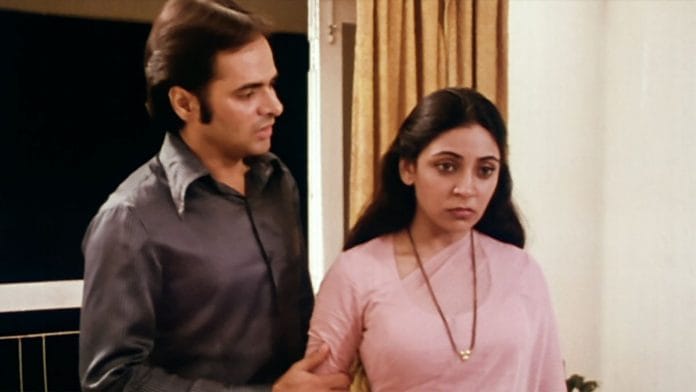



The Hindi film industry has given us one too many love stories, from Chandni to Dilwale Dulhania Le Jayenge to Kuch Kuch Hota Hai. Most of these films leave us believing that love ultimately wins—with the hero and heroine together at the end. But only a handful of stories show what happens after that so-called happy ending.
That is where director and writer Raman Kumar’s Saath Saath (1982) sets itself apart. The couple meet, fall in love and convince their family for their union within 54 minutes of the film. It’s only once they get married that the actual story begins to unfold.
The conflict doesn’t come from a disapproving father, a rigid society, or a jealous lover. It is life post-marriage. The differences are in the choices, values, and circumstances. The quiet battles of a couple.
Almost anyone who has navigated love, marriage, financial instability, ambition, and compromise can recognise elements of their own marriage in Avinash and Geeta’s story.
Also read: Indo-Soviet film Ali Baba Aur 40 Chor wasn’t a diplomatic feat but a commercial success
‘Yeh ghar haseen hai’
Avinash, played by Farooq Sheikh, is pursuing his MA and also writes articles for a newspaper to earn money. He falls in love with a wealthy businessman’s daughter, Geeta (Deepti Naval).
Avinash has high morals, and he speaks against capitalism and the media. While these ideals lead to his financial struggle, they impress Geeta.
Their honeymoon phase passes against the backdrop of the track, Yeh Tera Ghar Yeh Mera.
Then the troubles seep in. Both stretch themselves to make ends meet. Geeta teaches fourth-grade students and even takes extra coaching classes in Versova, while Avinash takes up a night job at a newspaper printing press.
With their schedules barely overlapping, their communication slowly shifts to notes left under a small whiteboard that reads, “Yeh ghar haseen hai” (This house is lovely). Over time, these messages shrink, from long paragraphs to a few lines, and eventually to just a handful of words.
Their fallout is not a dramatic or explosive clash. It is a slow erosion, the kind that happens in many real-life relationships.
The writing also deserves a moment.
The story avoids quick judgements or heavy confrontations. It portrays two people who genuinely love each other but find themselves struggling with expectations and circumstances.
Life’s pressures, the need for money, the fear of losing one’s values, the anxiety of unfulfilled ambitions, gradually become the reasons that threaten their happiness.
Also read: Mother India took Hindi cinema to global stage. Its Oscar nomination was a turning point
Strength of Saath Saath
Sheikh and Naval are central to the film’s success. And, their performances are wonderfully natural, making Avinash and Geeta feel like people you might know rather than fictional characters.
What makes their chemistry so appealing is that it grows on you gradually. There are no grand gestures. The soundtrack, composed by Kuldeep Singh with lyrics by Javed Akhtar, helps their love bloom on the screen. These songs have since become timeless classics.
Another strength of Saath Saath is its depiction of middle-class life in urban India. This v. in the face of life’s ordinary challenges.
And in doing so, the film proves that sometimes the most compelling love stories are not about overcoming villains, but about learning how to live together, ‘saath saath’, through everything life throws your way.
Views are personal.
(Edited by Theres Sudeep)