





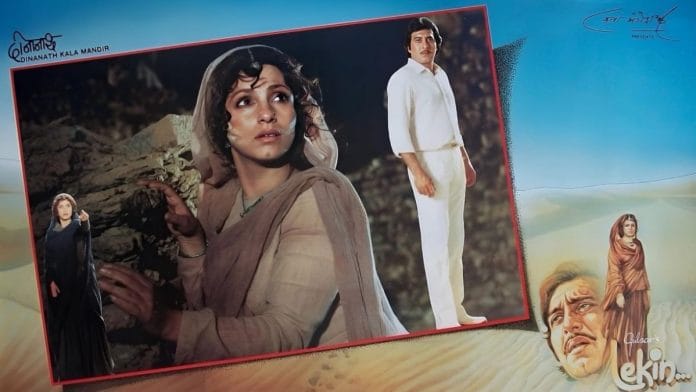

With Lekin…, released in 1991, Gulzar showed Bollywood that a ghost story didn’t have to be scary. The film uses the supernatural to tell a story about memory, injustice and the wounds left behind by a fading royal world.
Lata Mangeshkar produced the film. She wanted to make a film that gave music the importance she felt it deserved. She grew increasingly disappointed with how Bollywood worked and decided to produce a film herself. She then approached her friend Gulzar, who eventually decided to adapt Rabindranath Tagore’s 1895 supernatural story Kshudhita Pashan.
The film begins with Sameer Niyogi, played by Vinod Khanna, a government officer who is sent to a remote part of Rajasthan where a community of Banjaras have settled and conduct business. The place once belonged to Maharaj Param Singh. The old royal order had already been dismantled after Sardar Vallabhbhai Patel ended the privileges enjoyed by the princely states. But while the royals lost their power, the film suggests that the scars created by that world did not disappear so easily.
A kingdom in ruins
On his journey to Rajasthan, Sameer meets Reva, played by Dimple Kapadia, a Rajasthani woman whom he helps board a train. But when he wakes up, she has mysteriously disappeared. When Sameer eventually reaches his destination, he meets Jasoor, played by Amjad Khan.
Jasoor brings a rare comic energy to the mystery and becomes one of the film’s most memorable characters. His interactions with Sameer repeatedly break the tension. During one encounter, Reva begins flirting with a cat, prompting Jasoor to warn her, “Don’t dare to get out alone; it’s not safe for cats.” Sameer, meanwhile, repeatedly calls him “Miss Heaviness.”
But Reva continues to appear before Sameer, and the mystery around her only deepens. Is she simply a Banjara woman, or is there something supernatural about her? One day, Reva transports him back in time when the royalty was in charge, and the haveli was grand, not in ruins.
Reva and her sister used to perform in the royal court. But the king’s desire for Reva turned her life into a nightmare. When the sisters attempted to escape, their father was brutally murdered. Reva was captured and kept imprisoned for eight years. Eventually, while trying to escape, she died in a sandstorm. Her body disappeared into the desert, but her soul remained trapped there.
In between these well-written dialogues was music, which was the sole purpose of Lata Mangeshkar producing the film. Gulzar ensured that the film tells its emotions more through music and less through dialogues. While Gulzar wrote the lyrics, the music was composed by Lata’s brother, Hridaynath Mangeshkar.
But there is a fight between two songs. “Yaara Seeli Seeli” got into popular culture and won several National Film Awards at the 38th National Film Awards, including Best Music Direction, Best Lyrics and Best Female Playback Singer. But “Main Ek Sadi Se” captured the whole essence of the film, with Reva questioning the condition of a woman who has been waiting for liberation for centuries now.
She is waiting on the path that several people cross daily, but no one really cares to listen to what she needs. The song explores the psychological toll of being frozen in time while the wheels of the world turn without you: “Din raat ke dono pahiye bhi, kuch dhool udaakar chale gaye (both the wheels of day and night, too, passed by, kicking up a little dust).”
Also read: Kranti was Manoj Kumar’s biggest patriotic hit. There’s still a fight over who wrote it
The past returns
Lekin… becomes more than a conventional ghost story. Around the time the film was being made, reincarnation stories were widely discussed across India, from the most famous one, Titu Singh Toran, to stories emerging from smaller towns and districts. Gulzar brings that fascination with reincarnation into the film subtly.
When Reva was trying to escape, a man named Mehru tried to help her. He looked exactly like Sameer. This becomes the key to understanding why Reva appears only to Sameer and why she keeps seeking his help. Sameer is connected to Mehru through reincarnation; he is the return of the person who once tried to save her. Reva is therefore looking for the person who can finally help her escape the desert where she has remained trapped for years.
While music, dialogues and camerawork did justice to Gulzar’s imagination and story, it was Bhanu Athaiya’s costume designs which made Kapadia look like the most beautiful ghost, one that looks familiar, yet her charm never came close to being recognisable. Dressed in muted, earthy Rajasthani ghagras with heavy, oxidised antique silver jewellery, Kapadia’s costume gives Reva a strong historical reality while also making her look like someone who doesn’t completely belong to this world.
(Edited by Saptak Datta)