



Kolkata: It has been 100 years since Bengali literary legend Sarat Chandra Chattopadhyay’s novel ‘Pather Dabi’ was published. The British colonial government banned it under Section 124A of the Indian Penal Code for “preaching sedition” as it depicted a secret revolutionary society fighting for India’s independence.
It has also been almost a century since Chattopadhyay felt hurt and let down by Rabindranath Tagore, whom he had approached for support against the ban, only to be turned down.
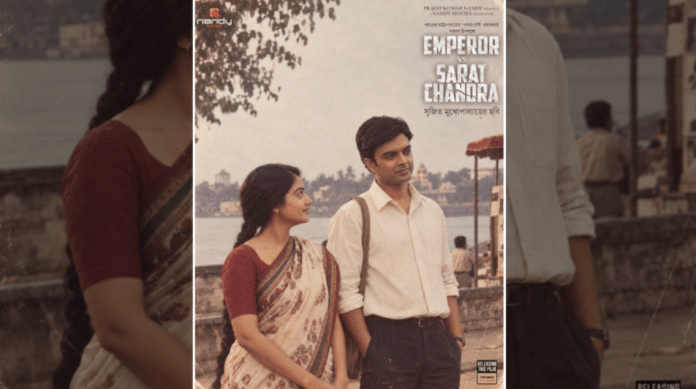
New Bengali film ‘Emperor versus Sarat Chandra’, set for release on 15 October, not only revisits Chattopadhyay’s faceoff with the British Raj but also examines an eternal dilemma: should the artiste stand by her own community or let art do the talking?
“As far as Bengal is concerned, the voice of dissent, the habit of questioning authority as Sarat Chandra did in ‘Pather Dabi’ has remained and will remain,” the film’s director Srijit Mukherji told ThePrint. “We do that when we go on social media, read editorials, watch films.”
Against the Emperor, without Tagore
Published as a novel on 31 August 1926, and banned on 4 January 1927, ‘Pather Dabi’ is the story of the charismatic and passionate fictional freedom fighter Sabyasachi Mallick, a polymath trained in Europe and America who uses disguise to hoodwink the police, and his secret revolutionary society ‘Pather Dabi’ which aims at bringing up a resistance against the British Raj.
“Sarat Chandra Chattopadhyay’s Pather Dabi (is) an antithesis of the Gandhian notion of ahimsa and satyagraha,” writes Mohammad Kaosar Ahmed, a professor of English at the International Islamic University, Chittagong, Bangladesh.
The story of Mallick and the powerful women around him — their inter-relationship, agony and ecstasy stirred anti-British sentiments at a time India was languishing under British rule, he added.
Ahmed writes that Mallick’s character is a mirror image of Netaji Subhas Chandra Bose, while the novel itself is peppered with a host of unforgettable characters like the timid and orthodox Bengali Brahmin Apoorba Haldar, the Christian lady who loves him, Bharathi Joseph, another lady who is the president of this organisation, Sumitra, Ramdas Talwarkar, a friend of Apoorba and a man ready to die for his country.
“The subaltern (Mallick) is a courageous, bold, committed and very talented leader who repeatedly haunts the British, defying their jails, police, and intelligence with sheer cunning. This anti-colonial narrative shows how he inspires people with his passion into the freedom movement, often changing their very lives,” Ahmed writes.
‘Pather Dabi’ captured the imagination of the readers. After it was published, 5,000 copies were sold in a week. When the police reportedly came to seize copies of the book from the office of Bangabani, a Bengali monthly journal where the novel was serialised, no copies were to be found.
Chattopadhyay had expected fellow Tagore’s support to fight the British Raj’s ban on the book. But Tagore declined to publicly back Chattopadhyay. In a letter dated 4 January 1927, Tagore wrote, “The book creates in the mind of the reader an unpleasant attitude towards the English rule. This may not be improper, as the author cannot remain silent if he feels it to be unjust. But he must be ready to face the eventuality of expressing his views.”
Mukherji said that Tagore had an incredible social voice during the British rule.
“The fact that he was a cultural force to reckon with as well as the fact that he had himself given up his knighthood as a mark of protest against the Jallianwala Bagh massacre and the impact it had on the country, I think he could have written a letter of protest against the ban of ‘Pather Dabi’ or protested the ban,” he added.
But exactly 150 years after the birth of Chattopadhyay, Mukherji’s film on the standoff between the writer and the emperor makes a larger point — if there is something governments, irrespective of colour or political ideology, are uncomfortable with, they will choke free speech or ban it.
“It is not about then, now or in the future; it is kind of a universal truth. In that sense, my film is topical forever. The idea of the film, though, germinated in 2021, during the Covid-19 pandemic when I was reading the letters between Chattopadhyay and Tagore. It is a matter of great coincidence that the film is releasing in 2026, 100 years after the publication of Pather Dabi and 150 years after the birth of Sarat Chandra,” he said.
Also read: Why does Bollywood not have Hollywood’s global reach? JioStar’s Uday Shankar has an answer
Banned, and alone
For senior entertainment journalist Bhaswati Ghosh, an important message that the audience should take away from the story of ‘Emperor versus Sarat Chandra’ is that artistes should not shy away from standing by their community in times of need.
“Be it in Bollywood or the Bengali film industry, we have seen how in times of need the artiste is targeted by powers that be; she has to walk through fire alone,” Ghosh told ThePrint.
Mukherji recounted how he was targeted during the release of his 2019 film ‘Gumnaami’, which dealt with the mystery of Bose’s death, based on the Mukherjee Commission hearings and the book ‘Conundrum’ written by Anuj Dhar and Chandrachur Ghose.
“Not only were there political outfits against the film, but the Bose family also threatened and put an injunction on it. We approached the Calcutta High Court and proceeded legally to quash the injunction before the release. Then came the death threats and pressers warning us of dire consequences,” Mukherji said.
Mukherji added that he didn’t really turn to anyone for help, but there were a few voices of support.
“But largely most of the voices were extremely quiet. But that has been the case with most controversies surrounding my films,” Mukherji said.
For author and oral historian Avishek Biswas, Chattopadhyay’s disappointment with Tagore 100 years ago became Salman Rushdie’s too, with the writerly community at large after the Satanic Verses controversy.
“We talk about art for art’s sake, but when books and films challenge the status quo, the artiste finds herself alone, often shunned by her very own,” he said.
(Edited by Saptak Datta)