



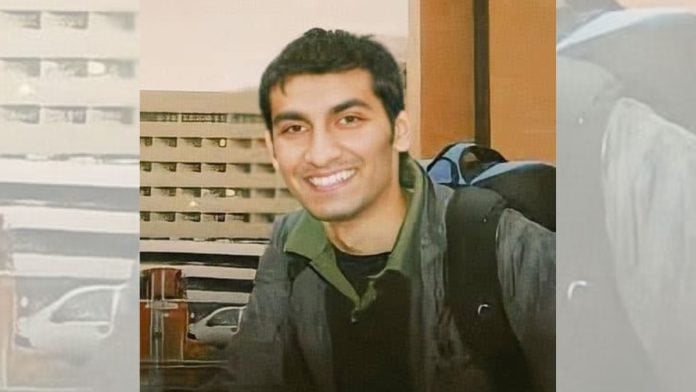
New Delhi: Pakistan has never really hanged anyone for blasphemy. In author Mohammed Hanif’s words, the country simply fits a noose around a man’s neck each morning and loosens it each night — a mercy just enough to let the country’s conscience sleep. Pakistani professor Junaid Hafeez has been wearing that noose for 13 years.
Pakistanis have used multiple adjectives for him — promising, brilliant, a self-proclaimed romantic who loves books, poetry, and music, and a prisoner of conscience. None of it has helped him be acquitted. He remains in solitary confinement serving a death sentence since 2019. Both inside and outside the jail, his life remains in danger.
Hafeez, a former visiting lecturer of English literature at Bahauddin Zakariya University in Multan, was arrested in March 2013, and accused of blasphemy for operating a secret Facebook group.
Hafeez was also accused of hosting Qaisra Shahraz, a prominent British-Pakistani novelist, as a guest speaker at Bahauddin Zakariya University and endorsing allegedly blasphemous remarks made during the lecture. Shahraz had to flee the country.
In December 2019, after six years of adjournments and the transfer of judges, a trial court sentenced Hafeez to death. The Lahore High Court is scheduled to hear his case on Tuesday and rights activists are yet again calling for his release.
In a video shared on X on Monday, activist Sheema Kermani called for a fair trial and his release. During the CJP protests in India, which saw a wave of support from Pakistan, author Mohammed Hanif called Hafeez a “Pakistan’s cockroach” who has been behind bars, forgotten.
The trial itself has become one of the most contentious cases in Pakistan’s legal history. Rashid Rehman, the lawyer who first took on Hafeez’s defence, was threatened openly in court by clerics and lawyers before he was shot dead in his office in 2014. In the years after, Hafeez was held in solitary confinement due to repeated attacks by other inmates, and the proceedings have been held behind closed doors, inside a high-security prison in Multan out of public view.
According to his current lawyer, the case against him never came together. “The prosecution, the witnesses and trial could not prove any of the allegations,” the lawyer told The Guardian after Hafeez’s 2019 verdict.
He recalled visiting Hafeez the night before the verdict and finding him almost lighthearted and certain, as everyone around him seemed to be, that acquittal was close.
What unfolded, however, the next day was what the lawyer described as “unprecedented”. Rather than presenting concrete evidence, the prosecutor told the judge that Hafeez was “against Islam” and reminded the court that the case was “sensitive”.
“It was the point I realised they were just using the religious card,” the lawyer added, “which was an immoral and unethical precedent in the court.”
“Pakistan’s blasphemy laws operate as black laws—draconian, anachronistic statutes completely devoid of statutory safeguards and weaponised for personal or ideological vendettas. The case of academic Junaid Hafeez exposes how these edicts systematically dismantle judicial independence,” Pakistani lawyer Shafiq Ahmed told ThePrint.
“By substituting rigorous evidentiary standards with populist intimidation and silencing the defence through targeted terror, these laws strip citizens of their constitutional right to a fair trial. For the legal community, Hafeez’s conviction and his agonizing 13 years behind bars remain a grim indictment of a criminal justice system that routinely capitulates to majoritarian veto,” he added.
From Jackson to jail
As a student, Hafeez initially studied medicine at Pakistan’s oldest medical college, the King Edward Medical University, in Lahore, but left after his first year to pursue English literature at Bahauddin Zakariya University, where he reportedly broke a decades-old academic record.
In 2009, he went to the United States on a Fulbright scholarship at Jackson State University in Mississippi, where he studied American literature, photography, and theatre. He returned to Pakistan in 2011, and became a visiting lecturer in the English department at his alma mater. He taught literature and invited outside speakers to the campus, including women’s rights activists.
Before his arrest, Islamist student groups had objected to what they described as his liberal teaching. Even finding a lawyer willing to represent Hafeez proved extraordinarily difficult. His father, Hafeez-ul Naseer, in a 2016 Dawn article recalled approaching one lawyer only to see him confronted by a large group of lawyers protesting his decision to take the case.
Naseer talked about how he would take books for Hafeez to read from his personal collection, which the family said contained more than 6,000 volumes. By the time the trial court sentenced Hafeez to death in December 2019, he had already spent more than six years in prison.
Also read: Almost all of Imran Khan’s family have been arrested. Three sisters picked up now
The burden of blasphemy in Pakistan
In Pakistan, accusations of blasphemy can carry consequences beyond the courtroom. According to a Human Rights Watch report, over 1,500 blasphemy cases have been lodged since the 1980s. Most turn out to be fabricated.
Human rights organisations have documented cases in which accusations have been accompanied by threats, mob violence, or attacks on those who defend the accused. Two prominent Pakistani figures who advocated changes to the blasphemy laws — former Punjab Governor Salman Taseer and former federal minister Shahbaz Bhatti — after a Christian woman, Aasia Bibi, was wrongfully convicted of blasphemy, were both assassinated in 2011.
That history hangs over Hafeez’s appeal. When an August 2026 Reuters report claimed that blasphemy cases had gone down under Pakistan’s de facto head, Army Chief Field Marshal Asim Munir, many were quick to highlight Hafeez’s case.
Ahmad Noorani, a Pakistani journalist, described the broader problem in stark terms. In his view, Hafeez’s case cannot be separated from the wider evolution of Pakistani society and the political use of religious sentiment. In the 80s, General Muhammad Zia-ul-Haq rewrote colonial-era blasphemy laws. His amendments tightened the hold of Sunni clerics and named specific offences like desecrating the Quran and insulting the Prophet’s companions. He outlawed Ahmadis from even calling themselves Muslim. The punishment was changed from 2-3 years to life imprisonment or death.
“What happens when a state is built on religion? The country was founded on a premise that a nation could be built on the basis of religion and a few years later, that premise produced the man suited to carry it to its logical end: Zia-ul-Haq. Everything he did to this society — the fracturing, the unravelling — followed from that founding choice,” said Noorani.
“Hafeez, a well-educated man, a professor, was accused of something he almost certainly didn’t do, but the accusation itself made justice impossible. No lawyer could represent him and remain in the city. Any lawyer who tried was driven out. And when one finally came from elsewhere — Rashid Rehman — he was killed for it. Sit with that. Consider how hollow, how manufactured a case has to be, that the people behind it needed to remove every honest voice from the room before it could proceed,” he added.
“This is what happens when you build a state on religion or build it on something else entirely and dress it in religion’s colours afterward. The wound doesn’t stay contained to one courtroom. It spreads,” he added.
Qindeel Azam, a human rights activist who recently spoke to Hafeez’s lawyer, described Hafeez, now in his 40s, as a man who has developed mental health issues after years of imprisonment. His solitary confinement has itself become a form of punishment. His family has aged outside the prison walls. His father, now almost 70, refuses to give up. His mother has largely withdrawn from ordinary life.
“The real challenge right now is that he appeal in the high courts is heard,” Azam said. “There’s a pattern we’ve watched for years — a date gets set, and then charges get quietly altered, or the paperwork ‘isn’t available,’ or the date just moves,” said Azam.
She is hopeful they will see an acquittal this time. “It’s been years. Hafeez’s lawyer, Saif ul-Malook, is genuinely hopeful, that they’re finally about to hear it. And if they do, there’s a real chance he’s acquitted.”
According to her, what the lower courts want to avoid isn’t a wrongful conviction, it’s the fallout from an acquittal. She pointed to the Aasia Bibi case as the template: “Every time one of these ends in acquittal, right-wing factions of society are unwilling to accept the verdict. Years of indoctrination have resulted in radicalism where there is no differentiation between the innocent and the guilty. It doesn’t matter what the court finds. In the public’s mind, the verdict was already decided the day the accusation was made. That’s the narrative, and everyone in power has learned to tiptoe around it rather than confront it.”
Hafeez and his family meanwhile wait. His trial was relisted for a later date on Tuesday by the Lahore High Court.
As a Pakistani writer, Saki Nama, wrote on Facebook: “Among many other national sins, this one looks the gravest of all.”
(Edited by Aamaan Alam Khan)