



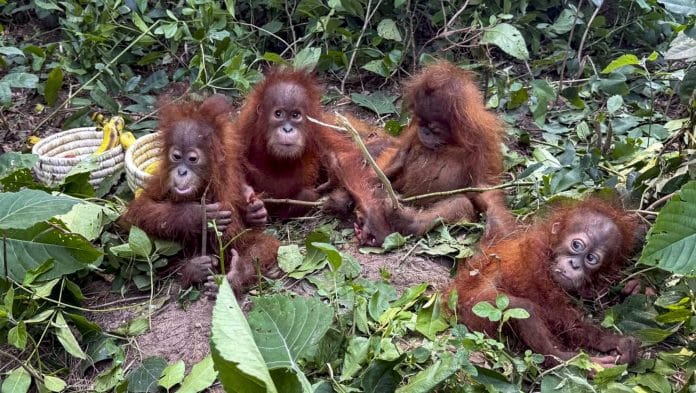

New Delhi: When the five baby orangutans rescued from Odisha’s Balasore were seen clinging to each other and making distressed noises, the authorities could tell they were showing signs of anxiety typical to the species. To soothe their frayed nerves, the Nandankanan Zoological Park officials have installed swings, given them soft toys, and are even playing them classical music.
“We referred to research papers and had discussions with biologists and found that playing them classical music, the kind that we play in our homes in the mornings, would be helpful for their stress,” Pradeep Mirase, deputy director of the Nandankanan Zoological Park, told ThePrint.
To identify the orangutans’ country of origin, the authorities were supposed to collect blood samples on Thursday. However, sample collection was delayed by 10 days after a Wildlife Health Committee from the Odisha University of Agricultural Technology assessed that the baby orangutans were stressed.
For now, the authorities are waiting for them to acclimatise better and are only collecting external samples such as faecal matter. However, these samples aren’t enough to determine their origin.
The five orangutans were spotted near the edge of a forest in Odisha’s Balasore district on Tuesday morning. As a crowd began gathering around them, the animals were moved to a quarantine area at the Nandankanan zoo.
The five babies, four of whom are less than a year old, were found without their mother. The separation is likely to have been a major cause of stress, especially since orangutans are known to have long childhoods where they spend nearly six to seven years with their parents.
‘Just trying to make them comfortable’
For now, the zoo officials’ efforts seem to be working.
“At first, when they were brought to the Zoological Park, they were only clinging to each other and making noises. Now they are already friendlier with the animal keepers, and they are playing around a bit and climbing up the window,” said Mirase.
Among the five animals, only one is old enough to feed itself. While the animal keepers hand it a banana, the other four are being fed boiled apples and bananas and Similac, a low-lactose baby formula.
Mirase said that for now, the authorities are focused only on the baby orangutans’ health. They are likely to be kept in quarantine for about four weeks, after which they would be shifted to another enclosure where they can enjoy some sunlight.
“We have also given them soft toys. We usually do that for the chimpanzees that we have at the zoo. We are just trying to make them comfortable for now; we can’t say anything about where they will be taken afterward. Those instructions will come from the administration,” Mirase added.
Also read: Hollywood movies on tech bros Elon Musk, Sam Altman, Mark Zuckerberg coming this October
‘Authorities must consult experts’
According to wildlife activist Biswajit Mohanty, nobody in India is equipped to take care of orangutans.
“I told the authorities to get in touch with animal rescue and care centres in Thailand or Sumatra because they have developed procedures over the years and they know how to take care of these animals. Without proper care, they might just die,” Mohanty said.
He explained that the extent of their trauma and stress also depends on whether they were picked up from the wild or if they were a part of an illegal breeding racket where humans could have been rearing them from a very young age. The best thing the authorities can do now is consult experts who know how to care for orangutans. Repatriation is a much later thought, especially since they cannot be left in the wild in India, where they are neither used to predators nor food.
According to Mohanty, repatriating the animals to Borneo, Sumatra, or Indonesia is a great opportunity for India.
“This is a great opportunity for India to showcase itself at an international level as a country that takes wildlife laws extremely seriously, and a country that is truly committed to stopping such illegal wildlife trade,” said Mohanty.
(Edited by Prasanna Bachchhav)