





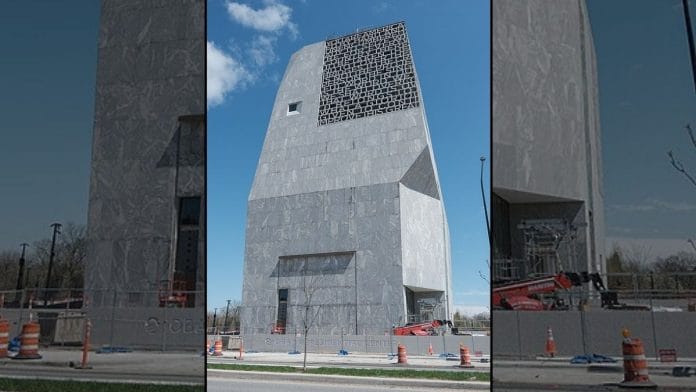


New Delhi: Stretching across Chicago’s historic Jackson Park, a towering structure of stone and glass is slowly turning into one of the most closely watched cultural landmarks in the US. The Obama Presidential Center, set to open on 19 June, is designed less as a museum of the past and more as an experience of memory, art and collective civic imagination.
Ten years in the making and costing $850 million to build, it is now the most expensive library in US history.
The highly anticipated centre is finally scheduled to open on Juneteenth—a US federal holiday celebrated annually on 19 June to commemorate the freeing of enslaved Black Americans—after more than a decade of construction. It becomes a defining addition to Barack Obama’s post-presidential legacy. At its heart is an eight-storey museum tower that anchors the sprawling 19.3-acre campus, which combines exhibition spaces with public amenities and community programming.
A presidential library is supposed to be an archival depository that preserves and makes available the papers, records, collections and other historical materials of every US president since Herbert Hoover.
But the project goes far beyond a traditional presidential library. Designed by architects Tod Williams and Billie Tsien, the campus includes a museum, gardens, a fruit and vegetable garden, an NBA-regulation basketball court, and a new branch of the Chicago Public Library. The site also features nearly 30 artist installations, woven into its landscape and architecture to reinforce its focus on culture, identity, and civic life.
Surrounded by Chicago’s South and West Sides and overlooking Lake Michigan, the centre has been envisioned as a public space as much as a historical archive. According to early looks from CNN, the campus is already active during its soft-opening phase, with school groups touring exhibitions and visitors observing final construction, landscaping, and art installations still being completed.
The design itself is shaped around a symbolic concept: four hands coming together, representing collective effort and community building. That idea is reflected in the building’s bold, sculptural form, which some have described as brutalist in character. Informally, the structure has even earned the nickname “Obamalisk” among observers, reflecting both its monumentality and cultural significance.
Also read: Work from home is wrecking mental health, says new US study
The controversy
Unlike traditional presidential libraries overseen by the National Archives and Records Administration (NARA), the Obama Presidential Center will be operated privately by the Obama Foundation. The decision marks a significant, yet controversial departure from the standard model of presidential archives.
Legal experts, archivists, historians, and local activists have voiced major concerns, arguing that the private model sets a troubling precedent for presidential transparency, historical research, and the use of public resources.
The project has also faced a backlash due to its location. Situated within a historic public park, its construction has raised concerns about environmental impact and gentrification on the South Side. Legal challenges from environmental groups and community activists have highlighted tensions between large-scale development and the preservation of public green space in Chicago.
Inside the museum, exhibitions trace Obama’s political journey, his presidency, and broader American historical movements that shaped his leadership. Displays also highlight Michelle Obama’s initiatives and influence, alongside major civil rights milestones and the women’s suffrage movement. Campaign memorabilia, personal artefacts, and interactive installations aim to situate the Obamas within a wider cultural and political narrative.
A notable feature of the exhibits is the emphasis on cultural influence, including Michelle Obama’s public image and style, presented as part of the broader story of representation and visibility in American life.
As opening day approaches, the Obama Presidential Center stands at the intersection of celebration and scrutiny—part monument, part museum, and part civic experiment. Whether it ultimately reshapes how presidential legacies are preserved remains to be seen, but its ambition is already clear: to turn history into a living, participatory space rather than a static record of the past.
(Edited by Saptak Datta)