





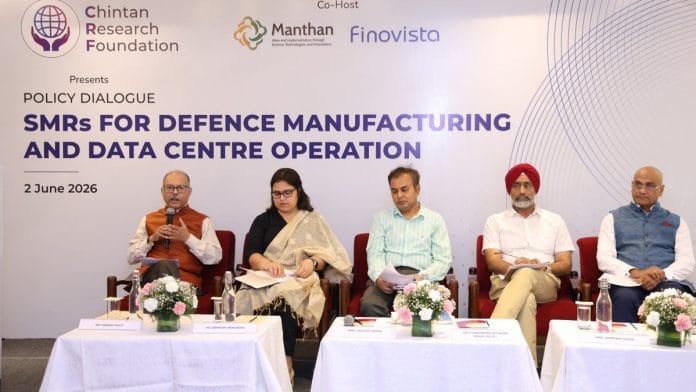


New Delhi: Nuclear energy is essential for India’s energy transition, especially for its defence sector and data centre expansion, according to a panel discussion organised by Chintan Research Foundation on 2 June at the India Habitat Centre.
The event, titled ‘SMRs For Defence Manufacturing and Data Centre Operation’, focused squarely on small modular nuclear reactors (SMRs) and their role in providing uninterrupted, reliable energy for strategic sectors such as defence, manufacturing, data centres, and industry. It brought together policy experts, government officials, academics, and private players to discuss India’s evolving energy needs.
“India’s 100 GW nuclear vision should now be treated as a strategic requirement rather than an aspiration,” said one of the panellists, Prasenjit Pal, Former CEO of NTPC Parmanu Urja Nigam Ltd, in a press release.
This year, the Indian government allocated Rs 20,000 crore for the research, design, and deployment of SMRs as part of India’s Nuclear Energy Mission. To boost the sector further, Finance Minister Nirmala Sitharaman, in her Union Budget speech in February, also announced that all goods required for nuclear energy projects would be exempted from customs duty until 2035.
Through these steps, the Indian government plans to increase nuclear energy production in the country threefold over the next decade, from 8,780 MW in 2026 to 22,380 MW in 2031-32.
But higher production is only one part of the story. Demand for nuclear power is growing too, panellists said.
Also Read: Delhi’s DEVi buses can revolutionise neighbourhood mobility. Fix frequency first
N-power for strategic sectors
Access to energy is the first step in building e-governance systems, said Rajnish Kumar, chief operating officer, National e-Governance Division, Ministry of Electronics and Information Technology (MeitY), in his keynote address. And nuclear power can support India’s transition to digital governance by helping build and sustain the necessary infrastructure.
In a similar vein, Vimal Kumar, co-founder of Finovista, a programme development agency, spoke about nuclear energy for defence manufacturing. He said that for defence and strategic requirements, the quality of power supply is just as important as the quantity.
“The deployment of SMRs in emerging defence corridors, and their precision-oriented power supply could prove transformative for mission-critical operations,” said Kumar.
Even as the panellists highlighted the need for SMRs and nuclear energy in India’s power mix, they also spoke about the challenges of deployment and scaling up.
Shishir Priyadarshi, president of CRF, emphasised the need to address questions of cost, fuel security, regulation, waste management, and safety to enable scalable SMR adoption in the country.
According to the International Atomic Energy Agency, SMRs offer a safe option for nuclear energy generation, while also allowing for a flexible mix of nuclear and renewable energy. They are also more affordable than large reactors, and can be deployed as part of a large plant, or in factories and other facilities as demand requires.
However, the technology is still new, and only a handful of SMRs are fully operational globally. Most others, in countries such as China, Russia, and Argentina, are being developed. Since India has its own indigenous concept design of SMRs, known as Bharat Small Modular Reactors (BSRs), it has a first-mover advantage, according to a policy brief by MP-IDSA.
The CRF panel discussion also highlighted the low-carbon benefits of nuclear reactors, and how the expansion of SMRs over the next decade can help India transition away from fossil fuel-based energy.
“There can be no energy transition without nuclear,” said R. Srikanth, panellist and Professor at National Institute of Advanced Studies.
(Edited by Asavari Singh)