


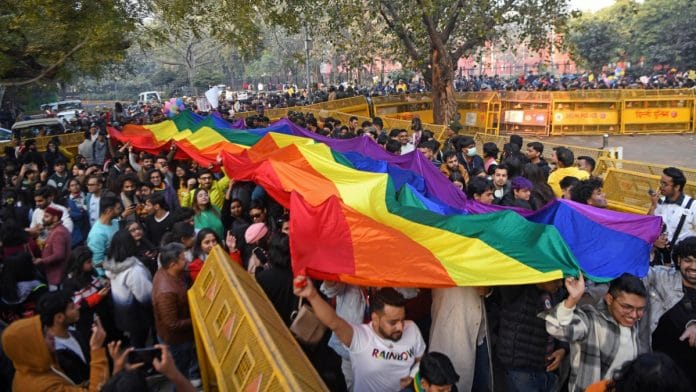
New Delhi: The Delhi Queer Pride March will not take place this November, the organising collective announced on Instagram Wednesday, citing safety concerns of the LGBTQIA+ community. The decision comes after months of discussions within the collective, the statement said.
“Keeping the current political climate, the concerns surrounding the Transgender Amendment Bill, the restrictions on spaces for public protest and, most importantly, the safety and well-being of our community in mind, the Delhi Queer Pride March will not be taking place this November,” the statement added.
Delhi Police denotified Jantar Mantar as a designated protest site on 11 October, replacing it with three alternative venues away from the central hub of the national capital. Earlier on 30 March, President Droupadi Murmu signed off on the Transgender Amendment Act, which removes self-identification of gender, narrows the definition of ‘transgender’, and adds strict penalties for “coercing” someone “to adopt or present” a transgender identity.
Delhi Queer Pride, which began in 2008, has been organised every year with the exception of the Covid-19 period and in 2025, when organisers of postponed the march. This was done after discussions with the Delhi Police regarding safety and weather conditions, and the march instead took place in February 2026. However, the DQP statement at the time made clear that the march had been postponed, not cancelled.
The announcement this time did not offer such clarification. Many in the community greeted the announcement with disbelief and indignation.
“Queer people never needed permission of others to exist and in a time like this, it’s actually more crucial for us to stand up and speak out and not take a step back,” read one comment on DQP’s Instagram post.
Organisers have now clarified that the march has not been cancelled.
“Delhi Queer Pride has been postponed, not cancelled… The collective remains committed to organising Pride when it is possible to do so safely,” DQP told ThePrint.
However, the collective also stated that the decision was not due to an inability to obtain police permission.
“Given the scale of the march… ensuring that participants can be evacuated safely in the event of violence or an emergency is a serious consideration. Police permissions also help facilitate the safe movement of marchers through high-traffic areas. Taking these factors and the current circumstances into account, the collective decided not to proceed with organising the march or seeking permission this year,” the collective said.
‘Don’t take a step back’
Yes, We Exist, a prominent LGBTQ+ rights watchdog in India, has called the postponement of Delhi Queer Pride March an act of self-censorship. Others in the community argue along similar lines.
For PB, a project manager at an NGO, the decision goes against the ethos of Pride.
“Pride was not created because we were allowed the space; we claimed it. In the face of blatant oppression, this decision is like bowing down to the oppressor, especially at a time when we have to stand in solidarity with other protests. Protests that are being led by proud members of the queer community,” she said.
The recurring note in the community’s response is that the “political climate” and “restrictions” are precisely the reasons not to postpone the march.
“We cannot keep postponing resistance until the circumstances become convenient. They may never become convenient. It is a protest, not a party,” Shreya Sardana commented on the DQP’s Instagram post.
Swaja Saransh, who performs as Avatari Devi, would like the organisers to find alternate ways to register dissent.
“Times like these definitely demand a protest more than ever before. The question is how we can adapt our methods in order to respond to the establishment, escape digital surveillance, and take care of the safety of the community. If queer folks cannot find ways to be creative with protest, bhai laanat hai phir hum pe (shame on us then),” she said.
The DQP asserts that while Pride as protest remains important, the collective cannot ignore safety.
“The responsibility of organising a march also means considering the safety and well-being of everyone who participates, particularly those who may be more vulnerable… As an open, voluntary collective, we welcome greater participation in these conversations and in the organising process,” the collective said.
For NCP(SP) spokesperson Anish Gawande, the DQP decision points to larger questions about Pride and protests in Delhi.
“The denotification of Jantar Mantar as a protest site has raised existential questions for Delhi Pride, whose traditional route has gone from Barakamba Road to Jantar Mantar. At the same time, the refusal of the Delhi Police to grant permissions for any kind of marches outside of Ramlila Maidan or the newly designated sites at Shahdara and Burari is concerning, because that means Delhi Queer Pride may no longer be able to take place in Central Delhi,” Gawande said.
Also read: What happens to neutrality when a queer person reports on their community. Ask queerbeat
‘Lives are at risk’
Sharif Rangnekar, the founder of Rainbow Lit Fest, argued that while the decision by the collective was “extremely disappointing”, it must not be vilified.
“However sad the DQP’s decision is, there is also the fact that there are lives at risk… One has to understand that the DQP is a collective that takes responsibility for all of us, not knowing what may happen. Given the pushback on protests politically in Delhi, safety is an issue. Who takes responsibility for harm that may be caused to any individual?”
He made the case for other gatherings that could be held in place of a march. Gawande, on the other hand, would like the community to look beyond the organisers and ask more from the government.
“Pride parades across the world have been cultural institutions. They have been nurtured, supported, and championed by the cities that they’re held in,” he said.
Pointing to World Pride in Amsterdam, which saw the active participation of Dutch Prime Minister Rob Jetten, Gawande argued that the administration in Delhi must do more to support Pride.
“If Incredible India has to be given a boost, then Pride parades should be supported not just by communities who have to struggle hard to secure permissions, but by cities that should earmark these routes and set dates for Pride as an active matter of public policy.”