





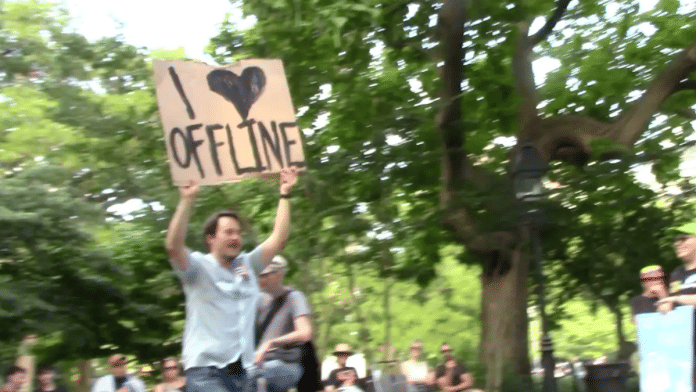


New Delhi: A week-long festival in New York is asking people to do something increasingly unusual—put away their phones and spend time offline. The Summer of Ludd, an eight-day anti-Big Tech festival held across Manhattan’s East Village and Tompkins Square Park, has brought together Gen Z, artists and activists questioning the influence of technology on work, attention and everyday life.
The festival features plays, zine-making, mending workshops, shortwave radio sessions, offline dating events and discussions on data centres, surveillance and artificial intelligence. Posters and printed pamphlets replace digital promotion, while attendees are encouraged to stay off their phones. At one opening performance, the audience of about 300 was told there would be no phones, recordings or photographs.
The event takes its name from the Luddites, 19th-century English textile workers who resisted industrial machinery they believed threatened their livelihoods. The festival’s organisers, however, are not calling for a rejection of technology. Instead, they argue that people should have greater control over how digital tools shape their lives and communities.
Welcome, Luddites!
The message appears to resonate with some members of Gen Z, the first generation to grow up entirely with smartphones and social media. A 2025 Pew Research Center study found that 48 per cent of US teens said social media has a mostly negative effect on people their age, up from 32 per cent in 2022.
Participants describe concerns ranging from loneliness and burnout to endless scrolling, algorithm-driven feeds and the growing role of surveillance and artificial intelligence in daily life.
Organisers have also linked criticism of technology to broader debates around labour, public space and corporate power, echoing the original Luddite movement’s focus on economic and social change rather than technology itself.
Andrew Maynard, a professor of advanced technology transitions at Arizona State University, told WIRED that while the historical Luddites were primarily concerned with labour, the term today describes people “pushing back against the prevalence of tech and how it pulls away from their autonomy on multiple fronts.”
Beyond the symbolism, the festival reflects a broader cultural shift. Rather than abandoning modern life, many participants say they want greater control over how technology shapes their time, relationships and attention. The Summer of Ludd turns that sentiment into a shared experience, replacing endless scrolling with workshops, discussions and face-to-face interactions. Whether the movement grows beyond a week-long festival remains to be seen, but it captures a question resonating with a growing number of young people–in a world of constant connectivity, how much of their lives should technology be allowed to occupy?
(Edited by Insha Jalil Waziri)