





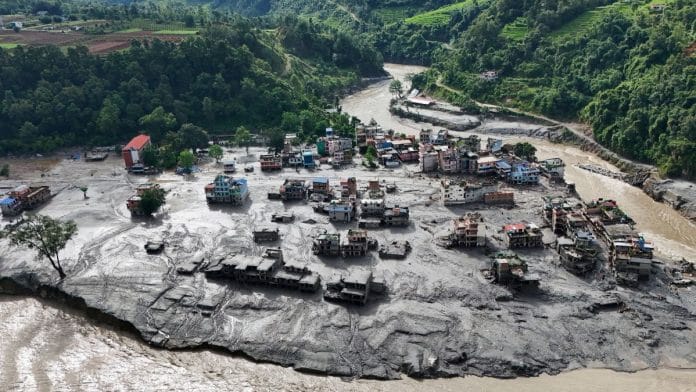

New Delhi: Nepal has estimated that it will need nearly $4 billion to $5 billion to rebuild itself after the recent ice-rock avalanche spelled disaster in the Rasuwa district and on the banks of the Bhote Koshi River. But the country is not asking for aid anymore; it is asking for “justice and compensation”.
The ripples of this demand have made their way to the United Nations Fund for Responding to Loss and Damage (FRLD), which was established at COP27 on 20 November, 2022 in Egypt. Since then, 27 partner countries have pledged a total of $822.06 million to the fund, of which only about one-third has trickled in so far.
But in the aftermath of the devastating Nepal floods that have claimed over 1,000 lives and left several more missing, some of the FRLD board members have called for an extraordinary meeting to put together money for the disaster-stricken country.
“Even if the board agrees, it will be a symbolic action. We might be able to set aside $20 million. It can’t be $5 billion, but it could provide some immediate relief for reconstructive work,” Richard Sherman, South African climate negotiator and former co-chair of the FRLD, told ThePrint.
Nepal’s demand is the first of its kind. While several countries have stressed that the impacts of climate change are experienced disproportionately across the world, this is the first time a disaster-hit nation is immediately bringing up the subject of climate compensation and calling it a “legal and moral liability”.
The Nepal foreign minister, Shishir Khanal, speaking to the local media, said that major industrial emitters like China, the US, and India have a “historical responsibility to compensate vulnerable nations like Nepal”. The statement gained significant backlash from the media, after which Khanal reissued a different statement on 4 September.
“Neither I nor anyone in the Ministry of Foreign Affairs or Government of Nepal has claimed or asked for compensation from India or any other country, including China or the United States,” Khanal told ANI. “Our call has been for the global community to look at this disaster from the perspective of climate change and the impact it’s having in Nepal.”
On Friday, India responded by calling on the developed nations to “take the lead” in reducing emissions and share technologies. “India has consistently maintained that climate change is a common challenge. India believes in common but differentiated responsibilities. Developed countries who are historically responsible for emissions must take the lead in meeting this challenge,” Randhir Jaiswal, the official spokesperson for the Ministry of External Affairs, said at a regular press briefing.
However, Sherman highlights that international bodies like the FRLD are far too underfunded. Even then, the board members are trying to help.
“Given the magnitude of the event, we urge that this request be acted upon as swiftly as possible, so the Board and Fund can provide predictability and support to the government and people of Nepal,” read a letter by several board members of the fund, addressed to the co-chairs and executive director.
Nepal bears the brunt despite minimal emissions
Across the world, it is countries like Nepal that bear the disproportionate effects of climate change. Among the top polluting countries in the world is China, which emits nearly 32 to 34 per cent of global emissions, followed by the US at about 12 per cent, and then India at 7.6 per cent. In contrast, Nepal is one of the least polluting countries and contributes only about 0.1 per cent.
Nepal was supposed to graduate from being a ‘Least Developed Country’ before it eventually decided to postpone it for at least another three years, reported The Kathmandu Post in March 2026. Even as the country cites worsening economic and geopolitical challenges, Nepal is also one of the few countries that have brought down their emissions even further in the past five years.
In FY 2024/25, over 70 per cent of passenger car imports in Nepal were electric vehicles. As part of its clean energy push, nearly all of Nepal’s domestic electricity grid is reported to be powered by renewable energy, predominantly hydropower. Yet, after the recent floods, several experts have said that Nepal will continue to experience such climate change-related disasters.
So, if the country continues to face such disasters, a meager fund is unlikely to be a long-term solution.
“The UNFCCC has a fund for loss and damage, but it is structurally, deliberately, and explicitly not a compensation mechanism. There is no admission of fault, no formula tying a country’s payment to its emissions, and no enforceable claim. Nepal’s use of the word “compensation” is therefore a political and moral framing, not a claim it can currently press through the UNFCCC’s own machinery,” Arabinda Misra, professor and dean at the TERI University, told ThePrint.
Misra further explains that while the Nepal floods “fit a well-documented warming-driven pattern”, it is too early to claim that “scientists have confirmed climate change caused this flood”.
In addition, the FRLD itself is a young body that is not yet equipped for rapid relief. The FRLD works through country-led funding requests. So far, since the fund opened to proposals, it has received an overwhelming 175 proposals from various countries affected by disasters. Even before the current floods, Nepal too had already requested funds from the FRDL board.
Initially, the board members were to convene in December 2026 to assess and allocate funds between $5 to $20 million. But now that some of them have called for an emergency meeting, the members might just meet earlier to discuss Nepal.
The long fight over climate compensation
Climate activist Harjeet Singh, global convenor of the Fill the Fund campaign and director of the Satat Sampada Climate Foundation, says he knew over a decade ago that such disasters would strike.
In 1992, when the United Nations Framework Convention on Climate Change (UNFCCC) was being formulated, developing countries tried to add in a mechanism for the kind of loss and damage that climate change would eventually cause. Later in 2007, when the issue was picked up again, people still spoke of “compensation” — a word that did not sit right with the UN.
“Because of the way the United Nations works, it did not allow the word compensation to be part of the negotiating terms at the time. But when we fought for the loss and damage fund, it happened because of the spirit of compensation, even if the terminology was not used. We see that Nepal contributes only 0.1 per cent of global emissions and faces disproportionate impacts. So this is absolutely a matter of compensation and reparations,” Singh told ThePrint.
While Singh agrees that Nepal deserves compensation, he thinks it is not ideal to name countries like China and India as ‘top emitters’ and expect them to pay up.
“The impact that we are seeing because of global warming is not because of the emissions in the last 30 to 40 years. It is because of the historical emissions of the last two centuries. So to blame current emitters like India is not fair,” said Singh, adding that India is already providing quite a lot of aid and has done so even earlier during the 2015 Nepal earthquake.
According to Singh, the Nepal floods might just be a catalyst to turn the FRLD into a more ‘rapid response fund’, because so far, the fund is filling far too slowly to make a difference.
“This is all the politics of developed countries. They are keeping the disbursement process slow because once the fund runs out of money, the pressure will be back on them to fill it again. For them, it works better if the existing money is used slowly so they get more time. That is the game,” said Singh.
Sherman explains that the “replenishment” of the fund is only likely to take place in about two years. He says that the board still has to decide what the long-term financing model of the fund is to look like. According to him, the members eventually discussed having a “fast track replenishment process” in the last board meeting.
But there are many things the fund still has to figure out, including picking which disaster or which country they should prioritise when it comes to grants.
“So if you ask any of the countries, they would say to you, but my event is immediate and urgent, and you need to help me. And so that process of prioritising is very complicated, and we have to work within the confines of very limited money,” he said.
For now, Sherman and other board members want to help Nepal. If the board agrees, then they will ask Nepal to submit a formal request and perhaps guarantee it at least a $20 million grant.
“We’re not in an ideal situation. Unfortunately, I don’t think we ever will be. It’s just, there’s no money for climate change, there’s money for war in Iran or war in Palestine or whatever, but there’s no money for climate change,” said Sherman.
Edited by Maryam Hassan