





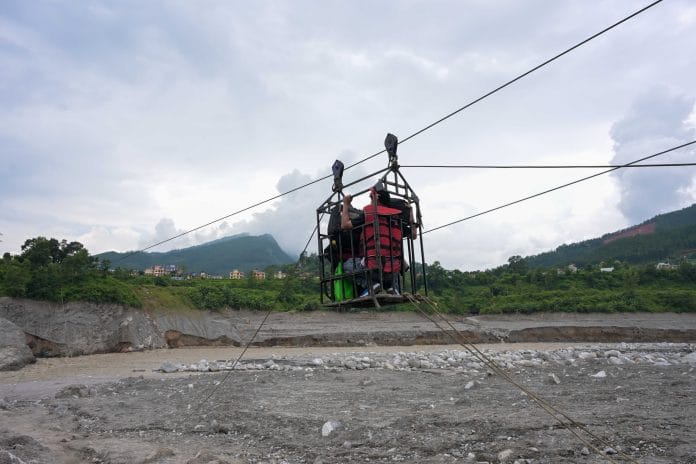

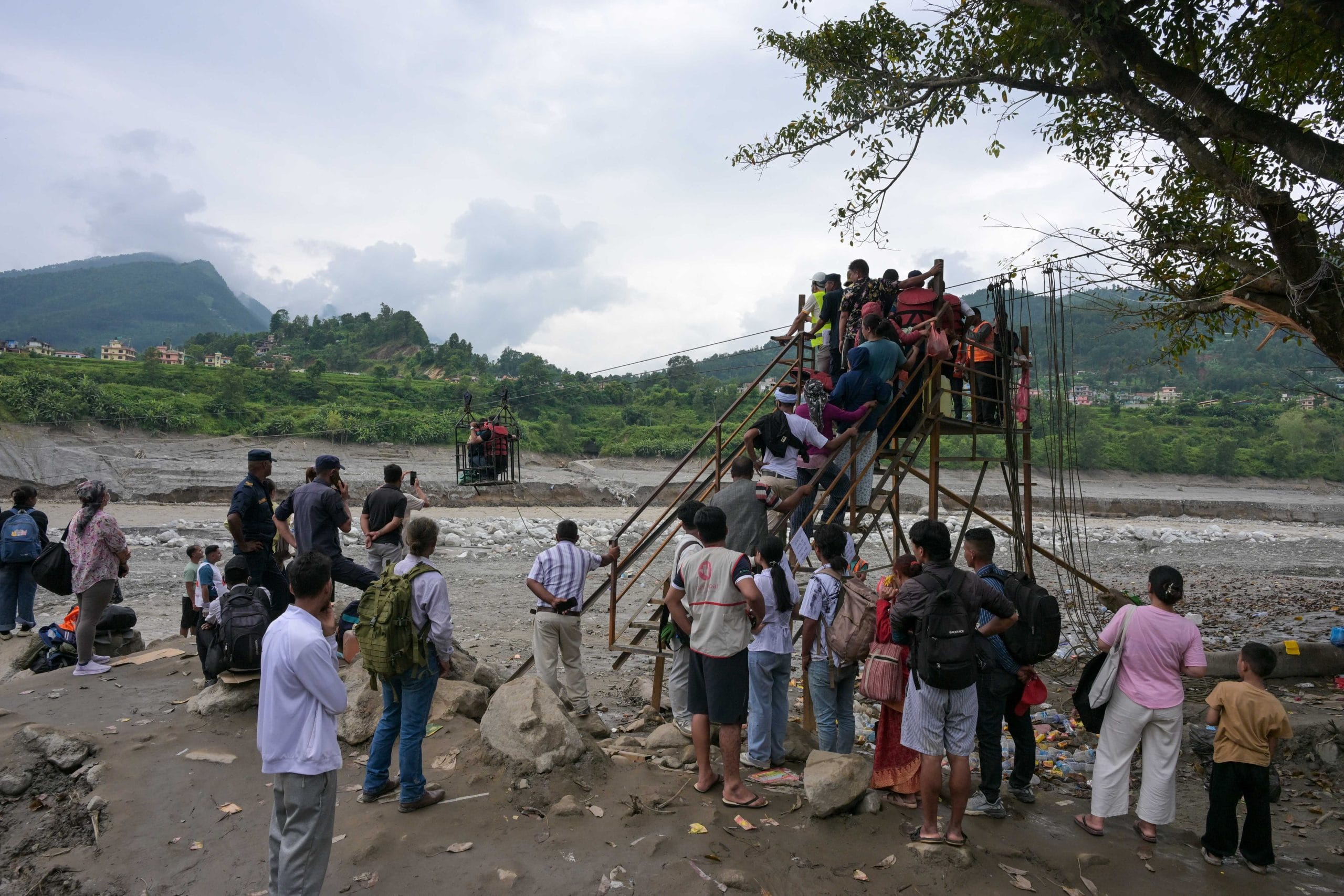
Trishuli: A journey home that used to take Vishnu Gurung 20 minutes has now taken him around 2 days. Clutching their bags, Gurung and his wife wait in line on the banks of the Trishuli River in Nuwakot, along with 100 others, for a strange mode of transport—a zipline to the other bank.
The floods of 26 August ravaged the Rasuwa and Nuwakot districts in northern Nepal, washing away entire colonies, markets, and, importantly, around 20 bridges on the Trishuli River, spread across the hilly landscape.
Since he lived in the uphill Trishuli Colony, on the east bank of the river in Nuwakot, Gurung’s house and family were safe from the devastation. Yet he and many others lost all access to the Trishuli Bazar on the other bank, and from there on to the nearest town of Bidur, and even to Kathmandu.
For the past three days, a temporary zipline had been set up by the Nepal Armed Police authorities, and now Gurung was on the other side of the river, waiting to go home.
“We have been here since 5 am, waiting for our turn to go back home on the zipline. It is now 12 pm; maybe in the next two hours we’ll get our chance,” said 60-year-old Gurung, a retired army officer.
A two-day ordeal
Gurung and his wife had woken up early on Saturday morning and walked from their house to the riverbank to take the zipline to Trishuli Bazar and then to Bidur. Usually, he would have driven his bike over the Bailey bridge that was less than 1 km from his house, and reached Bidur in 20 minutes. Now, he had to write his name on a list and wait for two hours before it was his turn.
“My daughter is here in a relief camp in Bidur as a nurse … she has been attending to the flood victims since day one,” explained Gurung. “I had to bring her some fresh clothes. She is too busy to come, and it would have taken her too long,” he added.
After reaching the other side, Gurung and his wife waited for a bus to take them toward Bidur, as the once-accessible road was now denuded with mud and silt from the floods. By the time they met their daughter, a nursing student, it was evening, and they decided to spend the night in Bidur and leave the next morning, taking the zipline back.
Gurung is just one of many residents from both sides of Trishuli, and from other upstream villages such as Kimtang, whose daily lives have been upended by the floods in more ways than one. The destruction of cell towers, bridges, and key connecting roads has impacted many civilians in Rasuwa and Nuwakot, irrespective of whether their houses were directly impacted by the floods.
Also read: ‘Hunncha’ to ‘Hare Krishna’—how two words kept hope alive in Nepal’s flooded tunnels
Getting used to a new reality
Dhanbad Tamang, a 55-year-old resident of Kimtang village, had travelled to Kathmandu on 20 August to get a medical check-up for a persistent stomach infection. After spending days admitted to a hospital there, being attended to by his distant cousin, he finally felt healthy enough to return on 5 September.
But the road he had travelled by no longer existed. He had heard about the floods, but did not know the extent of the damage until he got off the bus from Kathmandu at Trishuli Bazar and realised the bridge to his village had been washed away by the floods.
“I asked around how to get to Kimtang. I thought of going down to Devighat, but I heard that bridge was gone too,” said Tamang, carrying a backpack, sitting down on his suitcase. “Finally, I was told I could come here for the zipline.”
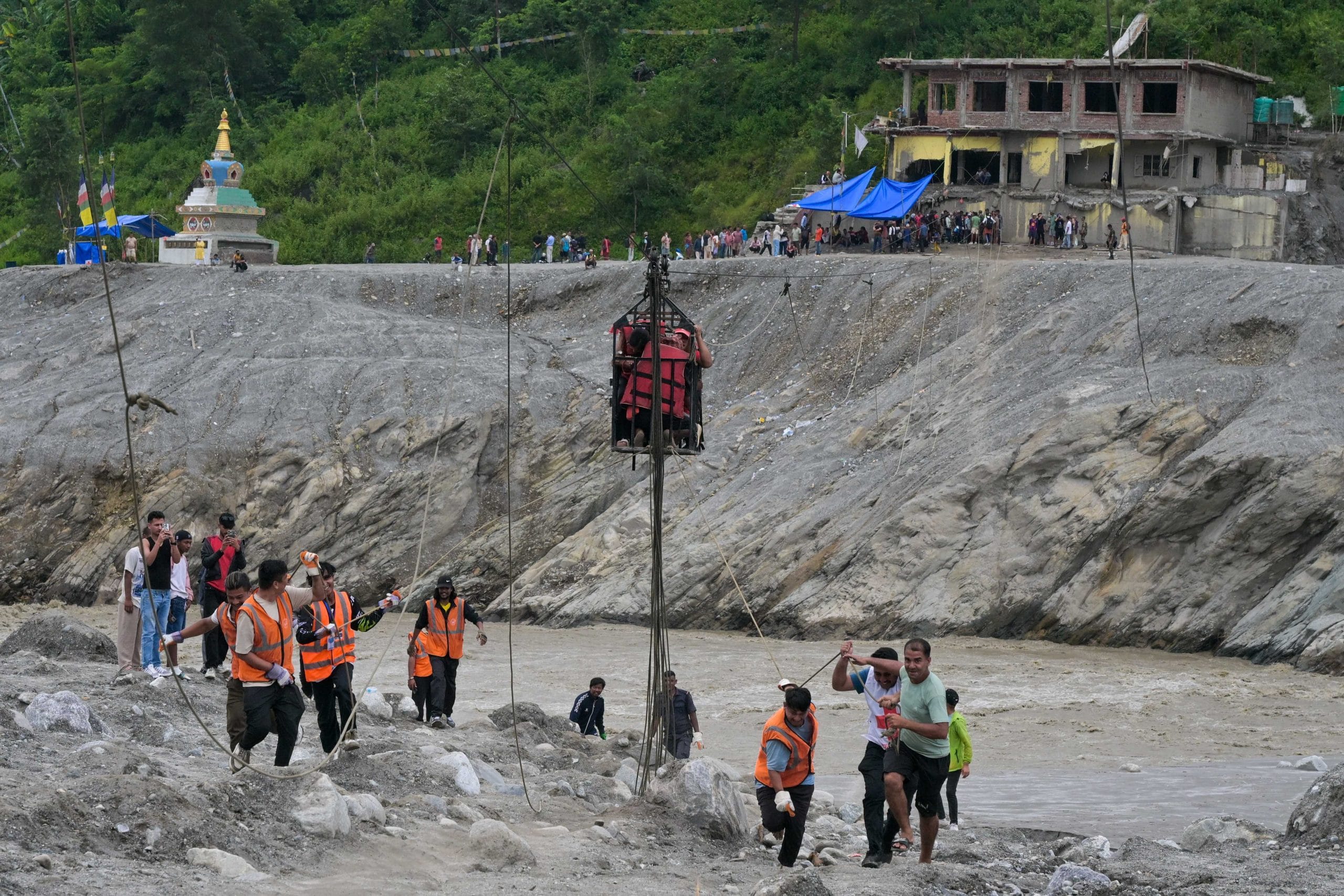
The zipline was installed on 2 September. All along the flooded regions, in Betrawati and Devighat too, similar ziplines have been installed to carry people, relief materials, and aid workers across both sides of the river, before the government comes up with a more permanent solution.
At the Trishuli zipline, the Armed Police officers are helped by volunteers from the Nepal Red Cross to manage the rocky zipline that allows two people to traverse the treacherous river at a time. Among the crowds are students, shoppers, and people returning from visiting their relatives on the other bank.
Finally, the police personnel call out Gurung’s name, and he and his wife rush forward, climb the iron ladder, and put on the lifejackets handed by the operator.
“We might have to come tomorrow to visit our uncle in Battar. I guess we should get used to the zipline now,” said Gurung.
(Edited by Prasanna Bachchhav)