





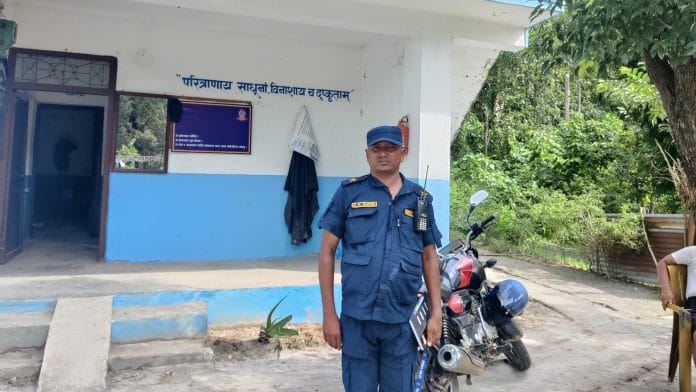

Devighat (Nepal): It’s been a week of heroism and hard recovery for police officer AK Baitha after the devastating floods in Nepal. First, he saved around 350 residents of Devighat from the surging Trishuli River. Now, he is helping them recover what they can—bicycles, cash, important documents, photographs and other belongings.
A truck laden with food and water bottles backs into the one-room police station at Devighat, as Baitha, the station house in-charge, supervises. In the inundated expanse of Devighat town in Nepal’s Nuwakot district, the police station is one of the few structures still standing after the floods on 26 August.
But even though the station itself had a lucky escape due to its geography, the 350 residents of Devighat all owe their lives to Baitha.
Last Wednesday morning, Baitha had sat down to eat his breakfast at his desk at 8:30 am, as was his routine. Barely ten minutes later, he received a call from a station officer uphill in Rasuwa, who spoke a few muffled words.
“Baadh! Big baadh coming now!” is all Baitha said he remembers hearing, and it was enough for him.
Leaving his breakfast half-eaten, he got onto his motorbike, swinging a loudspeaker at his side, and set off towards the Devighat bazaar road. He knew it was a race against time, and even as he drove, he got more phone calls from people uphill who had seen the flood and miraculously survived.
“I began announcing frantically that there’s a huge flood coming; please run to safety. The bazaar was right next to the Trishuli River, and so were many houses,” he recalled. “I directed everyone to run uphill, as far from the riverbank as possible.”
Since it was a bustling market, there were already many people opening their shops, starting their day, when Baitha’s announcement came. As they heard, most people were bewildered.
“I heard him say it’s a flood, rush to safety, but I took a second to wonder how strong the flood could actually be?” said Badri Adhikari, a 30-year-old shopkeeper from Devighat. “My shop was more than 200 m from the river; surely it would be safe?”
But Baitha, a stocky, closely cropped-haired man wearing his blue-coloured police uniform, was insistent. For ten minutes, he went to every side road, mobilised the other police officers and the young men he could find on the roads, and asked them to herd people to safety.
By this time, some people in Devighat, including Adhikari, with relatives upstream, had also started getting calls from their family members. They knew the threat was real, and decided to follow Baitha. Most of the people ran up the road towards the police station and beyond, while others went behind their houses and climbed up the mountain bordering the town.
Impact and recovery
By the time the floods crashed down the river, Baitha had herded most of the Devighat residents—around 350 to 400 people—to safety. Perched atop a hill, they watched as their homes and shops were washed away instantly. They also watched as some neighbours, who had chosen to head to the rooftops rather than uphill, were swept away by the floods.
“I tried saving as many people as possible, but even I could not have predicted the scale of what happened,” said Baitha. “Maybe if I had known sooner, I would have ensured everyone was out of their houses,” he added.
The civilians all camped at the Shree Chandrajyoti Secondary School, a few hundred metres from the bazaar, while the injured were taken to an Ayurvedic Medical Centre nearby. Now, a week into the floods, Baitha still stays at his police post, ensuring that the residents uphill get enough to eat, and that the rations coming in from the government and multiple NGOs are accounted for.
Now and then, residents would wander into the town, trying to search for their belongings and salvage what remained from the floods. Before relief teams from the UN and Nepal Scouts and Guides arrived, Baitha would himself accompany the people inside.
“Most of them want their important documents, some cash and gold. Many take photographs of their family and friends,” said Baitha, as he handed out water bottles to a group of residents in the relief camp. “Yesterday, a boy came searching for his bicycle. I went with him and rescued it from inside the house.”
(Edited by Prashant Dixit)