





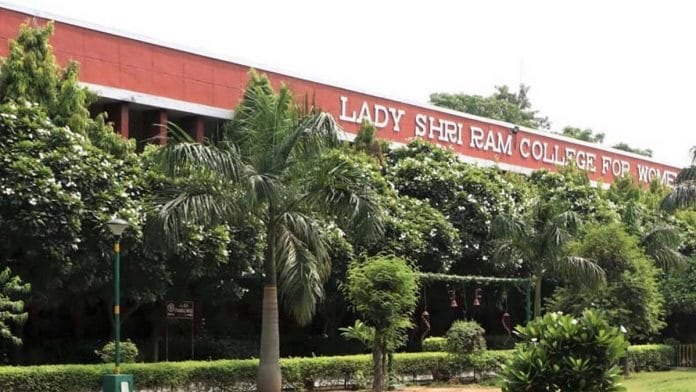


New Delhi: A day after protests over Lady Shri Ram College’s principal, Kanika Ahuja’s appearance in a BJP social media video, students have alleged surveillance and intimidation by the college administration.
“Members of the administration have been wearing Ray-Ban Meta glasses to record us. Parents have been receiving calls — mine too received a call yesterday. They told them to ask me to stop protesting if they want to avoid disciplinary action,” a second-year student told ThePrint on condition of anonymity.
Another third-year student alleged restrictions on movement during the protest. “The principal spoke to us for 5 minutes yesterday. She had promised we would resume discussions after her 4 p.m. meeting today. We were waiting for her, but she left the premises without speaking to us. The college gates were locked, and we were stopped from exiting until after she left — we were effectively locked inside the campus,” she said.
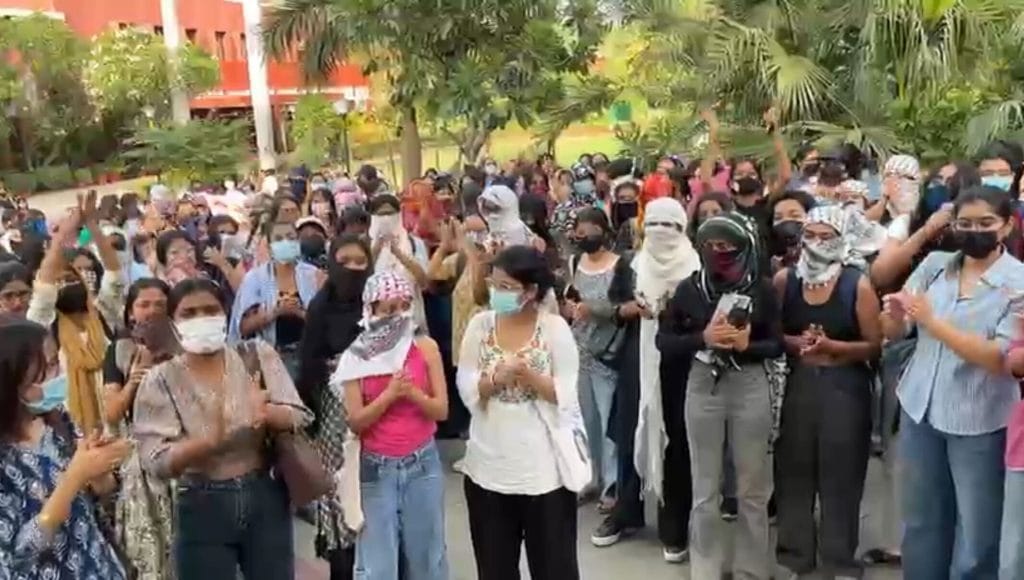
Students also claimed that CCTV cameras were installed inside the campus shortly after the protests began, prompting many to cover their faces. “It took them two hours after the protest started to put up CCTV cameras inside the college,” a student said, pointing out that earlier demands for cameras at the college gates — where harassment by men has been a recurring concern — were declined by the administration, citing a lack of funds.
In clear contradiction
The allegations came alongside a detailed public statement issued by the student body, marking the latest development in the controversy triggered by an official BJP video in which Ahuja was spotted on 13 April.
In the statement, students said the protest had been widely “mischaracterised as opposition” to the Women’s Reservation Bill, formally titled Nari Shakti Vandan Adhiniyam, which is currently under discussion in Parliament.
“This protest was not against the Women’s Reservation Bill, as has been widely assumed. It emerged in response to a video featuring the Principal of the college being posted on the official Instagram page of BJP4India,” the statement read.
Students argued that the principal’s appearance on a political party’s platform stood in “clear contradiction” to LSR’s stated position of being “apolitical”—a stance the college has often invoked to restrict student-led political activity on campus.
“Regardless of whether the content was framed as support for women’s empowerment, the platform on which it was delivered is explicitly political,” the statement added.
According to students, the principal told them during Wednesday’s brief interaction that the video had been recorded for the Ministry of Women and Child Development and uploaded by BJP4India without her consent. However, they questioned why she had not taken steps to have it removed.
They also took issue with her statement to The Indian Express (16 April), where she said she was participating in a “personal capacity”.
“This distinction is untenable. She appeared in the video, identified as the Principal of LSR. When one occupies a position of institutional authority, statements made on public political platforms cannot be meaningfully separated from the institution itself,” the statement said.
Students also questioned the claim that the video was part of an “intellectual discussion”, noting that it was circulated through a political party’s social media platform rather than an academic forum. They also pointed out that the Bill’s draft was not publicly available at the time, making “substantive critical engagement questionable”.
Also read: Delhi University is crumbling. And it has united NSUI, ABVP, AISA
Part of a pattern
The principal called the protest “unconstitutional” and referred to students as a “mob”, according to the statement.
“The protest was a peaceful assembly of students within campus spaces, raising legitimate questions about institutional accountability. Labelling such dissent as unconstitutional delegitimises students’ right to question administrative actions,” it said.
The student body has issued a set of demands, including immediate removal of the video, “full disclosure” of any communication between the administration and the political party, and a commitment to “non-partisan engagement”. They also called for an end to what they termed the “communalisation” of campus spaces, deletion of images of protesting students taken without consent, and an assurance that “no student will face disciplinary action” for participating in the protest. They have also sought a formal reaffirmation of the institution’s commitment to “secular and democratic values”.
Framing the incident as part of a broader pattern, students pointed to protests in September 2025 over a lecture by retired diplomat Deepak Vohra, which they had described as “misogynistic” and “derogatory”.
“It is not just about this particular protest but about a series of things that have been happening,” a second-year student said, alleging that “pro-government speakers are repeatedly being called to the college premises” and that attendance at such lectures is often enforced.
“When students say they’re being made to attend ideologically slanted lectures with mandatory attendance, that is shocking to me. It’s a real departure from what I experienced, and it reflects how much the tolerance for student dissent has shrunk,” said activist and author Gurmeher Kaur, who was part of the 2016-2019 batch.
Apart from how protesting students are being treated, Kaur said she’s also concerned about the takeover of academic spaces by Hindutva forces. “Both say something about how the BJP-RSS views women.”
“When I was at LSR and running a campaign against ABVP violence on campus, the faculty stood by me publicly when I had received death and rape threats by ABVP and BJP members and supporters. LSR felt like a place I could be safe both physically and emotionally. The fact that the same institution is now calling its students a mob — that’s not just disappointing. It genuinely breaks my heart,” she added.
(Edited by Ratan Priya)