



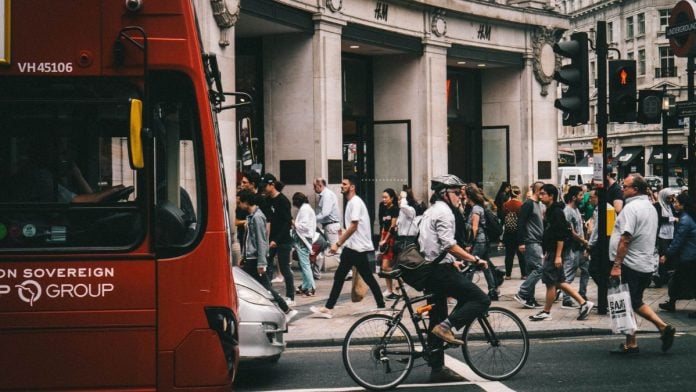
New Delhi: Oxford Street became traffic-free on Monday, but cyclists continued riding along the newly pedestrianised stretch despite security staff asking them to dismount. Around seven security personnel stationed near Oxford Circus could be heard calling out to cyclists to get off their bikes.
From 26 October, nearly a kilometre of Oxford Street, between Selfridges and Great Portland Street, has been closed to traffic. Buses, taxis, private hire vehicles, bicycles, e-bikes, e-scooters and pedicabs are no longer allowed on this stretch.
The restrictions mark the first phase of a £150 million plan to transform one of Britain’s busiest shopping destinations into a more pedestrian-friendly public space. The plan aims to make shopping more pleasant, attract more visitors, and revive a street facing growing competition from online shopping and retail parks.
“By choosing to be imaginative and bold, we can deliver a better future for Oxford Street, a cleaner, traffic-free and truly accessible world-class public space,” Mayor of London Sadiq Khan said in a statement published by City Hall in October 2025.
Also read: The Social Reckoning pulled down from 2,000 theatres to 619 after box-office flop
No exemption for bicycles, scooters
Buses and taxis have been a regular sight on Oxford Street for decades. Their removal means commuters and visitors will have to use nearby roads or walk along the shopping street.
Transport for London (TfL) has diverted bus services onto surrounding roads, including Wigmore Street. Some routes will serve new stops on Wigmore Street, Henrietta Place and Cavendish Place, while alternative bus stops are generally around 200 metres from the pedestrianised area.
Taxi ranks have also been relocated to nearby streets, with ranks available within approximately 100 metres of the traffic-free section. Underground and Elizabeth line services continue to operate as usual.
Unlike some pedestrianised areas where cycling is permitted, Oxford Street’s new rules prohibit bicycles, e-bikes and e-scooters throughout the restricted stretch. Mobility scooters and emergency vehicles are still allowed on the street. Delivery and service vehicles can enter through designated routes between midnight and 7 am.
The scenes near Oxford Circus show that enforcing the new rules could be a challenge.
Some concerns diverting traffic could lead to more congestion, noise and pollution on nearby streets. Westminster City Council has previously raised these concerns.
A long standing debate
Oxford Street’s pedestrianisation plan has been debated for years. Sadiq Khan first proposed it in his 2016 mayoral programme, but an earlier plan was dropped after Westminster City Council withdrew its support. The proposal was revived in 2024.
A public consultation in 2025 received 6,642 responses. According to City Hall, 66 per cent of those who answered the question on pedestrianisation supported making the street traffic-free.
An earlier trial offered some indication of how the change might affect shopping. During a traffic-free event on 21 September 2025, the number of visitors was 45 per cent higher than the previous week. A survey by New West End Company also found that 67 per cent of Oxford Street stores reported sales that were similar to or higher than on a typical Sunday.
Further work is planned for 2027, including adding more seating, trees, plants and public spaces. The initial phase will help shape the final design and determine whether the traffic-free zone should be extended to the rest of Oxford Street.
(Edited by Janaki Pande)