



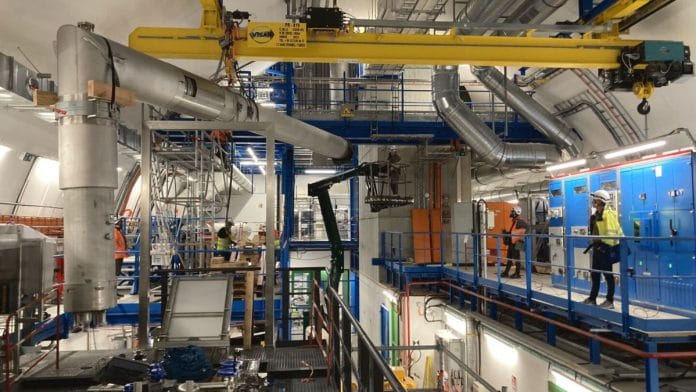

CERN/Geneva: The world’s most powerful particle accelerator, the Large Hadron Collider at the European Organisation for Nuclear Research, CERN, is going to shut down for three years. This is the time that the organisation will be upgraded to significantly boost its collision capacity and its ability to unlock possible clues on dark matter–one of the greatest mysteries of the universe.
The Large Hadron Collider or LHC—the world’s largest proton accelerator that pushes protons or ions to near the speed of light—will be opened again by the end of 2029 after it shuts down this week.
“The idea behind the shutdown is to increase the luminosity, which is basically the total number of collisions produced over a given period, by a factor of 10 compared to the LHC,” Indian origin experimental physicist and a principal staff scientist at CERN, Archana Sharma, told ThePrint. “It is the same collider, but with upgraded magnets, cavities and luminosity. Ten times more collisions, which means an increased production of particles that we are looking for.”
The facility will be renamed as High Luminosity LHC (HL-LHC) when it reopens in 2029. The upgraded LHC will be capable of 140 to 200 collisions each time two packets of particles meet inside the detectors in the tunnel, up from the current 60 collisions.
The LHC consists of a 27-km ring of superconducting magnets with several accelerating structures to boost the energy of the particles along the way. The facility is famous for the discovery of the Higgs boson, dubbed the ‘God particle’.
The LHC’s tunnel, which is a facility about 100 metres below ground level, has superconducting magnets and accelerating structures that propel particles to extreme energies and collide them with each other at immense speeds.
Also read: Cat brains might help scientists study dementia and Alzheimer’s
Future course
As the LHC is set for the long shutdown, the air in the CERN campus is thick with heavy reminiscence and excitement about what the future holds. Scientists say that the upgrade will bring a new era of scientific discoveries, which is set to advance particle physics to new and undiscovered dimensions.
Representatives from the CERN media cell told ThePrint that the total cost of the LHC upgrade is likely to be around $1.5 billion. The process will consist of replacing components in 1.2 km of the 27-km tunnel. The advanced superconducting magnets, which are designed to increase the number of collisions in the collider, will also further concentrate the particle beam. More collisions mean there will be several times more data to be studied.
Tapan Nayak, experimental physicist and outreach coordinator, ALICE Experiment, said that over the years, the data generated by LHC will enable a broad physics programme ranging from precision studies of the quark-gluon plasma (a hot and dense state of matter where protons and neutrons melt) and hadronic interactions.
“The work at CERN is not going to stop in the meantime. We are just going to be preparing for much more advanced experiments,” Nayak told ThePrint.
(Edited by Ratan Priya)