



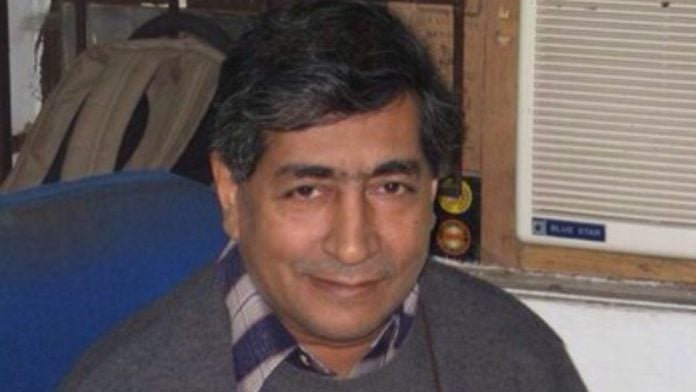
After communal violence tore through Gujarat in 2002, Kamal Mitra Chenoy warned that the assault on secularism was an assault on democracy itself. For the political scientist, who spent decades documenting communal violence, challenging majoritarian politics and defending minority rights, Gujarat was a warning about the kind of nation India risked becoming. Chenoy, who entered JNU as a student in 1972 and retired as a professor in 2018, died in Delhi on 10 October at 75.
“The all-out assault on secularism is not merely against tolerance; it is against democracy itself and the very basis of a pluralist India,” Kamal Mitra Chenoy wrote in 2003, after the 2002 Gujarat violence.
For Chenoy, secularism meant challenging the idea that a religious majority constituted a single, homogeneous community. India’s diversity, he argued, lay not only in differences between religions but also in the divisions of caste, class, gender, language and region within them. Democracy, in his view, had to recognise that diversity and protect minority rights.
His commitment to fighting communalism had a personal turning point. In an account published in 2014, Chenoy recalled moving around Delhi on 1 November 1984, with the help of a friend in the press, amid the anti-Sikh riots that followed Indira Gandhi’s assassination. He remembered residents guarding their homes against “alleged well armed Sikhs”, amid rumours that water supplies had been poisoned.
“After this traumatic experience, I vowed that I would fight communalism,” he wrote.
He pursued that commitment through fact-finding missions and people’s tribunals, travelling to places including Meerut, Ayodhya, Gujarat and Muzaffarnagar after episodes of communal violence. His work involved documenting what had happened, meeting survivors and challenging accounts that obscured the responsibility of those in power.
JNU professor Anuradha Chenoy and Kamal Mitra’s wife said her husband was diagnosed with fast-progressing Alzheimer’s disease in 2020. The Covid-19 pandemic worsened his condition.
Born in 1950, Chenoy’s route to academia was not straightforward. A student at Doon School, he briefly joined the Indian Military Academy in Dehradun before leaving after three months. He realised that literature and poetry held him more strongly than military life.
In 1969, he enrolled at Delhi University’s Kirori Mal College to study economics and entered student politics. He moved towards the Left and was associated with the All India Students’ Federation (AISF), the students’ wing of the Communist Party of India. When he joined JNU in 1972, campus debates became an important part of his intellectual formation.
In a 2014 first-person essay, Chenoy recalled that after he joined JNU in 1972, Trotskyist Jairus Banaji challenged the SFI–AISF alliance with references to Marxist classics, literature, philosophy and social science. “Because of this challenge all of us had to do our readings,” he wrote.
He went on to teach comparative politics and the Indian Constitution at JNU’s School of International Studies (SIS), retiring in 2018. For him, teaching and political engagement were inseparable. Beyond the classroom, Chenoy wrote on political economy, democracy and sustainable development. In the run-up to the Mahatma Gandhi National Rural Employment Guarantee Act, passed in 2005, he travelled for 53 days by bus with economist Jean Drèze and activist Annie Raja to build support for employment guarantees. He also served on the core committee of the 2004 World Social Forum in Mumbai, which brought together activists from across the world.
His politics remained restless. After four decades in the Communist Party of India, Chenoy joined the Aam Aadmi Party in 2014, hoping to support a political formation connected to social movements and committed to opposing communalism. He eventually left that party, too.
Explaining his departure from the CPI, he wrote: “I am capable of many mistakes, but seeking political power at any cost is not one of them. I wish all secular forces all the best. I will remain left and my ideology will not change.”
An old college friend, journalist Anand K Sahay, remembered Chenoy as “a gently romantic chap”, a poet and revolutionary who could quote poetry and great literature. His humour, Sahay recalled, was subtle and soft, though occasionally earthy. Later, Chenoy travelled across the country for people’s enquiry commissions and tribunals, carrying his arguments beyond university seminar rooms.
His 2003 essay warned that defining India through a single religious identity could undermine the pluralism on which its democracy depended. Chenoy spent much of his life trying to resist that outcome, not only through scholarship but also by documenting violence, standing with protesters and teaching generations of students to question political power.
For him, secularism was not a concession to minorities. It was a condition for a democracy in which no citizen had to prove that they belonged.
(Edited by Prashant Dixit)