




New Delhi: Jodie Foster had stopped eating. The 15-foot reticulated python, named after the Hollywood star, was becoming increasingly inactive, and vets soon found the reason to be a malignant tumour that was eating into her jaw.
When the cancer returned after surgery, her veterinary doctors tried something that had never been done on a snake before: adapting a human cancer treatment. The 50 kg python, who lives at Chester Zoo in Cheshire, England, is believed to be the first snake in the world to receive electrochemotherapy, a treatment that uses controlled electrical pulses to help chemotherapy drugs penetrate cancer cells.
Working with cancer specialists at the University of Liverpool, Chester Zoo’s veterinary team adapted the procedure for Jodie after the cancer returned.
“When the tumour came back and started destroying part of her jawbone, we knew more surgery on its own probably wasn’t going to be enough,” said Ian Ashpole, veterinary officer at Chester Zoo. “We were facing the possibility of losing her as the tumour made it more and more difficult for her to eat.”
A remarkable procedure
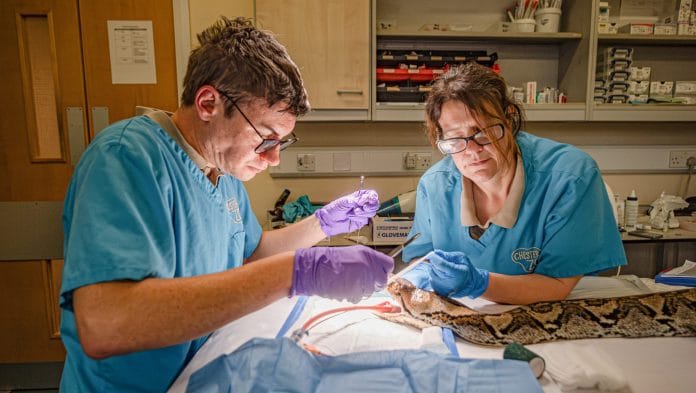
Zookeepers first became concerned when Jodie began eating less and spending more time inactive in her habitat. Tests showed that she had fibrosarcoma, a malignant tumour, in her jaw. Now, the team has decided to combine the python’s second operation with electrochemotherapy. Ashpole removed the tumour and part of Jodie’s diseased jawbone in a 90-minute procedure. The chemotherapy treatment was then used to target any cancer cells that might have remained.
The procedure required some improvisation. There was no operating table large enough for a 15-foot python, so the vets joined two tables together, effectively creating one the size of a double bed. Jodie was kept warm with heated blankets and warmed air during the operation to maintain her body temperature.
“After 90 minutes of surgery, she recovered remarkably quickly,” Ashpole said.
Electrochemotherapy combines the cancer drug bleomycin with controlled electrical pulses delivered to the tumour site. The pulses temporarily make cancer cells more permeable, allowing the drug to enter them more effectively.
For Jodie, the treatment appears to have worked. Months after the procedure, she is eating normally and back in her habitat at Chester Zoo. Staff said she can still strike, grip, and swallow food without difficulty despite having lost part of her jawbone.
A final check this week found no signs of the cancer returning. “Seeing her back to her normal bright and feisty self has been incredibly rewarding. A few months ago, we genuinely didn’t know whether she’d survive,” Ashpole said.
Also read: Kangana Ranaut vs Sharmila Tagore on Vande Mataram. Which version to sing?
Back to swallowing chickens whole
Jose Alvarez Picornell, from the University of Liverpool’s Department of Small Animal Clinical Science, said the procedure was the first time electrochemotherapy had been used on a snake, as far as the team was aware.
“Electrochemotherapy is an emerging treatment, and this was the first time it had been used in a snake,” he said, describing Jodie’s recovery as “a testament to the power of collaboration”.
The team plans to formally publish details of the procedure so veterinary specialists around the world can study and build on the approach.
Jodie, who has just turned 23, arrived at Chester Zoo 20 years ago. She was named after Hollywood actor Jodie Foster after keepers noticed her paperwork was marked “JF”, shorthand for “juvenile female”. Reticulated pythons are native to Southeast Asia, including Indonesia and Malaysia. They are non-venomous and kill their prey by constriction before swallowing it whole.
Jodie is now back to her usual routine, including swallowing thawed chickens whole.
(Edited by Prasanna Bachchhav)