



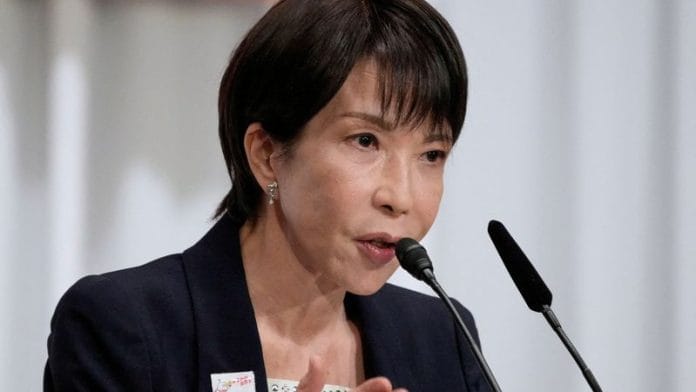
New Delhi: Japan’s first woman prime minister, Sanae Takaichi, has sparked debate after saying that household chores and makeup add three to four hours to her daily routine.
“In the morning, I bathe, fix breakfast and then wash dishes, not to mention apply makeup,” Takaichi told parliament on Wednesday. “I feel like I’m spending three or four more hours than male prime ministers doing these things.”
Her remarks sparked debate over women’s responsibilities at home and Japan’s long working hours. While some questioned her limited time for parliamentary duties, others highlighted the extra burden of housework and expectations around women’s appearance.
Takaichi, who took office in 2025, is Japan’s first woman prime minister. Her remarks have drawn attention to a wider problem in Japan, where women continue to do more housework than men, even when employed.
Japan’s Statistics Bureau, in its 2021 Survey on Time Use and Leisure Activities, found that women spent an average of three hours and 24 minutes a day on housework and related activities, including childcare, nursing and shopping. The corresponding figure for men was 51 minutes. The survey showed that the gap had narrowed since 2001, but remained substantial.
The burden is particularly noticeable among parents of young children. According to Japan’s Cabinet Office, in 2021, wives accounted for 77.4 per cent of housework-related time in households where both parents of children under six were employed. The figure rose to 84 per cent when the wife was not employed.
The Associated Press reported that her comments attracted criticism from people who argued that women raising children or caring for elderly relatives often face heavier demands. Lawyer Fusako Miwa, commenting on social media, questioned the use of makeup as an explanation for the prime minister’s schedule.
Also read: 54% air travellers going home for Diwali are paying 50% more than in 2025, finds survey
‘Tough to find time for planning’
Takaichi’s remark came amid questions about the long hours Japanese prime ministers spend in parliament and whether they have enough time for strategic thinking.
A report by the NXJI Research think tank, cited in Japanese media, compared parliamentary attendance by national leaders in 2022. It said Japan’s prime minister attended parliamentary sessions on 72 days, compared with 50 days for Britain’s prime minister and 13 for Germany’s chancellor. The figures have been raised in discussions about whether Japan’s parliamentary schedule needs reform.
Fumitake Fujita, a senior official of the Japan Innovation Party, a partner in Takaichi’s governing coalition, suggested reducing the hours ministers spend in lengthy parliamentary sessions. A proposal discussed in this context also called for cooks and other household staff at the prime minister’s official residence, allowing the leaders to focus on government business and get adequate rest.
Takaichi has previously described herself as a workaholic and said that she sleeps only a few hours a night. Speaking in parliament on 14 October, she acknowledged the difficulty of finding time for long-term planning.
“I do enjoy reading them late at night,” she said of the documents she takes home. “Honestly, I feel it is not easy to squeeze out time to sit down and think about the future direction of Japan or have a grand vision.”
Takaichi’s appointment is historic, but women remain under-represented in Japanese politics. They won just 68 of the 465 seats in the lower house in the February 2026 election, accounting for 14.6 per cent of the chamber, according to the Inter-Parliamentary Union.
(Edited by Aamaan Alam Khan)