






New Delhi: When Faizan Ali Khan made it to the first waiting list for admission to the MA Gender Studies programme at Jamia Millia Islamia, he was confident of claiming a seat. But it didn’t happen, even with a rank of 12. And those ranked below him, he said, got selected.
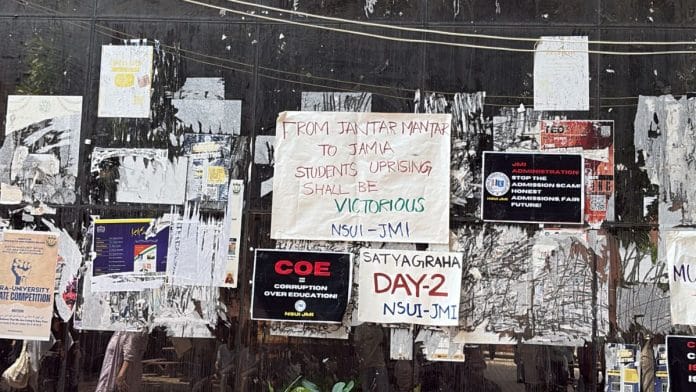
Khan is among several students at Jamia who have alleged irregularities and corruption in the spot admissions process this year, which is taking place in offline mode for the first time. The allegations have sparked protests on the campus, with students demanding transparency in seat allocation.
This comes as the country witnesses student unrest in different regions over issues ranging from poor school infrastructure and paper leaks to student suicides. At IIT Delhi, students have been staging a sit-in demanding justice for Rishikesh Kumar, a second-year MSc Physics student from Patna, who died by suicide on 22 August on the campus.
At Jamia, students claim that changing the mode of spot registrations to offline allowed the university to give seats to those outside the published waiting list order. Jamia released the first notice for offline spot registrations for 2026-27 on 31 July, indicating vacant seats in various programmes.
Spot registration is a process through which a university fills those seats that are left vacant after the completion of regular counseling. It is the final step in the admission process, where seats are allocated strictly on the basis of residual merit order.
Students at Jamia claim that the spot registration this year is plagued by irregularities, which has left them confused.
Insha Rehmani, who appeared for the BEd entrance examination, has written to Jamia’s Controller of Examination, claiming a discrepancy in seat allocation. Insha said she ranked 4th in the Muslim category waitlist and 1st in the Muslim OBC list, yet a candidate ranking 5th in the Muslim category was granted a seat under the general category.
“The candidate with higher merit should be given preference over candidates with lower merit, irrespective of the category in which they are admitted,” she wrote.
The National Student’s Union of India (NSUI) is leading a sit-in protest against such irregularities at gate number 20 of the university. “Where are our seats going?” asked one of its members.
NSUI members and other students have camped there since 5:30 pm on Monday, demanding that the administration release a full transparent account of what really happened during spot admissions. They want to know how the seats were allotted, with some asking why those ranking high on the waiting list could not get a seat.
Students say the alleged irregularities amount to a failing on the administration’s part. Protesters claim that the administration has dismissed this as a clerical error.
“This is corruption,” said Arshad Abdul Hakeem, an NSUI member and student enrolled in the MBA programme at Jamia. “They are playing with the lives of future students and taking money for seats”.
Also read: IIT Delhi students question ‘pattern of suicides’. Demand resignation, justice for Rishikesh
Abrupt changes
But the protest is not limited to irregularities in spot registration, students are also claiming that the university is denying J&K residents and Kashmiri migrants the seats that are reserved for them.
One student said that in the list of students selected for BArch, eligible J&K students were not allotted seats, even when the waiting list for the course had several J&K students seeking admission.
The students at the protest site are calling for accountability, asking why J&K residents are not being admitted when the university reserves two seats each for them in every programme.
Sahil, secretary of NSUI’s Jamia unit, pointed to a third change in this year’s admission cycle — interviews for certain courses, including BA LLB. This, he said, adds another layer of assessment on top of the common entrance test. The interview stage, Sahil argued, puts students from Jammu and Kashmir at a greater disadvantage, especially because they come from institutions with far fewer opportunities.
“If they add interviews to courses at random, how will I be able to speak in front of a panel of professors? I am from Kashmir and away from the internet, I do not have as much exposure as students who went to CBSE schools. I went to a government school. How can I compete with them? My English is not that good either,” Sahil, who is also from Kashmir, told ThePrint.
Jamia’s Chief Proctor, however, has a very different version of events at Jamia. He claimed that the students’ demands have been met.
“We were at the protest site till 3 am this morning. We have been talking to the students and their demands have been met. But they are choosing to protest because the DUSU (Delhi University Student Elections) are near. And they are being told by the top order to create political disturbance on the campus, to gain traction,” said Mohammad Asad Malik, the Chief Proctor of Jamia Milia Islamia.
Jamia’s ‘saffronisation’
Besides the irregularities and abrupt changes in the admission process, students say that Jamia’s “saffronisation” is near complete. They say that Yuva Morcha, the BJP’s youth wing, often gets permission to host events on the campus while other student bodies face scrutiny when they plan peaceful assembly or even reading circles.
“They want to make Jamia the new Sangh Pathshala,” said Arshad Kareem.
Jamia’s Vice Chancellor, Mazhar Asif, made headlines in April for attending an RSS-organised Yuva Kumbh event, held at JMI’s Faculty of Engineering and Technology auditorium.
But it was not just his attendance that sparked the controversy, but also what he said there: “Looking at everyone seated here, I do not believe that everyone shares the same mother tongue, upbringing, or culture. Geographically speaking, and I am stating this in a geographical context, they may not even hail from the same region. Their religions, too, may differ.”
He then continued, “Yet, despite all this, we remain Indians. We are Indians because the DNA of Mahadev resides within our own DNA”.
For now, the students have no intention of ending the sit-in, and the NSUI has issued a wider call to protest.
(Edited by Aamaan Alam Khan)