





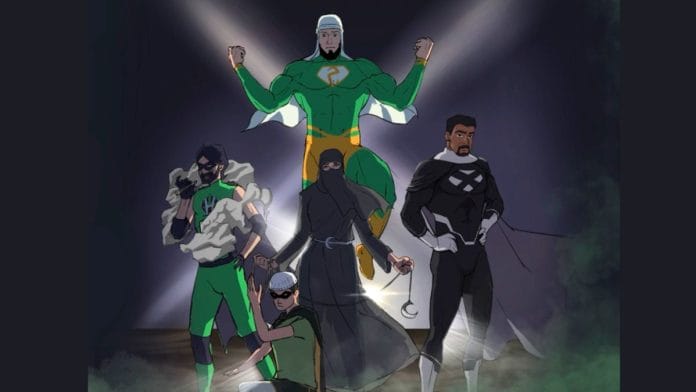


New Delhi: Up in the sky! Look! It’s a bird! It’s a plane! It’s Musalman!
What does a Muslim superhero look like in the current political climate in India? The answer is not a brooding, Batman-esque vigilante or a symbol of suffering. Instead, it is a bearded figure in a bright green bodysuit with a ghutrah-like headscarf called a ‘skullcape’. His chest is emblazoned with the Urdu alphabet M, stylised to look like an inverted S. He takes on supervillains, lynch mobs, and media frenzy—not with violence, but with wit, absurdity, and a refusal to play by the script.
Created by Bengaluru-based journalist, writer, and stand-up comedian Falah Faisal, Musalman Comix and its eponymous superhero show what representation looks like in a space where Muslims are seldom allowed complexity or the freedom to step outside a narrow, orthodox or violent narrative.
Faisal describes Musalman—which he pronounces Musal-Man—as “India’s first Muslim superhero” in a “nation gripped by Islamophobia”. He’s the alter ego of a left-arm pacer, born amid communal riots, and destined to challenge and defeat the ruthless Taana Shah.
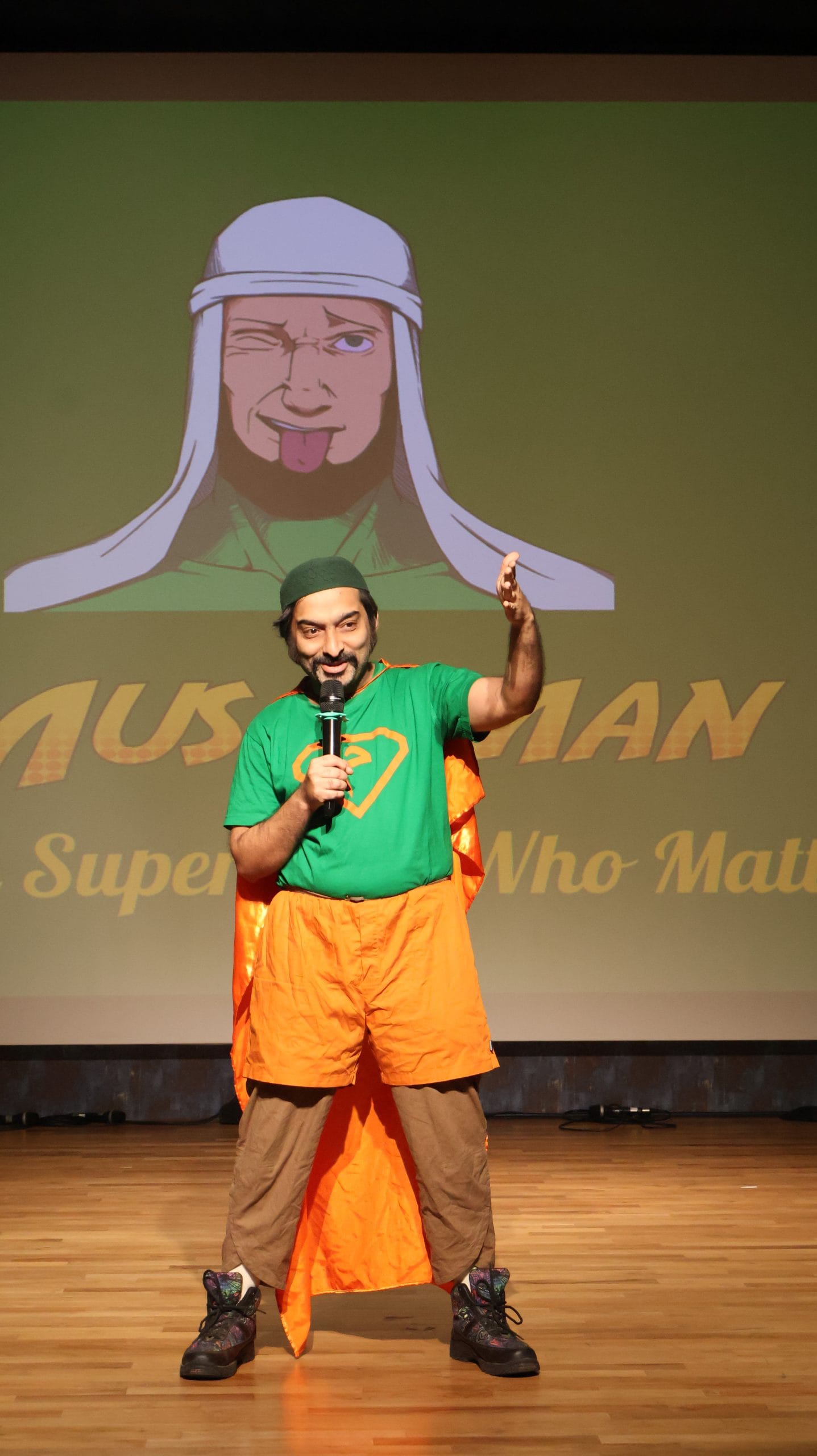
The series, which began as an online series in 2017, manifested as a physical graphic novel in March 2026 and was published by Yoda Press. The book also received an endorsement from Indian writer and poet, Jerry Pinto on Instagram who called Musalman ‘one of the wildest, wackiest, and funniest comics’ he’d read in a while. He said it ‘packs a powerful social punch.’ The print copy signalled a growing audience and a deepening of Faisal’s storytelling universe. But it was not always this way.
Also read:
Inventing Musalman
Faisal started Musalman Comix in 2017 as an alternative to the overwhelming negative portrayal of Muslims in the media. It was just online, available on webcomic portal Bakarmax and Instagram.
“Initially, Muslaman didn’t have a set plot or an arc. It was just scratchings on the wall, with just four to five frames. There was no set villain, just an arbitrary system. The initial comic strips showed Musalman as a provocateur solving problems with satire,” he said.
He pointed to the media’s ‘jihad’ obsession as the starting point of Musalman.
“The intent of every piece of media was to be divisive. They invented a new jihad every week. So I thought I could go and give them Comic Jihad,” he quipped.
The comic started evolving during the lockdown. It was the CAA protests in 2019 that brought about the change.
“I was a freelance journalist at the time and was interviewing people at the CAA protests. The people I met and interviewed changed the way I thought and gave me an idea of who Musalman is for and what it should be,” Faisal said.
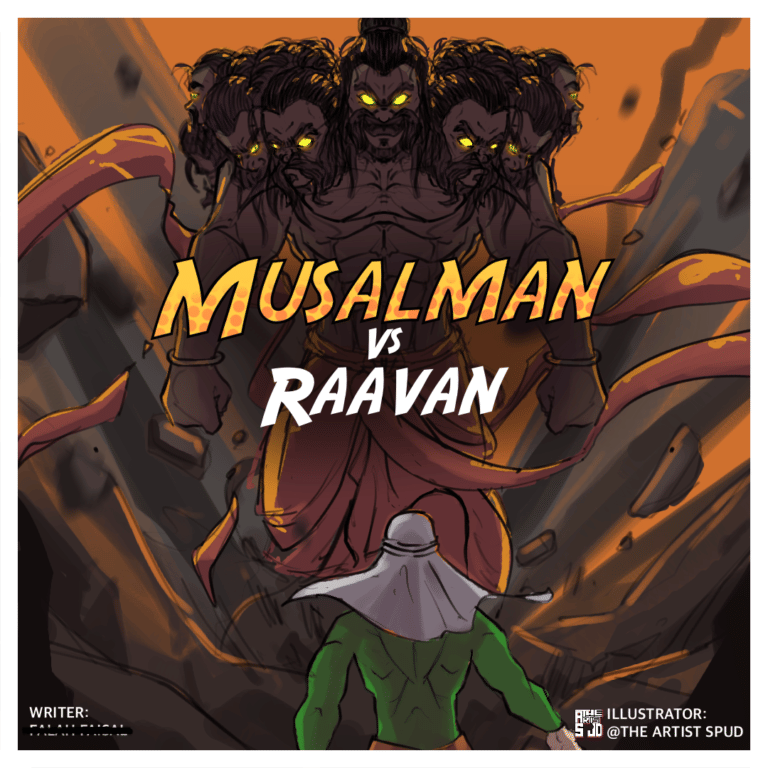
From then on, Musalman became more political, more deliberate in its representation and storyline. The villains are rooted in reality with unmissable cues to who the comic is referencing. From Taana Shah, the dictator ruling ‘Antim Pradesh’ and Arnab Cowswamy, the hate-monger news anchor to Chairman Maose, the owner of ‘Fisney Studios’, they are all thinly veiled caricatures.
In one strip titled Musalman vs Raavan, he fights the mythical 10-headed Raavan, who has been revived and is hellbent on destroying mosques and Mughal architecture. His weapon of choice? A “space joint” that makes the rowdy villain forget why they were fighting in the first place. In the end, no one loses because the fight is against an ideology and not an individual. Non-violence is a very common theme in the comics with “let’s talk it out” being the heart of it.

Faisal places his work in line with another satirical superhero ‘Rashtraman’, created by Indian comic Appupen and the irreverent, anti-hero style of the Amazon superhero series, The Boys, which is adapted from a comic book of the same name. He also draws heavily from Kurt Vonnegut’s dark, comedic tradition, an influence he readily acknowledges, noting he has read all of Vonnegut’s work (Slaughter House 5, Player Piano, and Cat’s Cradle being among his favorites).
That imprint is visible in Musalman’s world. The humour is not just playful but pointed. It is used to expose the logic or the lack thereof behind power and prejudice.
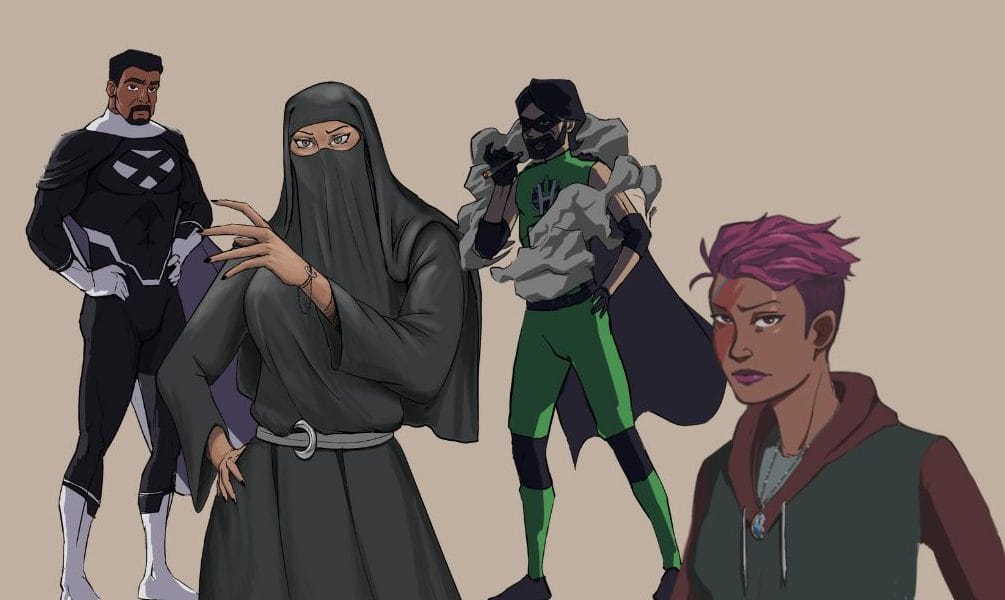
The Musalman Comix expanded into the Musalman Universe, introducing new superheroes to create a Muslim equivalent of Avengers. There is Starwoman, a former astronaut merged with the spirit of David Bowie, Begum Badass, the burkha-clad martial artist whose husband was lynched, Musalman X, a Black Muslim hero influenced by Malcolm X, and Falahdeen aka Harami No. 1, an “anti-hero who deliberately offends and defies religious taboos”, who discovers a genie in his bong.
Also read:
A non-violent superhero
Talking about his intent for creating Musalman, Faisal said he wanted to create a bridge between people rather than push people to the fringes. The intent was not simply dissent but putting forth a vision for a better future.
“What we see in the current political scenario is people focusing on what they are against. But I don’t think you can win based on what you are against. You need to know what you’re for,” said Faisal.
To him, Musalman stands for secularity, plurality, unity and what that would look like.
Thus unlike contemporary superheroes, Musalman doesn’t use brute strength or violence, but intervenes with absurdity, forcing the reader to confront the irrationality of hate. This is what flips the script. His power is perspective.

Musalman is a collaboration between writer Faisal and illustrator Spud, who he met in 2019. This meeting changed the course of Musalman. Spud chooses to stay anonymous. He describes the process of illustration as a reflection of the writer’s mind.
“I got to get really experimental with my art and break general comic book panelling conventions. There is nothing better than that,” Spud said.
Faisal, who is also a filmmaker, always intended on making a Musalman film. His future plans are geared toward the same. Musalman is moving from a comic to a video stand-up format with Faisal donning the costume and embodying the character. He has received overwhelming support from the Muslim community and beyond. It has encouraged him to build Musalman into something more.
The significance of Musalman lies as much in its storytelling as it does in its existence. Quoting Vonnegut, Faisal said the point of art is to make people feel less lonely and that is what he tries to do.
“In a highly superdivided universe with our phones dictating our realities, highly tailored to us, it is very easy to feel lonely. Musalman is for a lonely community. I want it to be like a lighthouse, a beacon for people who feel alienated by their country, their community and the world at large,” he said.
(Edited by Theres Sudeep)