





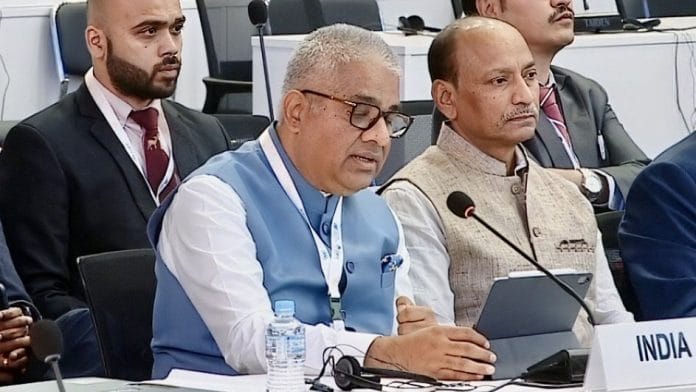

New Delhi: India has called for a shift in global drought policy from reactive response to proactive, technology-enabled resilience. Union Environment Minister Bhupender Yadav urged countries to strengthen early warning systems, watershed restoration and climate-resilient agriculture at the UN Convention to Combat Desertification (UNCCD) COP17 in Ulaanbaatar, Mongolia on Tuesday.
Speaking at the Ministerial Dialogue on ‘Accelerating Drought Resilience’, Yadav outlined India’s approach to drought management, which is guided by the National Disaster Management Authority (NDMA), the Ministry of Agriculture and Farmers’ Welfare, and the Ministry of Jal Shakti.
The UNCCD is a global platform comprising 197 countries that brings together strategies for environmental, water and land conservation. It has held its Conference of the Parties biennially since 2001. The current COP17 is taking place in Mongolia from 17 to 28 August, with the Indian delegation led by Yadav.
Emphasising the link between land and water, Yadav said, “restore the forest, before the flow,” according to a press release, underscoring India’s focus on catchment and riverscape forestry to reduce erosion and improve water retention.
On building drought resilience, Yadav pointed to India’s standardised early warning systems, which identify and manage droughts based on indicators including rainfall, remote-sensing data on vegetation health, soil moisture, and reservoir and groundwater storage levels.
The drought warning system is also supported by space-based drought forecasting from the India Meteorological Department and the Mahalanobis National Crop Forecast Centre. These systems are intended to ensure that a ‘dry spell’ or rainfall deficit does not immediately translate into a drought situation, Yadav said.
Apart from early warning systems, India has multiple schemes aimed at strengthening water security. These include the Atal Bhujal Yojana, introduced in 2019, which focuses on community-led groundwater management, and the Pradhan Mantri Krishi Sinchayee Yojana, introduced in 2015, which seeks to improve access to water for farmland through check dams, bunds and other water-conservation measures.
There are also supplementary measures, including crop insurance, to reduce the financial pressure on farmers in the event of drought-related crop losses and reduced incomes.
According to a press release from the Ministry of Agriculture and Farmers’ Welfare, approximately 68 percent of India’s total sown area is drought-prone, increasing the risk of crop failure and wider impacts on farmers’ livelihoods during droughts.
“Community ownership, capacity building and livelihood diversification are central to the transition from reactive relief to proactive, technology-enabled resilience,” Yadav said.
For the global community, Yadav called for measures including watershed restoration, climate-resilient cropping and stronger early warning systems in drought-prone areas. He also said drought resilience should be supported by disaster funds earmarked for droughts, employment guarantees and emergency water supplies.
(Edited by Prashant Dixit)