






New Delhi: When Christopher Nolan’s Interstellar released in 2014, it was “homework” for Rohan P Naidu. He watched it with his classmates to study how black holes had been depicted. At the time, Naidu was a student of Liberal Arts at the Yale-NUS College in Singapore.
Today, he is an assistant professor of astronomy at the University of Hawaii, and one of the lead researchers behind the discovery of a new astronomical object — the black hole star.
While much of what is written about Naidu depicts him as an “engineering dropout” turned astronomer, at heart he is essentially a quizzer. As a young boy, who grew up in Hyderabad, he recalls spending his weekends at the city’s oldest quizzing club, K Circle. He remembers returning home and looking up answers for questions he didn’t know.
“I’ve always been a quizzer. That is the great joy of my life, learning something about everything,” said Naidu, in an interview to ThePrint.
It is perhaps ironic that someone, who wanted to study a little bit of everything, is now behind the discovery of an astronomical object that doesn’t neatly fit into any existing category. A discovery that has created an uproar in the world of astronomy.
“It’s like that Marxist text. There is the old world and the new world, and then there is something in between. And in the in-between, there is the interregnum and all kinds of chaos reigns. We’re in that beautiful interregnum at the moment,” said Naidu.
The black hole star
One of the open questions that astronomers have grappled with for years is — how do massive black holes form and what did these black holes look like when they were just babies? When astronomers would pore over footage from telescopes, they would often find little red dots scattered across images. But, they had no explanation for what these tiny luminous objects could be.
In 2023, Naidu was a part of a team at the Institute of Science and Technology in Austria that published about the discovery of these little red dots. But at the time, they had no idea that these objects would turn out to be as spectacular as they have in the past few years.
His team’s most recent discovery, published in Nature on 12 August, examined a new cosmic object, which astronomers have described as a black hole hidden inside a dense cocoon of gas. In the images captured by the James Webb Space Telescope (JWST), a mysterious red spec seemed to glow so intensely that it looked almost like a star.
The object, named MoM-BH*1, is the size of our entire solar system and is situated billions of light years away from Earth. The light that reaches JWST was emitted nearly 660 years after the Big Bang, during a period astronomers call the “cosmic dawn”.
“This object has some of the quintessential properties of stars in our neighbourhood. At the same time, however, the object is so bright that it has the luminosity that we classically associate with growing black holes,” said Naidu.
Computer simulations suggest that instead of being powered by nuclear fusion, like our sun, the black hole star is surrounded by dense gas, which forms a thick layer and makes it look like a star.
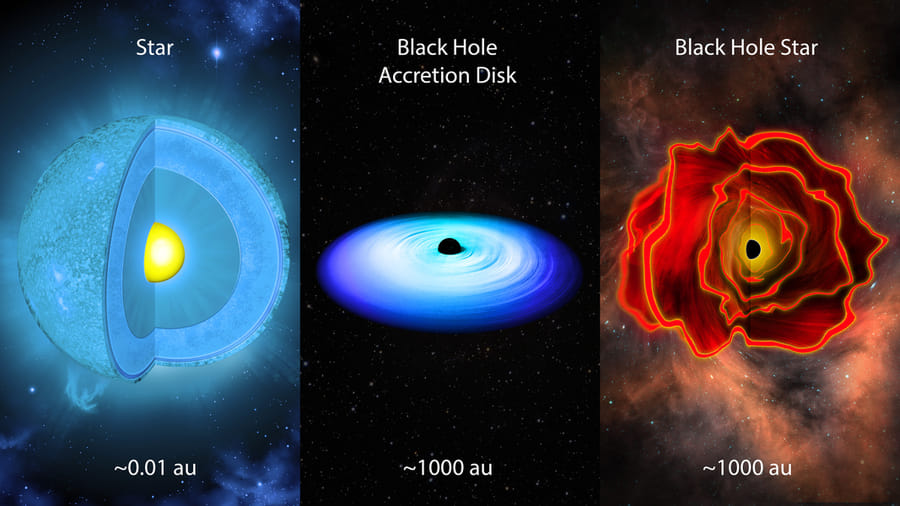
If this object is indeed the first look into the little red dots that appear in the universe, Naidu explains, then every supermassive black hole could essentially start off in such a “cocoon phase” where dense gases nourish the rapidly growing black hole seed. And someday, it will turn into the “gangantuan sources of light we see at the centre of galaxies.”
“We are in that period right now, where there’s a paper every day on the little red dots…It’s a really unusual and beautiful time,” said Naidu.
A new discovery vs old theories
Naidu’s colleagues have told him that such moments come once every generation, where a discovery challenges existing knowledge and demands that everything be rethought from a fresh perspective. This does not mean a complete overhaul. Instead, he says, the challenge is more about asking new questions and fitting in the new discovery with existing theories.
“It is universally agreed that these little red dots are everywhere, but a lot of the details are being contested and debated. Initially, we had just thought that the red specs were black holes surrounded by dust which made them red. But now, we are asking ourselves how big they are, what is their mass, their luminosity?” said Naidu.
Much of the credit goes to the technological leaps in the recent past. He knows that JWST is just starting out and in a few years, it might even give them fresh data on objects that have already been discovered.
At the moment, Naidu is working on a NASA mission called Celeste. It plans to put an artificial star in the sky, which will help calibrate telescopes and give crisper images of these red dots and their surrounding stars.
“Potentially, we would even be able to trace the layers of the black hole star moving. That would be a mind-blowing observation,” he said.
From Liberal Arts to Astronomy
Naidu’s journey that led him to pursue astronomy was hardly linear. In 11th grade, all he knew was he didn’t want to go to engineering school. Yet, it was while he was a first-year computer science student at the International Institute of Information Technology, Hyderabad that he first came across the Liberal Arts programme at Yale-NUS College.
“I was just randomly scrolling on Facebook when I learnt about it. So that afternoon, in many ways, dramatically changed my life,” Naidu laughs.
Until then, his life was all about quizzing. He would travel across India’s elite institutions including, IIT Madras, IIT Bombay, and IIT Calicut to participate in quiz competitions. His goal was simple: keep quizzing and have a good time.
“That year, if you would’ve given me a video camera, it would have been a great commercial for ‘Incredible India’. The amount of time I spent travelling in trains to the remotest parts of the country. I would use the prize money from the quiz competition to book tickets for the next one and so on,” recalled Naidu.
Once he traded his quizzing life for college in Singapore, he met a professor who taught astronomy. Naidu became one of the many guinea pigs for a textbook that the professor was writing.
Later that year, he ended up in Chile as one of his interns. Naidu, who had never quite seen the night sky in light-polluted Hyderabad, for the first time saw the Milky Way with his naked eyes at the Atacama desert. That transformative experience set the ball rolling for journey into the world of astronomy.
“Sometimes I think to myself: if one ran many simulations of the universe, there’s probably very few in which someone born in my postal code, living the kind of life I was, would take this remarkable deviation from that standard path. I’m very grateful for it,” said Naidu.
A team effort
Naidu lived the past ten years in Boston, first for his PhD then postdoc at Harvard University. But he keeps coming back to India, to meet his family, and most recently, for his youngest brother’s wedding.
His connection to India also remains strong because of his quizzing roots. Every weekend, he still spends hours connecting to online quiz communities, where he interacts with many fellow quizzers as well as several of his childhood friends.
Naidu might have led the team that found the black hole stars but he is quick to admit that such discoveries do not happen when one person locks themselves up in a room. He has a long list of colleagues whose contribution was essential to the findings.
“This discovery came out of a large JWST survey that I was co-leading along with Professor Pascal Ursch at the University of Geneva. Professor Gabe Brammer at the Dawn Institute in Copenhagen designed a lot of the observations. Andrea Weibel, a PhD student at the University of Geneva, made the photometric catalogues. Professor Harley Katz at the University of Chicago ran all these models with me. Yorit Mate and Anna de Graaf share the intellectual credit for everything we came up with,” he said.
For Naidu, the most interesting things are the ones he cannot fathom at the moment.
“My hope is I’ll be working in a few years time on something that I currently cannot name at all,” he said.
(Edited by Aakriti Handa)