





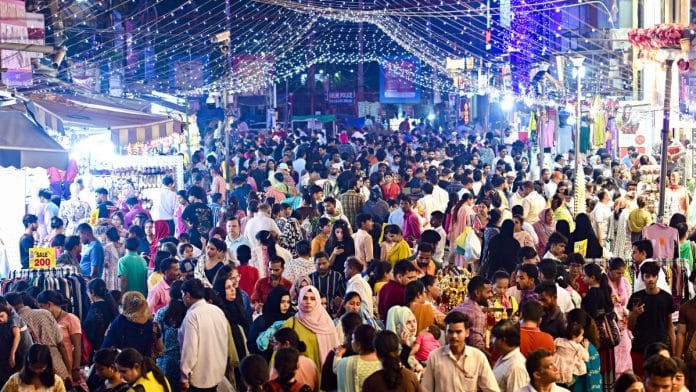


Bengaluru: Scientists have discovered a pattern in the way we walk but they can’t explain it. People have a consistent tendency to turn left and walk in an anticlockwise direction—in crowds and when alone.
The finding, published Wednesday in Nature Communications, emerged from research that was originally about something else entirely. During the Covid-19 pandemic, Iñaki Echeverría Huarte, a professor who studies pedestrian dynamics at the University of Navarra in Spain, was analysing how many people could safely share a space while maintaining social distancing. On reviewing video footage of crowds, the team noticed an unmistakable pattern—people were overwhelmingly moving counterclockwise.
“The discovery was a serendipitous one, as sometimes happens in science,” Huarte told 404 Media.
The observation set off a series of structured experiments. Researchers analysed the movements of hundreds of participants—adults walking freely in different settings, teenagers in a schoolyard in Spain, and children at a nursery school in Japan. They accounted for individual variables including right or left handedness, age, and local social etiquette around expected behaviour in crowds.
The nursery school children showed an even stronger bias toward counterclockwise turns, suggesting it may not be a learned behaviour but something biologically rooted.
“If you simply ask someone to start walking, whether they are wandering around a museum, a supermarket, or even an empty room, it is surprisingly likely that they will drift counterclockwise,” said Huarte to The Guardian.
The pattern was observed in both Spain and Japan, suggesting it was not driven by local cultural habits. This was a surprise. Echeverría Huarte and his co-author, Claudio Feliciani—a professor who studies crowd dynamics at the University of Tokyo—had expected the bias to reverse in Japan, given differences in cultural norms around pedestrian behaviour.
Also read: Did humans invent kissing? New study says ‘evolutionary puzzle’ goes back 21 million yrs
Why do we do it?
Since 1913 athletes have been running counterclockwise around a track as many felt the alternate was an “unnatural direction to run”, according Professor Gareth Irwin, head of sport and exercise biomechanics at Cardiff Metropolitan University.
“It is reasonable to assume that this emerged due to the right-leg dominance of the population,” he told The Guardian. “Running around the bend in an anticlockwise direction puts more internal force on the right side of the body.”
But this does not fully account for the bias in ordinary walking. “We have tested several ideas and the bias stubbornly keeps showing up, so the exact mechanism is still an open question,” Echeverría Huarte said.
The researchers describe it as potentially “a manifestation of a deeper biological principle of symmetry breaking.” They note that this kind of asymmetry is unusual in the animal kingdom—most animals show no bias, and humans appear to be an exception, or at least a rare case.
The study does point to a few animal parallels: Ants tend to turn left while exploring, and budgies show lateral preferences during flight.
A clearer understanding of the phenomenon could have practical applications in the design of airports, museums, shopping centres, and other high-footfall spaces.
Enrico Ronchi, who models emergency evacuations at Lund University in Sweden, told The New York Times that the findings “open up many new, interesting avenues in the field of crowd dynamics.”