





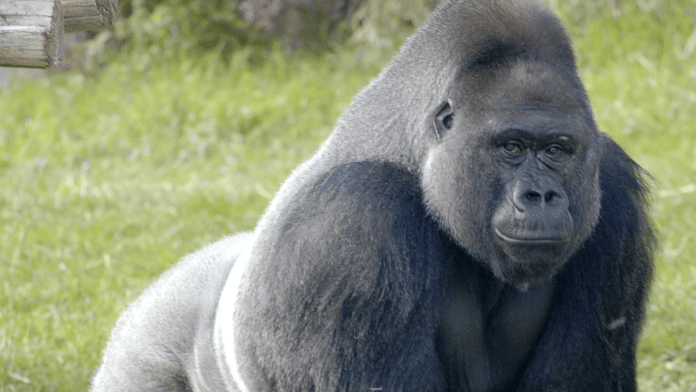


Bengaluru: A new study has found that laughter follows a strict internal rhythm that dates back at least 15 million years, to the last common ancestor of all great apes.
The research, published in the journal Communications Biology, compared laughter recordings from orangutans, gorillas, bonobos, chimpanzees and human children. It found that this ancestral laughter was “isochronous”—meaning the gaps between laugh bursts were evenly timed, much like a metronome.
But that ancient rhythm didn’t stay frozen. Over millions of years of evolution, laughter grew faster, less predictable, and more responsive to social context — a trajectory that peaked in humans, according to the study’s authors, Chiara De Gregorio and Adriano R Lameira of the University of Warwick, and Marina Davila-Ross of the University of Portsmouth.
The team recorded laughter from four orangutans, two gorillas, three bonobos, four chimpanzees, and four human children, capturing sounds during two settings: Rough-and-tumble play and tickling. In all, they analysed 140 laughter bouts and 458 intervals between individual laugh sounds.
Tickling laughter turned out to be the more reliable of the two contexts for tracking rhythm. That’s because play involves more physical disruption to breathing—twisting, thumping, compressing the chest—which throws off the regular rhythm that breathing would otherwise produce. Tickling laughter, by contrast, stayed closer to a steady beat, giving researchers a cleaner window into how vocal timing has evolved.
“Contrary to the classic notion that the first humans suddenly acquired vocal control capacities remarkably different from their predecessors, laughter evolution tells us that humans lay on a continuum, a prolongation of vocal control capacities that were already being cumulatively honed in for 15 million years,” said Lameira to Science Daily.
Also read: Monkey see, monkey eat dirt—The social science behind primate ‘self-medication’
Different laughs for every context
The study found that laughter sped up the further a species sat from humans on the evolutionary tree—but only in the tickling context. Humans were also the only species who changed their laughing tempo depending on the situation, laughing faster while being tickled than during play. No non-human ape showed this kind of context-sensitivity.
Humans also showed the greatest variability in laughter tempo of all the species studied. The authors note that in humans, less rigid, more unpredictable laughter tends to be read as more socially and emotionally genuine—suggesting that the flexibility itself may carry meaning, signalling emotional state or intent to whoever is listening.
The findings trace a gradual arc. Rhythm was present from the very beginning, shared by the common ancestor of all living apes, but it grew progressively faster, more variable, and more finely tuned to social context as evolution moved toward humans.
“Sound does not fossilize, making it difficult to trace the vocal origins of song, speech, and language,” reads the study. Its authors argue that laughter offers an unusually clear proxy for tracing how vocal control developed over time, potentially laying groundwork for the emergence of speech itself.
The recordings analysed were originally gathered between 2004 and 2006 across seven institutions, with the human data drawn from children recorded during play with their mothers.