





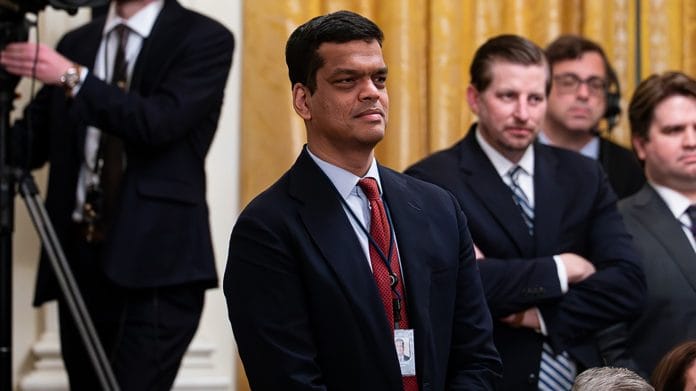


New Delhi: Sriram Krishnan left Chennai and built a career in the US that earned him a spot at some of the biggest names in technology. By 2024, his journey led him from Silicon Valley to the White House, where he helped shape America’s AI destiny. But on 6 June, at the peak of his influence, he announced he is leaving his position as Senior White House Policy Advisor on AI at the end of the month.
For 18 months, Krishnan helped develop policies to strengthen the US’ leadership in AI, secured federal government access to advanced AI models, and represented the US at major international AI summits.
“It is hard to express how big a privilege it has been to serve the American people and how grateful I am to have had the opportunity to do so. First and foremost, it has been an honour to serve under President Donald Trump. Without his leadership, we would not be leading in the AI race,” he wrote on his X handle.
During his time in government, he co-authored the America AI Action Plan, helped secure agreements from Google, Microsoft, and xAI to provide the US government with early access to AI models. He also participated in AI diplomacy efforts spanning Paris, India and the Middle East.
“After leaving behind his immensely successful private sector career, Sriram has been a critical asset for the White House and President Trump’s push to cement American dominance in technology and innovation,” said Kush Desai, White House spokesperson.
Also read: Who is Alex Bores? AI firms are spending millions to defeat him in New York congressional race
Krishnan’s journey
Sriram Krishnan was born in 1984 to a middle-class Tamil Brahmin family. His father worked in insurance.
In 2005, at the age of 21, Krishnan graduated with a BTech in Information Technology from SRM Institute of Science and Technology, Chennai, and moved to the US to join Microsoft as a founding member of Windows Azure.
It was the beginning of a rapid ascent through the technology industry.
After Microsoft, he joined Facebook, where he played a key role in scaling the company’s mobile app download advertising business. He later worked at Snap and then at Twitter (now X) in 2016. At Twitter, he collaborated with Elon Musk on restructuring efforts related to the platform.
His influence expanded beyond product development and investing. In December 2020, during the rise of social audio platforms, Krishnan and his wife Aarthi Ramamurthy launched The Good Time Show on Clubhouse. The project later evolved into The Aarthi and Sriram Show podcast, featuring conversations with guests including Elon Musk, Mark Zuckerberg, Virgil Abloh and Steve Ballmer.
By early 2023, the podcast had surpassed one million downloads and become one of the most influential shows in the technology world.
In 2021, Krishnan joined Andreessen Horowitz as a General Partner. There, he opened the firm’s first international office in London and focused on investments in AI and cryptocurrency. He also became a close ally of Musk and advised him during his 2022 acquisition of Twitter.
Also read: Bernie Sanders wants US public to own 50% of AI stock. Some call it a Socialist grab
AI advocacy
When Krishnan entered the White House in December 2024, AI had become one of the crucial geopolitical issues of the era.
“We framed the AI race as an existential race with China,” he said at POLITICO’s AI & Tech Summit.
For him, success in AI meant achieving global adoption and staying ahead in technology.
“We need to ensure that American AI—our chips, our models, and the entire technology stack—becomes the global standard,” Krishnan said. “Not Chinese models or Chinese chips.”
He outlined what he described as the administration’s three-part AI strategy. The priority, he said, is building the infrastructure needed to support the next generations of AI systems.
The second is fostering innovation. “We want to make sure our AI companies have the resources and capacity they need to remain globally competitive,” he said.
The third is global adoption. “We want the world to be using the American stack,” he said, referring to the ecosystem of technologies that powers AI, from semiconductors and cloud computing to software and models.
Krishnan argued against heavy-handed regulation and warned that excessive government intervention could slow innovation during AI’s formative stage.
He expressed his desire to avoid ideological bias from either the Left or the Right. He compared the current AI era to the internet’s early years in the 1990s, while acknowledging that certain areas, such as testing standards and preventing adversaries from obtaining sensitive technologies like advanced cooling systems, required government oversight.
He also helped create the AI Action Plan unveiled by Trump in July 2025. The plan included an executive order barring AI systems the administration described as “woke” from receiving federal funding, while encouraging the development of “truth-seeking” models and greater transparency about how AI systems are trained.
Even as he prepares to leave government service, Krishnan emphasised that many of AI’s toughest challenges still lie ahead.
“Whether it is energy, data centres or a clear path for Americans to experience the benefits of AI, there are many tough issues we all need to navigate together,” he said.
Looking forward, he said he intends to focus on building institutions that will help tackle some of those challenges for America and its allies. Although Krishnan will take a break from his formal government position, he is expected to continue advising the White House from outside the government.
(Edited by Theres Sudeep)