



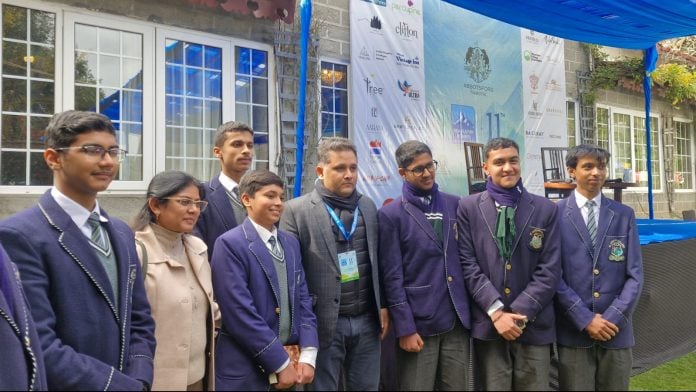
Nainital: At a time when history textbook revisions, the renaming of monuments, and the question of whose past deserves to be remembered have become central to public debate in India, author Amish Tripathi believes the challenge is not simply to recover forgotten histories, but to rethink the way history is told and interpreted.
Tripathi, a former banker and IIM Calcutta graduate, made his name with the Shiva Trilogy, widely described as the fastest-selling book series in Indian publishing history. Readers have long come to him for mythology, but now he is making an argument about the past.
For Tripathi, revisiting the past is not about forgetting uncomfortable chapters or replacing one version of history with another. It is about examining the language, perspectives, and assumptions with which history is written.
“I don’t think things should be forgotten. But how we remember history is very important. Because how we remember it defines how we live today,” he told ThePrint on the sidelines of Himalayan Echoes, the Kumaon Festival of Literature and Arts in Nainital.
The idea has paved a new genre for Tripathi. His first children’s book, Dhruv-Tara & The Great Indian History Quiz, marks his entry into children’s literature. The idea, he says, grew out of a conversation with his 17-year-old son.
A voracious reader, he told Tripathi that the history he was being taught in school was still colonial in its thinking.
“I thought the time had come to teach our kids a decolonised version of history,” he said. “If I’d like kids to learn about our history, a decolonised version of our history, why don’t I write a book myself? And write in the garb of an adventure, not a textbook, so that they enjoy it.”
For Tripathi, this starts with asking whose histories make it into textbooks, and whose stay at the margins. Tripathi says Indian textbooks tell the story of a narrow slice of the country, and he is blunt about how far the neglect extends.
“Most of India east of Agra is ignored. South of Jaipur is also ignored in our history textbooks.”
According to him, this geographical concentration also shapes how Indians understand their civilisational history—often as a largely defensive story of invasions from the northwest.
A wider perspective, he argues, would bring into focus India’s maritime and commercial histories, including its trading networks and connections with other parts of the world.
“If you cover the rest of India, you’ll discover we were a great seafaring nation. We were a great trading nation. We had huge trade surpluses with the Roman Empire and China. You don’t learn any of this. That needs to be balanced,” he said.
If geography is the first omission, language is the second, and the more combustible one. Tripathi points to an asymmetry in how foreign rule is named, and blames the British for creating it.
“The British colonial rule is not called the Christian invasion. But the Turkic colonial rule is called the Islamic invasion,” he said.
According to Tripathi, the Turkic rulers were foreigners whose crimes should be recorded as such, just as Indians record British crimes without blaming Christians. Naming them by religion, he suggests, turns a political history into a communal one.
He argues that this distinction is necessary to understand the past without carrying its divisions into the present.
Also read: Union Minister Gajendra Shekhawat urges decolonisation of memory at Tarun Vijay book launch
Making history accessible
During the festival, Tripathi spoke about the role of storytelling in shaping a civilisation, arguing that shared stories are as important to a civilisation’s continuity as customs, food, and rituals.
He cited India’s continuing civilisational identity as an example, saying generations of storytellers kept older narratives alive by adding new interpretations.
His example was the Lakshman Rekha, which is absent from Valmiki’s Ramayana and entered popular memory through Tulsidas’ Ramcharitmanas and Ramanand Sagar’s Ramayan.
For Tripathi, such reinterpretations are not necessarily distortions of tradition. They are part of how storytelling evolves. He recalled a line often attributed to Austrian composer Gustav Mahler: “Tradition is not the worship of ashes, but the preservation of fire.”
He suggested every generation has to add its own fuel.
“Take the best of the old, add in something of the new.”
With Dhruv-Tara, he is trying to do that for children by introducing them to lesser-known aspects of Indian history through an adventure rather than a conventional textbook format. He believes accessibility takes more than changing the syllabus. It takes a book children actually want to read.
“If you are going to write a boring book, then no one is going to force the kids to read it,” he said.
(Edited by Prasanna Bachchhav)