



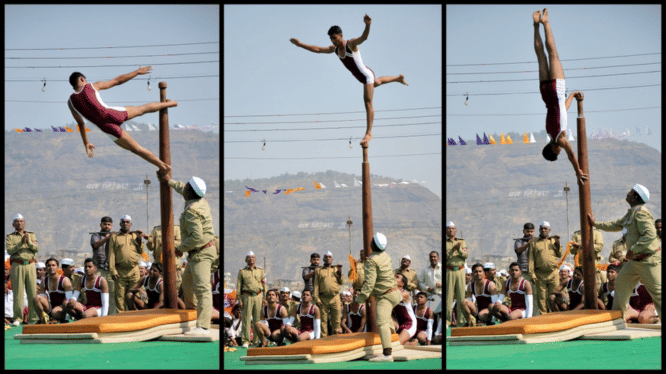

New Delhi: NCERT’s Class 9 Khel Praveen textbook is changing the landscape of India’s physical education, which leaned heavily on global sports. It brings indigenous martial arts such as Gata and Mallakhamb into the classroom, making them central to how students understand fitness, discipline, and identity.
Aligned with the National Education Policy (NEP) 2020, the curriculum makes physical education compulsory from Classes 3 to 10, and includes lessons on nutrition, sleep, mental health, and basic sports science.
“The art of self-defence began in the 16th century under Guru Hargobind. In the 17th century, Guru Gobind Singh further developed it and made it an essential part of Sikh tradition,” the book states.
NCERT Director Dinesh Prasad Saklani, in the textbook’s foreword, stresses the idea of “sportspersonship”—valuing teamwork, discipline, and resilience over competition alone.
Khel Praveen attempts to reconnect students with traditions that were sidelined over time—whether due to colonial restrictions or the growing dominance of global sports. It encourages students to explore and document local practices, and it also transforms classrooms into spaces of preservation.
The book addresses gender disparity in sports, acknowledging gaps in pay, visibility, and leadership. One chapter celebrates progress, such as women leading top sports bodies like the Indian Olympic Association and Paralympic Committee, while also pointing out problems, including unequal pay, less media coverage, and fewer leadership roles for women.
It supports global goals for equal participation and encourages girls to take the lead in traditional sports. It also highlights inclusivity by promoting sports for people with disabilities, mental health awareness, and supporting activities that connect urban and rural communities. The chapter shows different career options in sports, such as coaching and sports science, which are important for India’s future Olympic goals.
Also read: Nigerian student at AMU is now ‘overwhelmed and scared’ after Hindi speech goes viral
From Manipur to Kerala
At the centre of this shift is Gatka, a Sikh martial art that dates back to the 16th century. Introduced by Guru Hargobind and later shaped under Guru Gobind Singh, it was meant to train both body and mind. Students begin with a wooden stick and gradually love swords, daggers, and flexible weapons like the chakkar.
Today, its techniques–focused on speed, coordination, and awareness—are also taught through structured systems supported by bodies like the International Gatka Federation.
Then there is Mallakhamb, a sport that combines strength, flexibility, and control. Its references go back to texts like the 12th-century Manasollasa and the 19th-century Vyayam Dipika. It was revived in the 1700s by Balambhat Dada Deodhar during the time of Bajirao II to train Maratha soldiers. Athletes perform on a wooden pole, rope, or hanging apparatus, executing complex poses that demand both physical strength and mental focus. The textbook presents it as a full-body workout that builds balance, agility, and confidence–and notes its growing presence in international competitions.
From Manipur comes Thang-Ta, literally meaning “sword and spear”. Developed in the 17th century as part of the Huyen Lallong tradition, it blends combat techniques with controlled breathing and movement. Practitioners train in swordplay, spear techniques, and high-energy movement that mirror nature. Once suppressed during colonial rule, it is now being reintroduced as both a physical discipline and a way to engage with the cultural traditions of Northeast India.
The last one is Kalaripayattu, a 3,000-year-old traditional Indian martial art originating from Kerala. Traditionally taught in gurukuls, it begins with oil massages to prepare the body and moves through a series of animal-inspired stances. Students learn to handle weapons like the urumi, spears, and sticks. The British once banned it, wary of its role in training strong and disciplined fighters.
These are not just theoretical additions. Khel Praveen requires practical engagement—40 per cent of the assessment is based on physical performance, and another 20 per cent on projects such as documenting local akharas or traditions.
(Edited by Saptak Datta)