



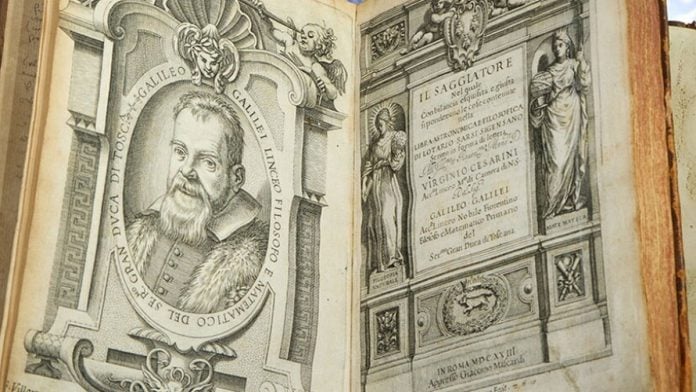
New Delhi: From Isaac Newton’s handwritten calculations to centuries-old texts, a collection of manuscripts that changed humanity’s view of the universe is up for an airing after decades in a private collection. New York auction house Sotheby’s is putting these works on public display before sending them under the hammer this October.
The auction, titled Reason and Revolution: Extraordinary Works from a Distinguished Private Collection, will feature first editions and rare manuscripts by Copernicus, Galileo, Kepler and Newton in a single-owner sale. Among them is a rare manuscript in Newton’s own handwriting, linked to his work on the Principia.
The collection offers an unusually intimate record of the scientific revolution — from early printed mathematical works to discoveries that transformed ideas about motion, gravity and the cosmos. The auction will be held on 20 October, with a public exhibition from 12-20 October at the Breuer, Sotheby’s New York headquarters on Madison Avenue.
“Few opportunities allow us to trace the origins of modern scientific thought through the hands of the people who created it. This collection does exactly that, bringing together the foundational texts of astronomy and physics that reordered humanity’s understanding of its place in the universe,” said Richard Austin, Sotheby’s Global Head of Books and Manuscripts.
He added that seeing so many of these landmark works reunited was a privilege for anyone interested in the history of ideas.
The collection will be offered in two parts. The October sale traces scientific inquiry from Copernicus’s heliocentric model through Newton’s laws of motion. A second sale in December will turn to the founding of the American nation, with further details of the collection to be unveiled later.
Also Read: Why Zuckerberg is betting on glasses, voice assistants and VR: Meta’s new AI gadgets
Stars of the show
The Sotheby’s collection will feature the first printed edition of Euclid’s Elements.
Printed by Erhard Ratdolt in Venice, the edition was the first to successfully integrate geometric diagrams into the text, a technical achievement in early printing.
It “set the model for how mathematical works would be produced for centuries afterward,” said the auction house.
Galileo Galilei’s Sidereus Nuncius, which records his early observations through the telescope, including the discovery of Jupiter’s four moons and the mountainous, cratered surface of the Moon, will also go under the hammer. Sotheby’s describes it as the book that established Galileo as the founder of modern observational astronomy.
Another highlight is Johannes Kepler’s Astronomia Nova, in which he set out the first two of his three laws of planetary motion, including that planets travel in ellipses rather than perfect circles.
One of the stars of the show is a rare manuscript by Newton.
“A rare manuscript in Newton’s own hand, revisiting calculations related to his Principia and produced during his celebrated visit with the astronomer David Gregory at Cambridge,” said the auction house. It noted that scientific manuscripts by Newton are exceptionally scarce in private hands and those relating to the Principia are almost never seen on the market.
The first edition of Newton’s Philosophiae Naturalis Principia Mathematica will also be presented. It is one of the most influential works in the history of science.
In the Principia, Newton set out the three laws of motion and the law of universal gravitation.
“There is something remarkable about holding the actual page where a scientific revolution happened, not a later account of it, but the object itself, like the sheet where you can watch Newton work through a calculation in his own hand. How often do we get to stand that close to the moment a discovery became permanent?” said Kalika Sands, Sotheby’s Vice President, Head of Books and Manuscripts.