


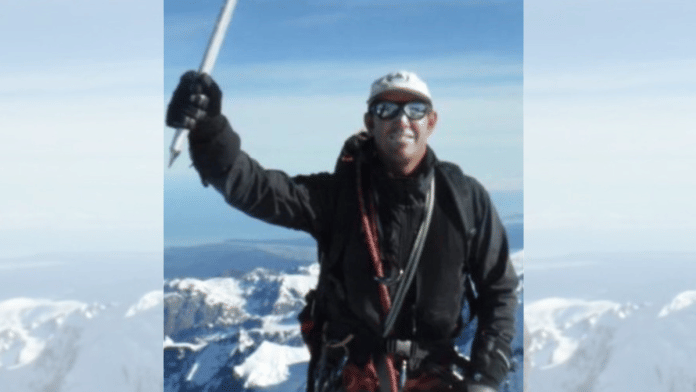
New Delhi: A few metres behind Adam Parore, a massive chunk of ice suddenly gave way. The ground shook, the noise sounded like a Boeing 747 taking off beneath his feet, and an area the size of a football field simply vanished. The former New Zealand wicketkeeper was stranded on moving blocks of ice, thousands of metres above sea level, with little he could do but stay upright and hope.
Parore survived. But he knew how close he had come to dying on Mount Everest.
Fifteen years later, the 55-year-old has revisited that terrifying experience in an interview with The Athletic, recalling how a man who spent more than a decade facing the world’s best fast bowlers ended up taking on the world’s highest mountain.
In May 2011, Parore became the first international cricketer to summit Everest, completing a remarkable journey that nearly cost him his life.
From behind the stumps to the Himalayas
Before swapping cricket whites for climbing gear, Parore was one of New Zealand’s most recognisable cricketers.
He played 78 Tests and 179 ODIs between 1990 and 2002, scoring 2,865 Test runs and effecting 204 dismissals behind the stumps.
Known for his sharp tongue and combative attitude, he was never afraid of a confrontation. In 2001, he scored 110 against Australia in Perth, sharing a remarkable 253-run eighth-wicket partnership with Nathan Astle.
But when he retired at 31, something was missing.
The adrenaline, camaraderie and purpose that came with international cricket had disappeared.
His introduction to mountaineering happened almost by accident. After bumping into his brother-in-law, experienced climber Johnny Davidson, Parore accepted an invitation to try climbing in Queenstown.
Three days in the mountains were enough to get him hooked.
He was introduced to expedition leader Russell Brice and later climbed Manaslu, the world’s eighth-highest mountain, as preparation for Everest.
The transition felt surprisingly familiar. Parore compared mountaineering to cricket, with long periods of waiting interrupted by short bursts of intense activity.
The day Everest nearly killed him
Parore travelled to Nepal in March 2011, hoping to fulfil a lifelong ambition while raising money for the Make-A-Wish Foundation.
His first summit attempt ended in failure when strong winds forced his team to retreat.
Then came the terrifying incident in the icefall.
In his recent interview, Parore recalled being caught near a massive ice collapse. Four climbers found themselves standing on moving blocks as the ice beneath them shifted.
He later admitted they had made a dangerous mistake by remaining in an exposed area late in the day.
They escaped, but the mountain had delivered a brutal warning.
A week later, Parore tried again.
On 21 May 2011, aged 40, he finally reached Everest’s 8,848-metre summit.
The climb had pushed his body to its limits. He ran low on oxygen, suffered symptoms of hypoxia and struggled to maintain his footing as exhaustion set in.
And after all that suffering, the summit wasn’t quite the emotional triumph he had imagined. “I had great plans on what I should do and how I might feel but in the end it was a bit of an anti-climax. I just wanted to get down and live,” Parore told Sunday News shortly after his climb in 2011.
Why reaching the summit was only half the battle
Parore spent roughly half an hour at the top. The sun was shining, there was barely any wind and the view stretched as far as the eye could see. But exhaustion and a lack of oxygen had taken their toll. Even his footwork, something he had prided himself on as a wicketkeeper, was beginning to fail him.
The danger was far from over. Parore knew that many climbers had died during the descent, their bodies left behind on the mountain because recovering them was too dangerous.
Fortunately, his own descent was relatively straightforward. He credited his Sherpa with keeping him alive and recalled how an old friend climbing behind him kept prodding him with an ice axe to push him forward.
By the time he reached Everest Base Camp, Parore was physically exhausted, struggling to breathe and suffering from a persistent cough. But he had survived the mountain that had nearly killed him days earlier.
Parore’s adventure did not end with Everest. He continued mountaineering for several years, eventually attempting K2, the world’s second-highest mountain, before bad weather forced him to turn back below Camp Four.
Now 55, with four children and a business to run, he considers his days on major mountains over.
For a man who spent 12 years playing international cricket, Everest offered something no stadium could.
It taught him that reaching the top means very little if you cannot make it back down.