


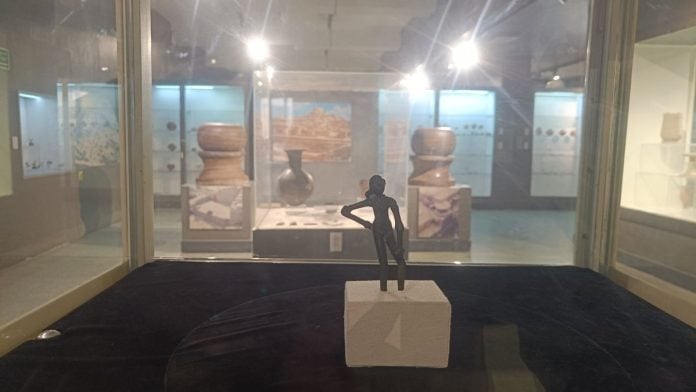
New Delhi: The Dancing Girl is back at the National Museum. But the 4,500-year-old bronze figurine, one of the most recognisable treasures of the Indus Valley Civilisation, has not quite returned to where it once stood.
A week after ThePrint reported that the 10-cm-tall figurine had been removed from public display, the National Museum reinstalled it in the Harappan Gallery on Wednesday. However, instead of restoring it to its original position, the museum placed it barely a metre away from its earlier spot.
And even that return appeared somewhat hurried.
On Thursday morning, the figurine stood inside its showcase without any dedicated lighting. It was only later that the museum authorities arranged focus lighting to make the diminutive bronze sculpture more visible to visitors.
The manner of its reinstatement has also raised questions among those familiar with the museum’s display arrangements.
“The reinstallation has been done in a hurry. The question is why the Dancing Girl has been placed at a new location. Such a masterpiece is now being displayed so poorly,” a source at the National Museum told ThePrint.
An office order issued by Additional Director General Meenakshi Jolly on 11 November directed the shifting of the Indus Valley bronze figurine back to its original display gallery. ThePrint has accessed a copy of the order, which states that the relocation was approved by the National Museum’s Director General.
The figurine had been moved in September to the Jewellery Gallery to make way for the mock gallery of the proposed Yuge Yugeen Bharat National Museum.
For the relocation, the museum constituted a five-member committee headed by Jolly, comprising senior museum officials. The committee was tasked with overseeing the physical handling, transit and reinstallation of antiquity.
The Dancing Girl’s removal had triggered questions over the shifting of important artefacts from the National Museum’s galleries. Former Lok Sabha MP R. Senthil had also written to Union Culture Minister Gajendra Singh Shekhawat, demanding that the figurine be restored to public display.
However, the Dancing Girl remains the only one among several prominent artefacts removed from the museum’s display to have been reinstated so far.
These include the Pashupati Seal, the black stone statue of Lord Buddha, the Kuber statue, the Dara Shikoh wedding painting, the Mother Goddess figurine and the Jallianwala Bagh Kalash.
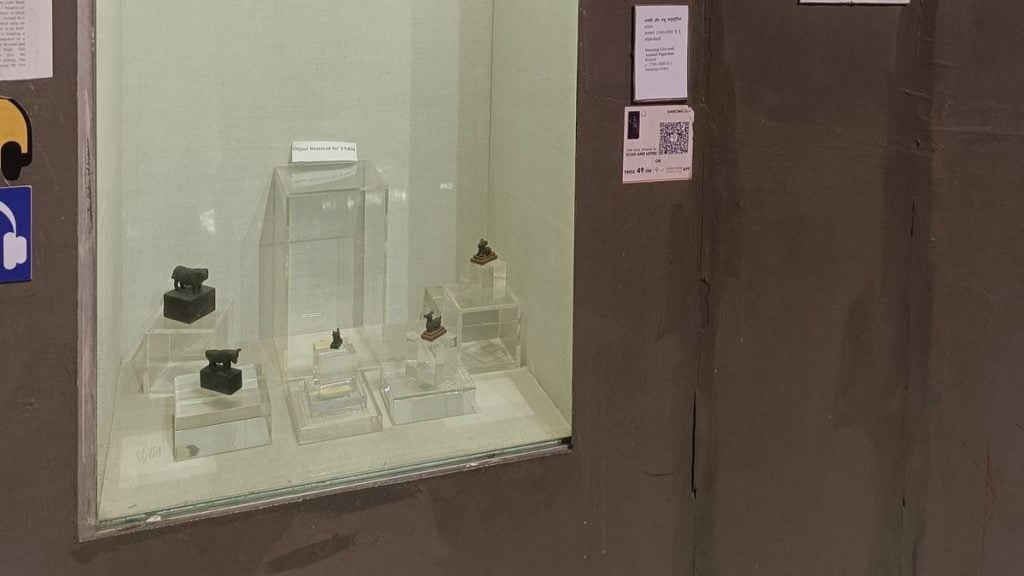
Also Read: Dancing Girl removed from National Museum. Former MP complains to culture minister
How the Dancing Girl was brought back
The return of the Dancing Girl to the National Museum’s display is not a simple matter of moving an object from one gallery to another. It involves a series of security and conservation procedures, all of which were laid out in the 11 November office order.
The order stipulated that the entire relocation process be continuously recorded through audio-visual documentation, without interruption.
The exercise began with shifting a bulletproof showcase from the Medieval Gallery to the Harappan Gallery. This was followed by unlocking the showcase in the mock gallery where the Dancing Girl was temporarily housed.
The committee then oversaw the physical handling of the figurine, its condition assessment and its transit back to the Harappan Gallery. The final stages involved mounting the antiquity, installing it inside the new showcase and sealing the display case.
The new showcase, however, appeared to be a work in progress even after the installation. Its platform had recently been constructed by carpenters, and the plywood portion remained uncovered when ThePrint visited the gallery.
Two security stickers bearing the signatures of all five committee members had been pasted at separate points on the showcase, marking the completion of the installation and sealing process.
The keys to the showcase were subsequently deposited with the museum’s security department. According to the order, these will be formally handed over to Moumita Dhar, research officer and in-charge of the Pre-History section, once she returns from official duty in Arunachal Pradesh.
“For now, the Dancing Girl has made her way back to the Harappan Gallery. But her return has done little to resolve the larger question of why several other important objects remain missing from the museum’s public displays,” said the source.
(Edited by Stela Dey)