





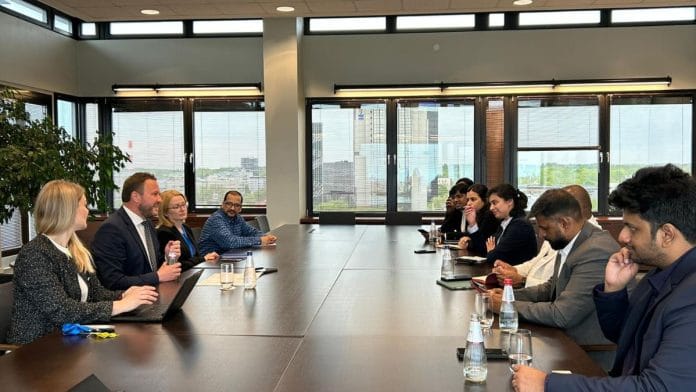


Tallinn: The Estonian Foreign Minister Margus Tsahkna on Tuesday said that he wishes more Estonians would travel to India for studies in the future, to deepen the countries’ bilateral partnership.
In a meeting with Indian journalists in Tallinn, the minister spoke about India-Estonia relations in the fields of digitalisation, AI, and increasingly, research and education, too.
“We believe Estonia can be a trustworthy gateway for India to the European Union, especially given the recent steps on the Free Trade Agreement (FTA),” said Tsahkna at a private meeting.
This year, India and the European Union (EU) have taken significant strides towards improving collaboration through the India-EU FTA, as well as through security and defence partnerships agreed upon in January 2026. Tsakhna, who visited India as part of a delegation in 2024, spoke about how India and Estonia can specifically enhance bilateral cooperation in the field of cybersecurity, AI, technology, education and research.
“India for us is a very important partner, and this relationship is improving more because of digitalisation and AI,” said Tsakhna. “Indians are already establishing start-ups here, and many Indians come to Estonia to study. I hope more and more Estonians go to India to study, too.”
From Memoranda of Understanding (MoUs) with the Ministry of Electronics and Information Technology (MEITY) and the Ministry of Defence, to collaborations between Indian and Estonian universities on gene technology research, the two countries have already expanded opportunities for learning from each other. India and Estonia have had bilateral links since 1991, soon after the Baltic country gained sovereignty after the collapse of the Soviet Union.
A major point of cooperation between the two countries is digital architecture and start-ups. In 2024, Estonia became the world’s first fully digital country. Many of its government initiatives, like the e-ID for citizens and the X-Road database, serve as a model for India’s own digitalisation process.
Moreover, Tallinn is named the world’s ‘best city for start-ups’, with Estonia having the highest number of unicorns per capita in the EU. From video-conferencing app Skype, to payment platform Wise, to food delivery and cab platform Bolt, Estonia is home to some of the largest start-ups in the last few decades.
Also read: India is rewriting the Mughals. Again
Science and research collabs
Tsakhna spoke about the e-Residency programme—aimed at attracting global entrepreneurs to establish start-ups in Estonia—and how more than 5,000 Indian entrepreneurs have registered under it. Since 2014, over 1,200 start-ups have been founded by Indians under the e-Residency.
“India is doing great, because you have a huge base of technology, engineers, all this kind of knowledge. They’ve shown interest in e-Residency, and we hope to collaborate further,” said Tsakhna in response to a question by ThePrint.
The minister also mentioned that in the future, as both countries tackle AI, it could be a point of cooperation between them. Estonian President Alar Karis visited India for the AI Impact Summit in February 2026, and Tsakhna said that PM Modi and President Karis spoke about possible bilateral cooperation on AI research and development.
“In Estonia, it is our private sector that does most innovation, so we are in talks with India to collaborate with them on AI, and maybe invite Indian companies to Estonia to work together,” he told ThePrint on the sidelines of the event.
Estonia’s University of Tartu is also a major European institution specialising in technology, and the minister mentioned that Indian students regularly study there. However, despite India’s own educational institutions in engineering and technology, there are hardly any Estonian students who travel to India for higher education. According to the Estonian Ministry of Foreign Affairs, less than 10-15 Estonian students study in India.
However, bilateral collaborations between Indian institutions like the Council for Scientific and Industrial Research (CSIR) and the University of Tartu are quite common, said Estonian officials.
However, in the future, the minister said these collaborations would only improve.
“There’s a difference of scale between Indians and Estonians. Our population is in millions, yours in billions. But the vision of technology and collaborating on it is the same in both our nations,” said Tsakhna.
(Edited by Saptak Datta)