





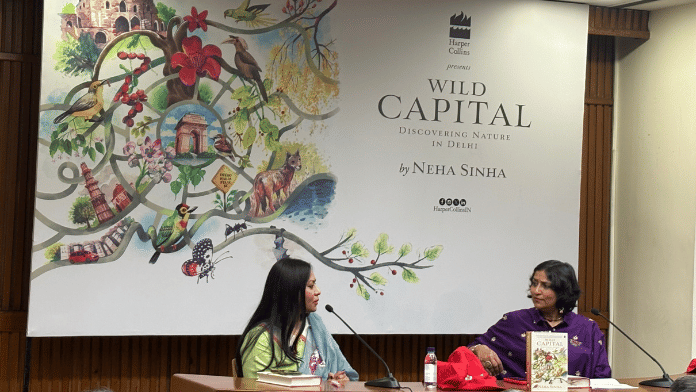



New Delhi: Delhi’s bird wildlife did not disappear overnight. It faded slowly. First from the skyline, then from the memory. For biologist and author Neha Sinha, that disappearance began with a simple question she could never really answer: Where had the vultures that once sat on the terraces of old buildings in central Delhi gone?
“I think the book started with a sense of loss, a sense of bereavement,” Sinha told the audience at the launch of her book Wild Capital: Discovering Nature in Delhi at the India International Centre on 26 February. The launch was followed by a book discussion, moderated by fellow author Nilanjana S Roy.
The memory eventually led Sinha on a decade-long search through the city’s overlooked landscapes — ridges, forgotten riverbanks, and rocky outcrops.
Wild Capital traces that journey. Written after research during the Covid-19 pandemic, Sinha asks readers to reconsider the national capital region as an ecosystem of rivers, rocks, and resilient wildlife. The author recalled that her research began as an attempt to reconnect with the landscapes and species she remembered from childhood, many of which had vanished from everyday urban life. The room was filled with birders, conservationists and nature enthusiasts, many of whom had spent years observing the city’s overlooked wildlife.
“My mother often talked about touching the Yamuna River, being near it, and that’s not something we experienced in our generation. By the time we were growing up, the river was already a non-place. It wasn’t something we ever interacted with. It wasn’t a place to go to anymore,” Sinha said.
Nature in the city
For Roy, one of the book’s striking ideas was the reminder that human beings are only a single thread in a vast tapestry that includes plants, animals and rocks. The conversation between Roy and Sinha reiterated that nature is not something outside the city.
“The most important thing is feeling a connection to nature — like we are a part of it,” Sinha said.
“Not that we own it. Once you feel that connection, there is no small or big–it’s all the same.”
She added that the most important thing to focus on is “reclaiming attention” — the act of noticing what lives around us.
Cities, she said, often make people feel trapped inside routines and deadlines. Watching birds or walking through a park can disrupt that rhythm in unexpected ways.
“I think it’s easy to get tired of life and tired of other people. Looking at something that’s not a human being, that is outside our Excel sheets and our budgets and the chores we have to do every day — it can be a very other-worldly experience. It immediately takes you out of your routine,” Sinha said.
For many birdwatchers, the author explained, the attraction lies precisely in that sense of unpredictability. Nature refuses to function according to the schedule.
“The practice of walking changes your relationship with everything around you,” added Roy, suggesting that this attentiveness reshapes how people find themselves within a landscape. “As you walk the Aravallis, the biodiversity parks, the city’s riverbanks with naturalists and ecologists, you become part of a community — people who have found joy in paying attention and sharing it.”
Sinha added to Roy’s point, saying that urban nature communities in India have grown in recent years.
“There are thousands of people now who love nature in almost every city in India. When I go birding in the morning, there are cyclists, runners, people walking and birdwatchers everywhere,” she said.
Also Read: New book champions AI-Climate nexus. It’s co-written by Amitabh Kant
Rethinking Delhi’s relationship with nature
The book, published by HarperCollins India, also allows readers to reconsider the language used to describe the natural world.
Sinha said that she only fully understood the relationship between language and perception after she began learning the names of the birds and animals in different languages. Many traditional names are shaped by sound, behaviour or appearance.
“When you learn the name of a bird in a local language, it often comes from the sound it makes or the way it moves. So you automatically have a dictionary for life, and also a dictionary for seasons.”
This rediscovery of names, sounds and seasonal cycles gradually reconnects people with their surroundings: “If you know the name, you can talk to others about it.”
Sinha argued that cities like Delhi need to rethink how they design and care for its green spaces.
“I think we inherited the British imagination of how a city should look. It should have lawns and very green trees with showy flowers, many of which are not from India,” she said.
But Delhi’s natural ecology tells a different story.
She defined the city’s native thorns which easily grows because they have adapted to heat and winter conditions. “First of all, thorns are beautiful, because it means you’re adapted to this 50-degree Celsius heat. It means you’re already climate resilient.”
These native species, she added, are often slower and less ornamental than imported ones, but far more suited to the city’s climate. This focus on native plants was also the author’s call to encourage readers to rethink how much more in tune the cities could be with the life that naturally belongs there.
“I’m asking for a decolonisation of our thoughts. I’m asking for a recolonisation by the native,” Roy read from the book.
(Edited by Insha Jalil Waziri)