



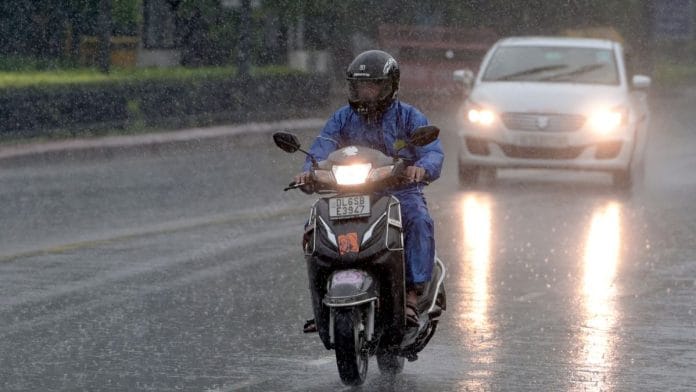
New Delhi: As this year’s heaviest spell of rain lashed Delhi on Thursday, the capital largely escaped what has become an annual monsoon ritual: widespread waterlogging. While neighbouring cities grappled with knee-deep flooding, Delhi reported far fewer waterlogged stretches and traffic moved more smoothly than it did last year.
A joint effort by the Municipal Corporation of Delhi (MCD), the New Delhi Municipal Council (NDMC) and the Public Works Department (PWD) made it possible.
The three departments joined hands to clean and desilt drains well before the monsoon, reducing waterlogging and allowing traffic to move more smoothly during heavy rain.
“Our teams reviewed the condition of the drains four months ago. Since then, our teams have been working continuously to prepare for the monsoon,” said Pravesh Wahi, Delhi’s newly elected mayor.
Rs 36-crore desilting plan
Every monsoon, images of the submerged Minto Road underpass—with vehicles stranded in waist-deep water—become emblematic of Delhi’s flooding. But this year, there was little to no waterlogging. The water was pumped out quickly. Traffic slowed, but vehicles were not stranded underwater.
It all started in February, when the three departments met. They resolved to minimise waterlogging this monsoon. The MCD also put in place a documentation and monitoring system under which all desilting work was to be supervised by deputy commissioners.
The desilting work started during the summer months—the ideal time to clean and prepare the drainage system before the monsoon arrives.
“There has always been confusion about who is responsible for which stretch, as all are interconnected. But this time all three teams participated equally,” said an MCD official.
While PWD looks after the larger arterials, MCD manages the secondary drainage network.
An action plan was prepared for large-scale desilting of drains. While desilting is carried out every year, officials decided to undertake “deep desilting” this time. It is a process of removing accumulated silt, sand, waste, and fine debris from drainage pipes and reservoirs. All teams, including junior and senior engineers, were informed about their role well before the monsoons.
“The silt settles at the bottom and forms a bed that reduces the carrying capacity of the drain. Once that layer is removed, water flows much more freely instead of overflowing onto the roads”, said Kumar.
The ambitious project was to be completed in two phases—first by 15 June and second by 31 December. For cleaning of 800 drains stretched over 545 km, MCD allotted Rs 36 crore. In February, after issuing the work order, MCD Commissioner Sanjeev Khirwar said the desilting of drains deeper than four feet began the same month. “Zonal offices were instructed to start issuing work orders in Feb itself, as in-principle approvals and financial allocations were already cleared,” Khirwar said.
The project is part of the BJP government’s 57,362.85 crore Delhi Drainage Master Plan 2025 to revamp the capital’s decades-old drainage system. As part of the plan, an Apex Committee headed by the Chief Secretary was constituted to coordinate efforts among the city’s civic agencies.
In the south zone of Delhi, 609 metric tonnes of silt was removed from smaller drains alone.
“Our target was to remove around 1.45 lakh units of silt from the drains. We have already exceeded that target by removing around 1.75 lakh units, and the work is still continuing”, said Wahi.
The MCD had directed removal of collected silt within 3 to 5 days.
While the MCD looked after 12 administrative zones, NDMC was looking after the New Delhi district and Lutyens’ Bungalow Zone.
Historically, there were 14 waterlogging points in the NDMC area, a senior officer told ThePrint. Over the last two years, continuous desilting has improved the hydraulic capacity of the drainage system.
“We have already completed two rounds [of desilting], and the third round is around 50 per cent complete. After every spell of rain, we also carry out this exercise,” said the senior NDMC officer.
Ground water recharge
After Thursday’s heavy rain, waterlogging was reported at one T-junction, but it was cleared within 15 minutes.
Similar incidents were reported from Sangam Vihar and a few other parts of South Delhi, but water was pumped out. Kumar said the South Zone has 46 pumps deployed. Two high-capacity pumps, each capable of pumping 10,000 litre of water per minute, have been deployed. One is stationed in Ramlila Maidan and another in Central Delhi.
The independent civic body has installed 340 rainwater harvesting pits across the NDMC– along the roads and in parks. The senior official told ThePrint that this has improved the groundwater table over the past two years.
NDMC has already started the third round of desilting gully traps and manholes.
Delhi recorded the wettest July in three years. But officials said that they are prepared.
The MCD has also asked workers on ground to collect feedback from residents. It has also designated two days for citizens to report clogged drains and share feedback.
(Edited by Prashant)