





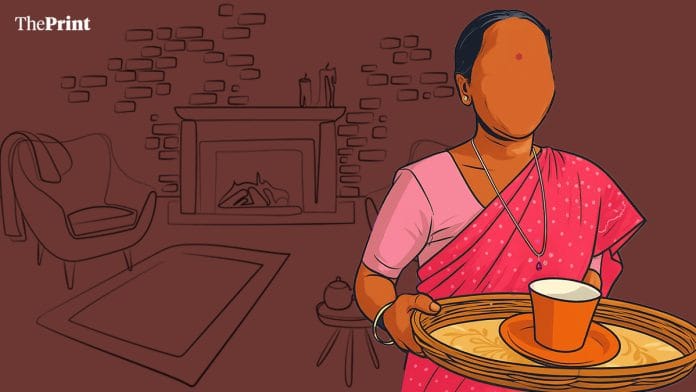


New Delhi: Priya Banerjee, an English teacher at a private school in Delhi, has been running late to work for the past two weeks. The reason is her cook, Beena Sarkar, who has travelled to West Bengal to cast her vote.
Sarkar (35) faced an issue with her documents: her father’s surname was spelled incorrectly. She had to leave earlier than usual for Malda, ahead of the polls scheduled for 23 and 29 April, to get the correction work done.
“Every year, she goes to Bengal, she arranges for a relative or someone else to fill in for her. But this time, she wasn’t able to find anyone because everyone has gone for the election,” said Banerjee.
Banerjee lives in an RWA society in South Delhi’s Vasant Kunj. Sarkar has worked for her for over 10 years.
“My father’s surname is incorrect in the voting list, and I had to go for documentation work. The same is true for my relatives and many others—that’s why everyone left. This time, we didn’t care about work; we cared about getting our names on the voting list,” said Sarkar, who left Delhi on 4 April.
Banerjee is not the only one facing the crisis of domestic worker shortage. Residents in gated societies across Noida, Gurugram, and the wider Delhi-NCR region are struggling to find replacements for their staff, who have gone to West Bengal. Driven largely by concerns over citizenship documentation under the SIR, many have left well before the elections—some as early as a month ago due to missing or incorrect documents.
The shortage led to a surge in demand for app-based cleaning services. But for many residents, the platforms have delivered nothing but disappointment.
“Many other residents and I tried one-hour app-based services, but we are not satisfied with their work. It takes too much time to explain the tasks, and by the time they begin properly, their hour is over, and they leave,” said Kapil Aggarwal, a resident of GK-1 in South Delhi.
And a larger labour shortage in the market means even these new-age platforms are struggling to provide services. There is up to four days’ waiting period on some of these apps.
ThePrint has reached out to Snabbit, Urban Company, and Pronto and is yet to receive a response.
‘Service vacuum’ for Delhi-NCR
Gurugram families are coping with their struggles through humour. In a recent reel, members of a family are seen sweeping, cooking, and washing utensils. A child runs to and fro, doing various chores. “Samjh rahe ho? (Get it?)” reads the caption.
In another video shared on X, a woman could be seen working away in the kitchen. “Maid didi jaa rahi hai (The maid is leaving),” read the text on screen. Social media has been flooded with reels and posts discussing the ‘crisis’.
Many are also comparing the current scenario to the Covid-19 period, when families had to manage household work themselves and support one another.
“It feels like we’ve entered the Covid-19 era again and have to do everything on our own. But at least back then, we were at home. Now, managing both office and household work without a worker is very different and difficult,” said Suchita Sharma, a resident of Gurugram.
Sharma added that even app-based services are unreliable, with one-hour slots often showing as full or unavailable.
“I had to call my mother-in-law from Banaras (Varanasi) to help with the morning routine—getting my child and us ready for school and office on time,” she said.
Societies in Noida are facing a similar problem. What started as casual conversations in parks and markets has now moved to group chat discussions, where residents are asking who has a worker available and whether they can help others find one.
“Managing logistics for residents in high-rise societies during a major election cycle in West Bengal presents unique challenges. The sudden, large-scale absence of domestic workers has created a significant ‘service vacuum’ for urban households,” said Rajiv Singh, president of the Noida Federation of Apartment Owners Associations (NOFAA).
Also read: Law coaching centres are booming. CLAT candidates rose by 68% in 6 yrs
Nationality vs job
Ashish Chaudhary’s family has a wedding during the last week of May. Preparations were already underway, with renovation work in full swing. However, shortly after the work began, several labourers returned to their hometowns, citing a shortage of LPG cylinders. The family eventually managed to find two labourers, but the very next day, their cook and house cleaner requested leave to return to West Bengal for the polls.
“It seems like we truly understand the value of our helpers now. As they left for their villages, we had to halt our house renovation,” said Chaudhary. He added that urban households have become so dependent on domestic workers that even a month-long absence has created a panic mode across Delhi-NCR.
Forty-five-year-old Ali Hussain has been working as a car washer and house cleaner in several South Delhi societies for the past 20 years. His wife is also employed as a cook in multiple homes. Every election season, he makes it a point to return to his village in Cooch Behar at least two days in advance to cast his vote. This time, however, both of them had to leave nearly a month earlier. His name had disappeared from the voter list.
He isn’t alone. Many workers like him find their names missing from the voter list. The ongoing SIR has triggered anxiety among migrant workers. It’s not just the fear that they would lose their place on the electoral rolls, but also larger concerns about identity and documentation.
Hussain has five siblings. While four of them still have their names on the voter list, three are struggling to get theirs restored—all while worrying about losing their jobs in Delhi.
“It’s a fight between saving our jobs and proving our nationality. And we had to choose to prove our nationality,” said Hussain.
(Edited by Prasanna Bachchhav)