



New Delhi: When political scientist and author Mujibur Rahman attended a discussion in Kolkata in January on the theme ‘Hinduism needs protection from Hindutva’, he was struck by a curious omission.
The nearly three-hour discussion — attended by politicians such as West Bengal Finance Minister Swapan Dasgupta, BJP MP Sudhanshu Trivedi, Congress leader Mani Shankar Aiyar, and TMC MP Mahua Moitra — touched upon several of Bengal’s literary and cultural icons, including Rabindranath Tagore and Satyajit Ray. But one name was missing: revolutionary poet Kazi Nazrul Islam.
“Why is it that? How is it that he (Nazrul) has disappeared from the Bengal intellectual consciousness? If you are discussing pluralism and multiculturalism, this is a name that should definitely figure,” Rahman said.
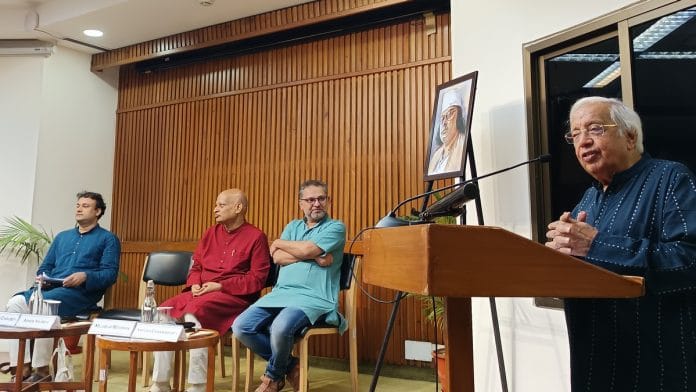
As a way of rectifying the omission, Rahman organised a discussion titled ‘Life and Legacy of Kazi Nazrul Islam’ with the Raza Foundation at the India International Centre in Delhi last week, ahead of the poet’s death anniversary on 29 August. There to weigh in on Nazrul’s place in Bengal’s literary and cultural history were Hindi poet and critic Ashok Vajpeyi, academic and writer Gautam Choubey, and Delhi University professor Amitava Chakraborty.
Known as the Bidrohi Kobi, or Rebel Poet, Nazrul gave voice to struggles for political, social and cultural liberation. His poetry and songs combined revolutionary fervour with spiritual universalism, challenged British rule, and took on religious intolerance and social inequality. Born in 1899 in Churulia, Bengal, he is now recognised as the national poet of Bangladesh.
Yet the panellists argued that over time, this expansive legacy has been reduced to his religious identity, overshadowing his contribution to South Asian literature and India’s freedom movement, including the Non-Cooperation Movement.
“Apparent neglect is the fate of syncretic figures in our history. His politics and his syncretic writings are completely forgotten and neglected. Nobody knows about them. We have to do something for this syncretic tradition of our country,” said Choubey.
Nazrul Islam & today’s Gen Z
Even as Hindu-Muslim tensions ran high in colonial Bengal, Nazrul appealed to what he called the “vast human heart” for them to set aside their differences, according to Vajpeyi.
He said Nazrul called for the creation of an undivided India and to throw out orthodox voices that threatened this vision. If anyone stood in their way, Nazrul urged them to “throttle him to death” so that the ever-young spirit of humanity may prevail in India.
“He was rather violent,” Vajpeyi said, and the hall burst into laughter.
The panellists noted how Nazrul fearlessly confronted the socio-political and communal challenges of his time. Chakraborty said the poet spoke directly to his audience, leaving people with a sense that they had to act because what was happening around them was not right.
Vajpeyi and Chakraborty also linked Nazrul’s ideas and the present day, particularly the Gen Z protests. The upheavals taking place today, they said, mirror some of the changes Nazrul witnessed in his own time, and that the actions of today’s youth align with Nazrul’s ideas.
“It is the young people who have liberated us from fear recently,” Vajpeyi said.
‘Don’t identify me as one of the Muslims…’
Chakraborty holds Nazrul’s religious identity responsible for the neglect he faced. Nazrul wrote articles on world literature, but was routinely overlooked even by intellectual and progressive groups. Chakraborty compared him with other Bengali writers who are widely recognised.
“Rabindranath Tagore’s poems are highly philosophical, while Nazrul’s are religious. And that’s the reason why he was so neglected,” he said.
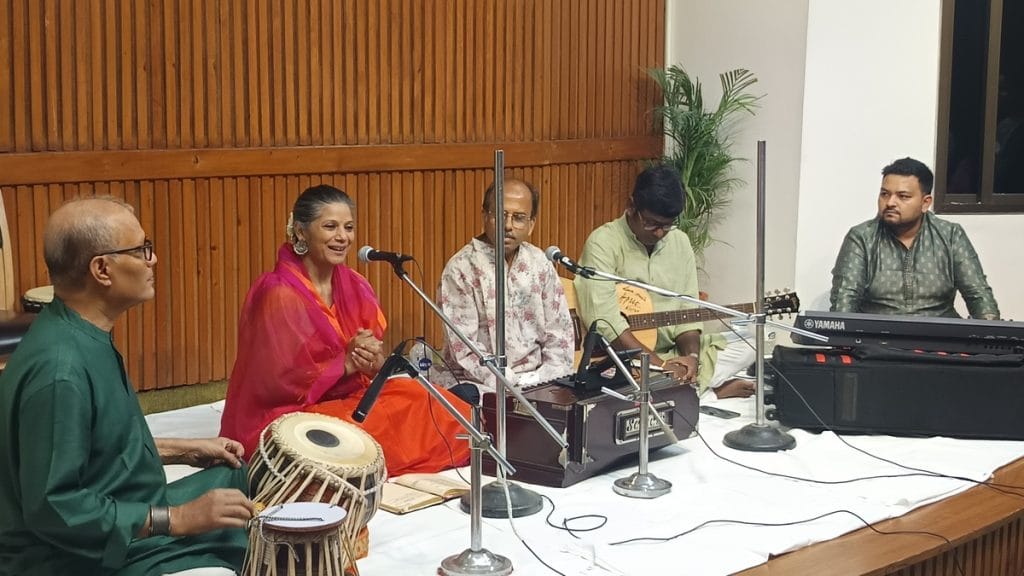
Nazrul was the only Hindu or Muslim author who could write both Shyama Sangeet and Eid songs, according to Chakraborty. Through his Bhakti Geet, Nazrul directly expressed his devotion towards Allah and Durga. His devotional repertoire included songs to the goddess Kali, at least one of which is played during virtually every Bengali puja. Nazrul was also the first to bring Farsi and Arabic influences into Bengali music, and the first to write ghazals in Bengali, according to Chakraborty. There is even a sub-genre of music known as ‘Nazrul Geeti’, with a performance taking place at the end of the evening.
“For Muslims, he was a kafir. For Hindus, he was someone who should not be taken seriously,” he said.
Chakraborty explained that Bengali Muslims started integrating into the modernist, colonialist education system much after Bengali Hindus. So, Nazrul seemed “childish” to them.
Newspapers such as Mohammadi accused him of not being a true Muslim, while Saogat, another Muslim-led journal, supported him.
Researcher Nazmul Nayem Biswas wrote in a 2019 paper that post-Liberation War Bangladesh made Kazi Nazrul Islam its National Poet. But the irony, he argues, is that Nazrul was not a nationalist and never believed in borders. Biswas also writes that Nazrul’s image was recast as that of a Muslim poet who praised God and His Messenger in numerous poems and songs, though he did not practise Islam during his lifetime and was more of a Kali worshipper.
During an April 1941 speech, ‘If the Flute Blows No More’, at a meeting of the Bengal Muslim Literary Society, Nazrul spoke of daily Hindu-Muslim riots, wars between nations, and the “greedy devils” who hoarded vast wealth in banks while others suffered in poverty.
“I came to remove all these disparities and differences. I came to create indifferent beauty and equality in my poetry, music, and life. I came to pardon the non-beauty and destroy the demon… please do not identify me as one of the Muslims. If I come, I will be one above all Hindus or Muslims.”
(Edited by Asavari Singh)